
Updated November 2026 | The Bulldog Law | California Criminal Defense
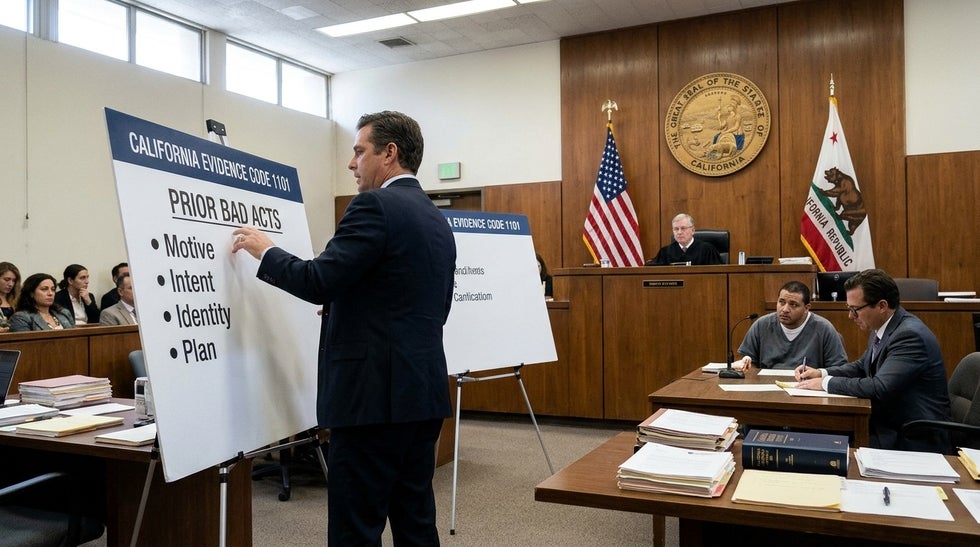
California Evidence Code 1101 forbids the prosecution from proving that a defendant committed a crime by showing he committed other crimes or bad acts in the past. That is propensity, or character, evidence, and section 1101(a) excludes it. Section 1101(b) creates the main exception: prior acts can be admitted to prove a specific disputed fact other than character, such as motive, intent, knowledge, a common plan, identity, or the absence of mistake. Separate statutes, sections 1108 and 1109, allow propensity evidence in sex offense and domestic violence cases. Whether prior acts come in, and how, is often the most important pretrial fight in a case.
Our attorneys litigate these motions in nearly every trial. The sections below explain the rule, the exceptions, and how the defense limits the damage when a prior comes in.
The rule: section 1101(a)
Evidence Code 1101(a) provides that evidence of a person's character or a trait of character, whether in the form of opinion, reputation, or specific instances of conduct, is inadmissible when offered to prove that the person acted in conformity with that character on a particular occasion. The reason is that juries overvalue such evidence and may convict a person for who he is rather than for what the evidence shows he did.
The exception: section 1101(b)
Section 1101(b) allows evidence that a person committed a crime, civil wrong, or other act when it is relevant to prove some fact other than disposition. The statute lists examples:
|
Purpose |
What the prosecution must show |
Degree of similarity required |
|
Intent |
That the defendant, who admits the act, claims it was innocent, and the prior act shows the same intent |
Lowest: the acts need only be similar enough to suggest the same intent |
|
Common plan or scheme |
That the charged act and the prior act are parts of one design |
Intermediate: shared features showing a plan, not just similar crimes |
|
Identity |
That the person who committed the prior act is the one who committed this one |
Highest: the acts must share distinctive marks, a signature |
|
Motive |
That the prior act supplies a reason for the charged crime |
Depends on the logical link, not similarity |
|
Knowledge |
That the defendant knew a fact, such as that a substance was a drug or a document was forged |
Prior act must show the same knowledge |
|
Absence of mistake or accident |
That a claimed accident was not one, because the same thing happened before |
Similar circumstances |
|
Opportunity or preparation |
That the defendant was positioned to commit the crime |
Logical relevance |
The critical question is whether the purpose is actually in dispute. If identity is conceded, prior acts cannot come in to prove identity. If the defendant denies the act entirely, intent is usually not a live issue and a prior cannot come in to prove it. The defense shapes the case to narrow the disputed facts for exactly this reason.
Section 352: the balancing test
Even relevant prior-act evidence must survive Evidence Code 352, which allows the judge to exclude evidence whose probative value is substantially outweighed by the probability that it will consume undue time, confuse the jury, or create a substantial danger of undue prejudice. For prior acts, courts weigh:
- How strongly the prior act proves the disputed fact.
- Whether the prior act is more inflammatory than the charged crime.
- Whether the prior resulted in a conviction, which reduces the risk that the jury will want to punish the defendant for it now.
- How long ago it occurred.
- Whether proving it will require a trial within the trial.
- Whether the same fact can be proved another way.
Sex offenses: section 1108
Evidence Code 1108 is a true exception to the ban on propensity evidence. In a prosecution for a sexual offense, evidence that the defendant committed other sexual offenses is admissible to show a disposition to commit such crimes, subject only to section 352. The prior offense need not have been charged or proved to a conviction; the jury decides whether it happened by a preponderance of the evidence. The California Supreme Court upheld the statute against a due process challenge, and it is used in most contested sex cases. Federal courts have parallel rules, discussed on our page on Federal Rules 414 and 415.
Domestic violence, elder abuse, and child abuse: section 1109
Evidence Code 1109 allows evidence of other acts of domestic violence in a domestic violence prosecution, and other acts of abuse in elder abuse and child abuse prosecutions, to show propensity. Acts more than ten years old are excluded unless the court finds admission is in the interest of justice. The practical effect is that in a domestic violence trial, earlier incidents involving the same or a different partner, including incidents never reported, may be presented to the jury.
Proving the prior act
The prosecution must prove the prior act by a preponderance of the evidence. It may call the earlier victim, an investigating officer, or use a certified conviction. The jury is instructed, under CALCRIM 375 for 1101(b) evidence, that it may consider the evidence only if it finds the act occurred, only for the limited purpose stated, and not as proof that the defendant has a bad character or is disposed to commit crime. For 1108 and 1109 evidence the instruction is different, because propensity reasoning is permitted.
If you testify: impeachment with priors
A separate route exists when the defendant takes the stand. A witness, including a defendant, may be impeached with a prior felony conviction involving moral turpitude, and with past conduct involving moral turpitude even without a conviction, subject to section 352. This evidence goes to credibility, not to whether the defendant committed the charged crime, and the decision whether to testify often turns on which priors would come in.
How the defense fights prior-act evidence
- Motion in limine. The issue is raised before trial through a motion in limine, with briefing on the purpose claimed, the similarity required, and section 352.
- Narrowing the issues. Conceding a fact that is not worth contesting, such as identity in a case about intent, can remove the stated purpose for the prior.
- Attacking the proof. A prior act that rests on one witness's account can be challenged as unproved.
- Remoteness and dissimilarity. Old or different acts carry little probative weight.
- Limiting instructions.If the evidence comes in, the defense requests the instruction and holds the prosecution to the stated purpose in closing argument.
- Preserving the record. A specific objection on each ground, and a ruling, preserve the issue for appeal and for a new trial motion.
Frequently asked questions
What is Evidence Code 1101?
California's rule on character evidence. Section 1101(a) says evidence of a person's character, including specific past acts, is not admissible to prove the person acted the same way on the occasion charged. Section 1101(b) allows evidence of other crimes or acts when it is relevant to something other than character, such as motive, intent, plan, identity, knowledge, or absence of mistake.
Can the prosecution bring up my prior convictions at trial?
Not to show you are the kind of person who commits crimes. A prior can come in under 1101(b) if it proves a specific disputed fact, such as that you knew a substance was a drug or that two crimes share a signature method; under sections 1108 and 1109 in sex offense and domestic violence cases; or to impeach you if you testify and the prior involves moral turpitude. Each route has its own limits, and the judge must weigh prejudice under section 352.
What is the difference between propensity evidence and 1101(b) evidence?
Propensity evidence asks the jury to reason that because the defendant did it before, he probably did it again. That reasoning is forbidden by 1101(a). Section 1101(b) evidence is admitted for a narrower purpose, such as showing intent or identity, and the jury is instructed not to use it as propensity. In sex offense and domestic violence cases, sections 1108 and 1109 allow propensity reasoning as an exception.
What is Evidence Code 1108?
An exception for sex offense prosecutions. When a defendant is charged with a sexual offense, evidence that he committed other sexual offenses is admissible to show a disposition to commit such crimes, subject to the judge's power to exclude unduly prejudicial evidence under section 352. The prior offense does not need to have resulted in a conviction.
What is Evidence Code 1109?
The parallel exception for domestic violence, elder abuse, and child abuse cases. Prior acts of domestic violence are admissible to show propensity, generally only if they occurred within ten years of the charged offense, again subject to section 352.
Does the prior act have to be a conviction?
No. Uncharged conduct, acquitted conduct, and acts that were never reported can be offered. The prosecution must prove the prior act by a preponderance of the evidence, and the jury is told it may consider the evidence only if it finds the act occurred.
How does the defense keep prior acts out?
By a motion in limine before trial arguing that the evidence is offered for propensity, that the claimed purpose is not actually disputed, that the prior is too dissimilar or remote to be probative, that it was not proved, or that its prejudice substantially outweighs its value under section 352. Where it comes in, the defense asks for a limiting instruction and keeps the presentation short.
What happens if prior act evidence was wrongly admitted?
A conviction can be reversed on appeal if the error was prejudicial, meaning it is reasonably probable the jury would have reached a different result without the evidence. Improper character evidence is one of the more common grounds for reversal in California.
Related reading from our attorneys
- Motions in limine in California
- Circumstantial versus direct evidence
- Federal Rules 414 and 415 in child molestation cases
Facing trial with a prior record? What the jury hears about your past is decided before trial begins
The Bulldog Law's criminal defense attorneys litigate prior-act evidence in courts across California. Call (888) 928-1609 or reach us online.