
Updated November 2026 | The Bulldog Law | California Trial Attorneys
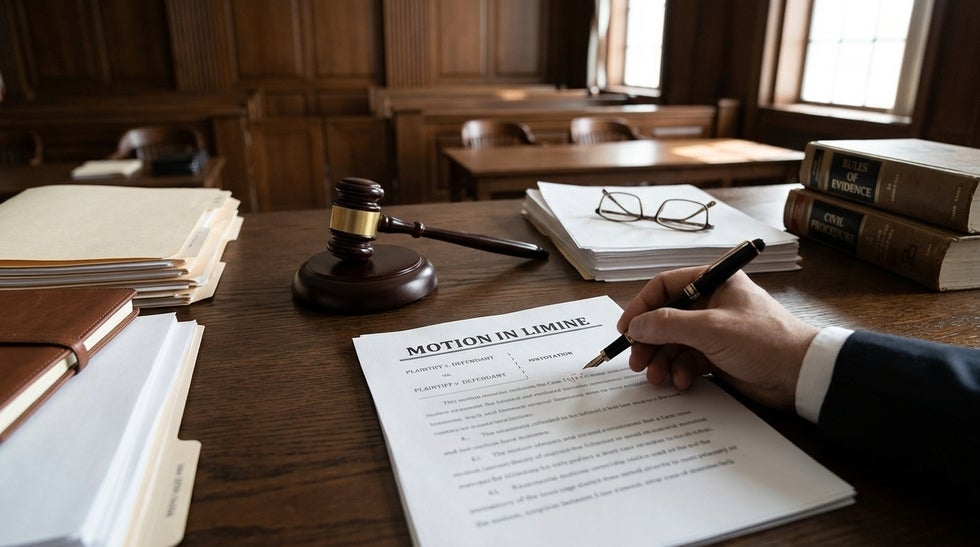
A motion in limine is a request made before trial, or at its very start, asking the judge to decide in advance whether particular evidence can be shown to the jury. The phrase is Latin for "at the threshold." Lawyers use these motions to keep out evidence that is unfairly prejudicial or inadmissible, and sometimes to get a ruling that their own evidence will come in. Much of what a jury does and does not hear is settled this way before the first witness is sworn.
By the time jurors take their seats, a well-prepared defense has already won or lost several of the most important arguments in the case. Our attorneys treat motions in limine as part of the trial, not a preliminary to it.
What the motion is for
The Legal Information Institute describes a motion in limine as a pretrial motion asking that certain evidence be found inadmissible and not be referred to or offered at trial. The reason for deciding these questions early is practical. Once a prosecutor asks a witness about the defendant's old conviction or gang ties in front of the jury, an objection may be sustained, but the jurors have heard it. An advance ruling prevents the question from being asked at all.
The motions also let both sides plan. Whether a defendant testifies often depends on whether prior convictions can be used to impeach. Whether to call an expert depends on whether the testimony will be allowed. Knowing the answers before opening statements changes how the case is tried.
Common motions in limine in criminal cases
|
Motion |
What it asks |
California rule |
|
Exclude unduly prejudicial evidence |
Keep out evidence whose value is substantially outweighed by the risk of unfair prejudice, confusion, or delay |
Evidence Code 352 |
|
Exclude or limit prior convictions |
Bar use of old convictions to attack the defendant's credibility, or limit which ones may be used |
Evidence Code 788, 352 |
|
Exclude prior bad acts |
Bar uncharged conduct offered to suggest the defendant has a criminal character |
Evidence Code 1101 |
|
Limit prior sexual offense or domestic violence evidence |
Exclude or narrow other-acts evidence the statutes would otherwise allow |
Evidence Code 1108, 1109, 352 |
|
Exclude hearsay |
Bar out-of-court statements with no applicable exception, or testimonial statements barred by the confrontation clause |
Evidence Code 1200 |
|
Exclude or limit gang evidence; bifurcate gang allegations |
Keep inflammatory gang testimony out of the trial on guilt |
Evidence Code 352; Penal Code 1109 |
|
Exclude a statement to police |
Bar a confession taken without Miranda warnings or made involuntarily, usually after a hearing |
Evidence Code 402 |
|
Exclude or limit expert testimony |
Challenge an expert's qualifications, methods, or the basis for an opinion |
Evidence Code 720, 801, 802 |
|
Exclude witnesses from the courtroom |
Keep witnesses from hearing each other testify |
Evidence Code 777 |
|
Admit defense evidence |
Obtain an advance ruling allowing third-party culpability evidence or evidence of a complaining witness's character for violence |
Evidence Code 1103, 352 |
|
Bar particular words or references |
Prevent terms such as "victim," references to punishment, or mention of matters ruled out |
Court's inherent authority |
Evidence Code 352 appears throughout the list because it gives the judge discretion to exclude evidence that is technically admissible. In practice it is the most frequently cited ground.
Evidence Code 402 hearings
Some questions cannot be decided on paper. Under Evidence Code 402, the judge may hear and determine a question of admissibility outside the presence of the jury, and must do so on request when the issue is the admissibility of a defendant's confession or admission. In a 402 hearing a witness testifies with no jury present, the lawyers examine the witness, and the judge rules. It is how courts test whether a statement was voluntary, whether an identification procedure was fair, whether an expert's methods are sound, and whether a witness has personal knowledge. A 402 hearing also gives the defense a preview of testimony it will face.
How the process works
- **Timing.** Motions are generally filed and heard just before trial, at the readiness conference or on the first day, before jury selection. Local rules and individual judges set their own deadlines.
- **Form.** Written motions with points and authorities are standard. Each should identify the specific evidence at issue; a vague request to "exclude all prejudicial evidence" will be denied.
- **Hearing.** The lawyers argue outside the jury's presence. The judge may rule immediately, hold a 402 hearing, or defer the ruling until the evidence is offered at trial.
- **Result.** The motion is granted, denied, granted in part, or deferred. Lawyers must then instruct their witnesses about any subject that has been excluded.
Where these rulings fall in the sequence of a trial is shown on our order of trial page.
A ruling in limine is not always the last word
Because the judge rules before hearing the evidence, an in limine ruling is provisional. If the trial unfolds differently, for example when a witness "opens the door" by raising the excluded subject, the judge can revisit the decision.
This matters for appeals. In California, a motion in limine preserves an issue for appeal without a further objection only when it was directed to a specific, identifiable body of evidence, was based on a specific legal ground, and was made at a time when the judge could decide the question in its proper context. When any of those is missing, or the judge deferred the ruling, the lawyer must object again when the evidence is offered or the issue is forfeited. Careful trial lawyers renew the objection regardless.
One rule surprises defendants. If the judge rules that prior convictions may be used to impeach the defendant and the defendant then chooses not to testify, the ruling generally cannot be challenged on appeal, because there is no way to know how it would have played out.
When the ruling is violated
A lawyer or witness who mentions excluded material in front of the jury has violated a court order. The remedies increase with the seriousness and the intent: an instruction to disregard, an admonition, monetary sanctions or contempt for a deliberate violation, and a mistrial when the jury has heard something no instruction can cure. Prosecutorial misconduct of this kind can also support a motion for a new trial after a conviction.
Motion in limine compared with a motion to suppress
|
Motion in limine |
Motion to suppress (Penal Code 1538.5) |
|
|
Basis |
Rules of evidence: relevance, prejudice, hearsay, character, foundation |
Constitution: unlawful search or seizure |
|
Timing |
Just before or at the start of trial |
At the preliminary hearing or by noticed motion well before trial |
|
Who has the burden |
Generally the party offering the evidence must show it is admissible |
The prosecution, when the search was without a warrant |
|
Effect if granted |
The evidence is excluded or limited at trial |
The evidence and what flowed from it are suppressed; charges often cannot proceed |
|
Review before trial |
Rarely |
Available by statute |
See our page on motions to suppress. The two are often used together: the defense first argues that evidence was unlawfully seized and, failing that, that it is more prejudicial than probative.
Civil cases
Motions in limine are just as common in civil trials, where they are used to exclude insurance information, settlement offers, undisclosed experts, and evidence of a party's wealth. The mechanics are the same. Objections made during pretrial testimony follow different rules, covered on our page about deposition objections.
Why it matters to a defendant
The quality of the in limine practice is a fair measure of how a case has been prepared. Each excluded item narrows what the prosecution can use: a prior conviction the jury never learns of, a gang expert who does not testify, a statement that stays out. Enough of those rulings, and a case that looked strong on paper becomes one of those with the signs of weakness that lead to better offers or acquittals.
Frequently asked questions
What is a motion in limine?
A motion in limine is a request made before or at the start of trial asking the judge to rule in advance that certain evidence may or may not be presented to the jury. "In limine" is Latin for "at the threshold." The purpose is to settle disputes about evidence before jurors hear anything that cannot be unheard.
How do you pronounce in limine?
In American courtrooms it is most often pronounced in LIM-in-ee. Some lawyers say in LIM-in-ay. Both are understood.
What is the purpose of a motion in limine?
To keep prejudicial or inadmissible material away from the jury, to let both sides plan their case knowing what evidence is in and out, and to avoid interrupting the trial with long arguments. An objection made after a damaging question has been asked in front of the jury comes too late to undo the harm.
When are motions in limine filed?
Shortly before trial, usually at the trial readiness conference or on the first day of trial before jury selection. Local court rules set specific deadlines, and many judges require the motions in writing. Issues that arise unexpectedly during trial can be raised orally outside the jury's presence.
What is the difference between a motion in limine and a motion to suppress?
A motion to suppress under Penal Code 1538.5 argues that evidence was obtained by an unconstitutional search or seizure and has its own procedures and deadlines. A motion in limine is based on the rules of evidence: relevance, unfair prejudice, hearsay, improper character evidence, or lack of foundation. The same piece of evidence can be challenged by both.
Is a ruling on a motion in limine final?
Not necessarily. In limine rulings are made before the judge has heard the trial evidence, and the judge can reconsider if the testimony develops differently than expected. A lawyer who lost the motion should usually renew the objection when the evidence is offered, and a lawyer who won should object if the other side strays into the excluded area.
What happens if someone violates a motion in limine ruling?
The judge can strike the testimony and instruct the jury to disregard it, admonish or sanction the lawyer, hold a lawyer or witness in contempt for a deliberate violation, and, if the jury has heard something too damaging to cure, declare a mistrial. Lawyers are responsible for telling their own witnesses what subjects are off limits.
What is a 402 hearing?
It is a hearing under California Evidence Code 402 in which the judge decides a preliminary question about admissibility outside the presence of the jury, often by hearing a witness testify. It is used to test whether a confession was voluntary, whether an expert is qualified, or whether there is a foundation for a piece of evidence, and it frequently accompanies a motion in limine.
Related reading from our attorneys
- Motions to suppress evidence under Penal Code 1538.5
- The order of trial in California criminal cases
- Nine grounds for a new trial in California criminal cases
Going to trial? What the jury hears is decided before the jury arrives
The Bulldog Law's criminal defense attorneys file detailed motions in limine in every trial and enforce the rulings once they are made. Call (888) 928-1609 or reach us online.