
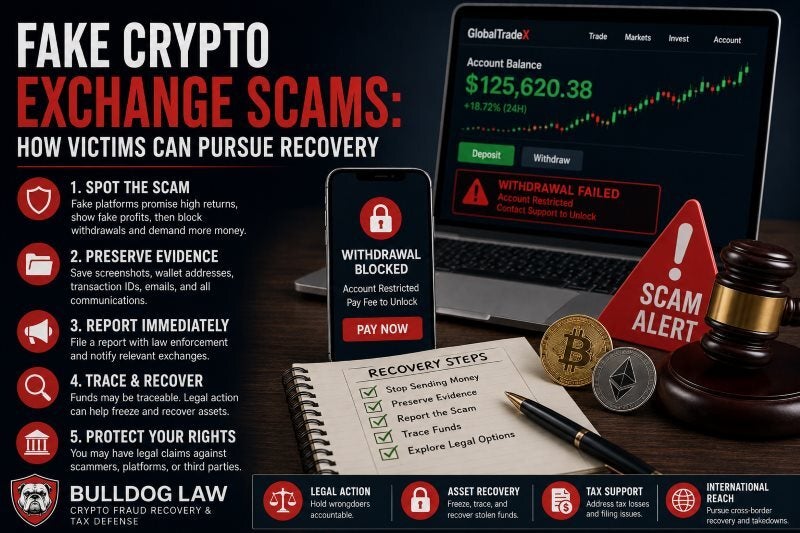
Fake crypto exchange scams are fraudulent platforms that imitate legitimate cryptocurrency exchanges, trading dashboards, wallet portals, or investment apps to trick victims into depositing digital assets or cash. These schemes often show fake profits, block withdrawals, demand additional payments, and disappear once the victim stops paying. For California victims, the legal response should focus on preserving evidence, reporting the fraud, tracing funds, evaluating civil claims, and addressing tax consequences.
Recovery is not guaranteed. Crypto transfers are difficult to reverse, and many fake exchanges are connected to offshore operators, mule accounts, stolen identities, and laundering networks. Still, some victims may have legal options if stolen funds can be traced to an exchange, bank account, identifiable person, domain host, app provider, promoter, or business entity.
How fake crypto exchange scams work
A fake exchange scam usually begins with trust. The victim may be contacted through social media, a dating app, a wrong-number text, an online investment group, or an impersonated customer support account. The scammer then directs the victim to a platform that looks professional, often with charts, account balances, trading pairs, tax notices, customer support chats, and withdrawal buttons.
The platform may allow a small withdrawal at first. That tactic makes the exchange appear legitimate and encourages the victim to deposit more money. Once larger funds are deposited, the platform may freeze the account, claim that taxes are owed, demand a verification deposit, invent anti-money-laundering fees, or require the victim to pay more before funds can be released.
Victims should compare these tactics against broader pig butchering crypto scam recovery patterns because fake exchanges often operate as the final stage of a longer emotional or investment grooming scheme.
Red flags of fake crypto exchange scams
Warning signs include guaranteed returns, pressure to move conversations to encrypted messaging apps, refusal to identify licensed operators, fake regulatory logos, suspicious app downloads, cloned exchange names, unrealistic account growth, and demands for extra payments before withdrawals.
Another red flag is a supposed tax bill issued by the exchange itself. A scam platform may claim that the victim must pay “IRS tax,” “liquidity tax,” “blockchain clearance fees,” or “capital verification deposits” directly to a wallet address. Legitimate tax obligations are not paid to anonymous crypto wallets controlled by a trading platform.
Romance and relationship-based pressure can also be part of the scam. When a fake exchange is promoted by a supposed romantic partner, mentor, or online friend, cryptocurrency romance scam recovery strategies may help frame the evidence, timeline, and victim-rights issues.
Immediate steps after discovering a fake crypto exchange
The first step is to stop sending money. Victims should not pay additional withdrawal fees, fake taxes, unlock charges, gas deposits, verification fees, or recovery deposits. Those demands are usually designed to extend the fraud.
The second step is to preserve evidence before the platform disappears. Important records include the exchange website, app screenshots, account balance pages, deposit addresses, withdrawal-denial messages, customer support chats, transaction hashes, bank wires, exchange confirmations, email headers, phone numbers, dating profiles, social media accounts, and domain information.
The third step is to secure remaining assets. Victims should change passwords, secure email accounts, enable stronger authentication, revoke suspicious wallet approvals, move remaining assets to a clean wallet, and preserve devices for possible forensic review. If a phone number or account was hijacked, the facts may overlap with SIM swap crypto theft liability if a carrier, exchange, or insider failure contributed to the loss.
Can victims recover funds from a fake crypto exchange?
Sometimes. Recovery may be possible if funds can be traced to a centralized exchange, payment processor, bank account, identifiable wallet cluster, domain operator, app developer, promoter, or wrongdoer with reachable assets. Blockchain tracing can help show where funds moved, but tracing alone does not force the return of property.
Victims may need law enforcement reports, exchange freeze requests, civil subpoenas, emergency court orders, or asset preservation demands. If stolen assets reach a compliant exchange, legal process may help identify an account holder or freeze remaining funds. If assets move entirely through non-custodial wallets and offshore laundering services, recovery may be more difficult.
A realistic strategy for recovering stolen cryptocurrency after fraud usually depends on speed, documentation, traceability, jurisdiction, and whether any third party can be compelled to preserve records or assets.
Civil lawsuits, subpoenas, and asset freezes
Civil litigation may be appropriate when there is an identifiable defendant or third party connected to the scam. Potential claims may include fraud, conversion, unjust enrichment, negligence, breach of contract, aiding and abetting, civil conspiracy, or unfair business practices depending on the facts.
In urgent cases, victims may seek temporary restraining orders, preliminary injunctions, asset freezes, preservation orders, or expedited discovery. Courts generally require specific evidence showing ownership, loss, traceable funds, and a real risk that assets will be moved or dissipated.
Subpoenas can be important when victims do not know the scammer's true identity. Legal process may help obtain records from exchanges, domain registrars, hosting companies, banks, payment processors, email providers, app stores, or communications platforms. A civil case should be evaluated carefully because litigation costs may exceed potential recovery if there is no reachable defendant or asset pool.
Law enforcement and international takedown options
Fake crypto exchanges are often international. A victim may live in California, the scammer may communicate from another country, the website may be hosted offshore, and the stolen crypto may move through wallets linked to laundering networks. These facts make recovery harder, but not always impossible.
Victims should file reports with local law enforcement and federal cybercrime reporting channels. A useful report should include a timeline, wallet addresses, transaction hashes, platform names, website domains, bank records, screenshots, suspect communications, and any information showing where funds may have gone.
Large-scale scam networks may become part of broader enforcement actions. When multiple victims, shared wallet addresses, or offshore platforms are involved, international cryptocurrency scam takedown efforts may affect whether assets are frozen, seized, or later distributed through restitution or remission procedures.
Tax consequences of fake crypto exchange scams
A fake exchange scam may create tax issues even when the victim loses everything. The victim may have sold appreciated crypto to fund deposits, transferred assets from an exchange, earned staking rewards before the theft, participated in DeFi activity, or received tax forms showing proceeds without explaining the scam.
Digital assets are generally treated as property for federal tax purposes. That means a victim may need to analyze basis, prior income, sales, transfers, and whether a theft-loss position is available. The correct result may depend on whether the loss was personal, investment-related, or connected to a trade or business.
Victims should not automatically claim the highest displayed balance on the fake exchange as a tax loss. Fake profits shown on a fraudulent dashboard may never have existed. The tax analysis should focus on actual deposits, basis, prior income, recovery prospects, and legal support for the claimed treatment. Coordinating the facts with cryptocurrency loss reporting rules can help victims avoid unsupported deductions or missed tax positions.
Form 1099-DA and exchange reporting problems
Tax reporting can become complicated when legitimate platforms report sales, transfers, or proceeds before assets are moved to a fake exchange. A victim may receive a tax form from a real exchange even though the assets were later stolen through a fraudulent platform.
Digital asset broker reporting is expanding, and Form 1099-DA is intended to report certain broker transactions involving digital asset proceeds. Victims should understand how Form 1099-DA crypto tax reporting may create IRS matching issues when platform records do not capture the later theft, scam, basis history, or recovery efforts.
Planning for future filings also matters. Victims preparing returns should evaluate crypto tax rules for 2026 investors so they can preserve wallet histories, exchange exports, basis records, transaction hashes, police reports, and recovery communications before records become harder to obtain.
Staking, DeFi, and fake exchange complications
Fake exchange scams often involve assets that were active before the theft. A victim may have earned staking rewards, used lending protocols, provided liquidity, swapped tokens, or bridged assets before sending funds to the fraudulent platform. Those earlier transactions may still need to be reported correctly.
If the stolen assets included staking rewards, prior income recognition may affect basis. Victims should connect the theft timeline with staking rewards tax treatment because rewards that were taxable when received may later become part of the documented loss calculation.
DeFi records can be even more complex. A wallet may show swaps, approvals, liquidity pool deposits, lending activity, and bridge transfers before the fake exchange deposit. Aligning the scam timeline with DeFi tax reporting for swaps and lending can help avoid inconsistent records in both recovery efforts and tax filings.
IRS audit risk after a fake exchange loss
Fake exchange victims can face IRS questions if reported income, proceeds, transfers, or losses do not match third-party records. An exchange may report a sale used to fund the scam, but the taxpayer may also claim a theft loss or explain that assets were transferred to a fake platform. Without evidence, the return may appear inconsistent.
An audit response should be organized and evidence-based. Useful records include police reports, federal complaints, wallet histories, transaction hashes, exchange exports, bank records, screenshots of the fake platform, communications with the scammer, valuation evidence, recovery efforts, and legal analysis supporting the reported tax treatment.
When the IRS questions a crypto scam loss, crypto tax audit defense after IRS contact should address both the factual record and the legal theory for income, gain, basis, theft loss, or other reporting positions.
Avoiding fake recovery companies
Many fake exchange victims are targeted again by recovery scammers. These companies may claim they can hack the blockchain, reverse a transaction, bribe an exchange employee, or guarantee recovery for an upfront fee. Some impersonate law firms, investigators, government agencies, or international regulators.
Warning signs include guaranteed recovery, requests for seed phrases, pressure to pay immediately, fake court orders, fabricated exchange emails, and demands for additional crypto to unlock funds. A legitimate recovery strategy should focus on evidence preservation, lawful reporting, realistic tracing, exchange communication, court process, and tax analysis.
Fake crypto exchange scams lawyers in California
Fake crypto exchange scams require quick action and careful coordination. A victim may need to preserve evidence, report the fraud, trace funds, request exchange freezes, evaluate civil claims, address international issues, document tax losses, and respond to IRS questions.
Bulldog Law helps California crypto scam victims evaluate legal options after fake trading platforms, fraudulent investment apps, romance-investment scams, wallet drains, SIM swaps, DeFi-related losses, and stolen digital asset disputes. The firm does not promise recovery, but it can help identify practical next steps, protect legal rights, organize evidence, and pursue available remedies when a fake exchange causes financial, legal, and tax harm.