
By the The Bulldog Law Criminal Defense Team • Reviewed by a licensed California criminal defense attorney
The dividing line is custody time: a MISDEMEANOR is punishable by AT MOST one year in county jail; a FELONY is punishable by more than a year 16 months minimum in county jail under realignment or state prison for serious offenses; and INFRACTIONS sit below both: fine-only tickets with no jail and no jury. But the year is the smallest difference.
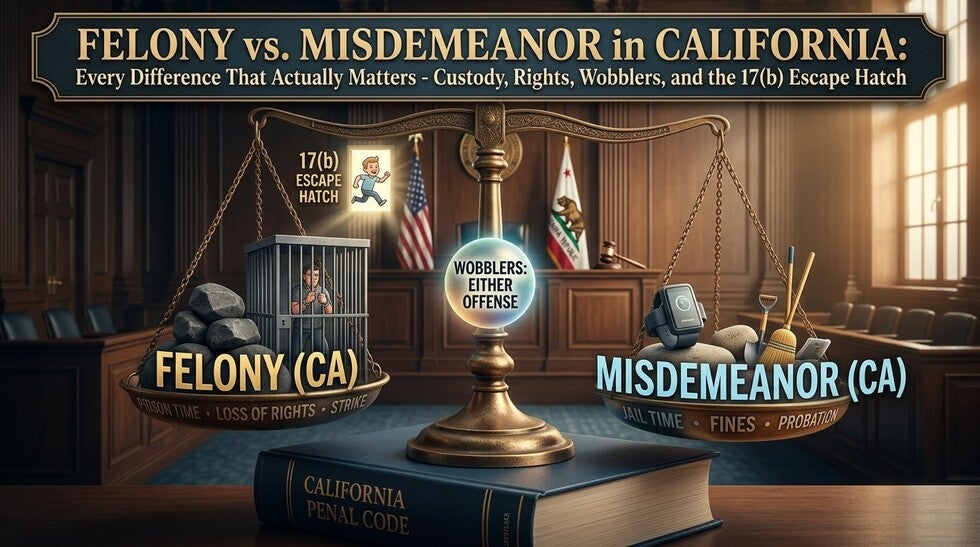
The felony label changes WHERE time is served and what fraction (up to 50% conduct credits in many county terms; 85% for violent felonies), what RIGHTS you lose (firearms for life on any felony, jury service, some public offices), what FOLLOWS you (professional-license discipline, housing and employment screens that ask the felony question specifically, immigration consequences that can turn any felony into removal), and what LEVERAGE the system holds (strikes, probation length, enhancement exposure). California then adds the two doctrines this entire guide orbits: WOBBLERS a huge class of offenses chargeable as EITHER felony or misdemeanor at the prosecutor's (and later the judge's) discretion and Penal Code § 17(b), the escape hatch that reduces wobbler felonies to misdemeanors “for all purposes,” past tense included.
Understanding both is understanding how California criminal defense actually works, because most of the fight, in most cases, is about which side of this line the case lands on. This complete guide from The Bulldog Law's criminal defense team walks every difference, the wobbler system, the reduction motion, and the questions people actually ask.
The Differences, Side by Side
- Custody misdemeanor: up to 364 days county jail (the 364 matters see the immigration FAQ). Felony: 16 months, 2, 3 years or more; county realignment custody for many offenses, prison for serious/violent ones; enhancements (guns, GBI, priors) stack years only felonies can carry.
- Probation misdemeanor (summary) probation: typically 1-2 years, no probation officer, court check-ins. Felony (formal) probation: 2 years standard now for most offenses, supervised, searchable terms and violation exposure measured in the full suspended sentence.
- Rights any felony: LIFETIME firearm ban (the § 29800 world), jury-service loss while consequences last, office and licensure bars. Misdemeanors: targeted 10-year gun bans for a specific list (DV, threats, brandishing), otherwise rights intact.
- The record's weight employment and housing screens ask the felony question by name; licensing boards treat the levels differently; strikes exist only at the felony level; and expungement helps both but erases the gun ban for neither only reduction or pardon reaches that.
- Process felonies get preliminary hearings (a defense opportunity misdemeanors skip), higher bail schedules, and slower timelines; both get jury trials a right infractions lack entirely.
- Infractions, for completeness fine-only, no jail, no jury, no record in the criminal sense: traffic and municipal violations and the destination some misdemeanors negotiate DOWN to (disturbing the peace being the famous example).
Wobblers: Where Most Real Cases Live
A WOBBLER is an offense the Legislature made chargeable either way - and the list covers a huge share of common charges: assault with a deadly weapon, criminal threats, forgery, receiving stolen property over $950, grand theft, corporal injury, stalking, vandalism over $400, animal cruelty, second-degree burglaryand dozens more. Three decision points move a wobbler's level, and they ARE the defense timeline: the PROSECUTOR'S charging choice (influenced by facts, injury, record and by the early defense presentation that makes misdemeanor filing the reasonable call); the JUDGE'S power at preliminary hearing to reduce a wobbler felony on the spot; and sentencing/probation-stage discretion.
The strategic meaning: in wobbler cases, the level is NEGOTIABLE TERRAIN from day one, and the difference between lanes is everything above strike or no strike, lifetime gun ban or none, the felony question answered ‘no' forever. It's why identical conduct produces wildly different futures for the represented and the unrepresented, and why ‘what am I actually charged with, and can it wobble down' is the first question counsel answers in week one.
The 17(b) Escape Hatch - Felonies That Become Misdemeanors Forever
Penal Code § 17(b) lets a court reduce a WOBBLER felony to a misdemeanor at preliminary hearing, at sentencing when probation is granted, or by later motion after probation and the reduction is retroactively total: the offense becomes a misdemeanor FOR ALL PURPOSES. The consequences are the point: the felony-based lifetime firearm ban lifts (the restoration path § 29800 cases turn on), the felony question on applications becomes answerable ‘no,' licensing postures soften, and paired with a § 1203.4 dismissal the record reaches its cleanest achievable state short of a pardon.
Limits worth honesty: 17(b) reaches WOBBLERS only (straight felonies need the pardon route), some offenses carry consequences that survive reduction, immigration treats the original in its own ways, and granting is DISCRETIONARY - built on post-conviction conduct, completed probation, and a motion that gives the judge reasons. For anyone carrying an old wobbler felony: this motion is the single highest-value piece of record work in California law, it's regularly granted for people who've stayed clean, and most who qualify have simply never been told it exists. Now you have.
Frequently Asked Questions
What makes something a felony instead of a misdemeanor?
The Legislature sets each offense's maximum punishment, and the line is one year: offenses punishable by more than a year are felonies; up to a year (364 days), misdemeanors; fine-only, infractions. Many offenses are fixed at one level petty theft is always a misdemeanor, murder always a felony but California's huge wobbler class is punishable either way, with the level chosen by the prosecutor at filing and adjustable by the judge afterward, based on the facts' severity, injury, sophistication, and your record. Practical translation: for a wobbler charge, the level isn't fate it's the first negotiation, and early defense work aimed exactly there routinely decides which word follows you.
Can a felony be reduced to a misdemeanor in California?
If it's a wobbler yes, through PC 17(b): at preliminary hearing, at sentencing with probation, or by motion after successful probation, and the reduction makes it a misdemeanor ‘for all purposes' lifting the felony firearm ban, changing how applications are answered, and (paired with a 1203.4 dismissal) producing the cleanest record short of a pardon. Straight felonies can't take this route their path is the Certificate of Rehabilitation and Governor's pardon. Eligibility plus a clean post-conviction record plus a well-built motion is the formula; judges grant these regularly for people who've moved on. If you're carrying an old wobbler felony, having counsel screen it for 17(b) is an afternoon that can change a decade.
Is a misdemeanor really that serious?
Serious enough to defend properly: up to 364 days' jail, probation with conditions, and the collaterals that specific misdemeanors carry 10-year firearm bans for the DV-adjacent list, protective orders that reorganize families, license discipline in caregiving and professional fields, and immigration exposure where the offense type (drugs, DV, theft) triggers it. The mitigation: misdemeanors avoid the felony question, strikes, and lifetime gun bans; diversion programs reach many of them (ending with no conviction at all); and expungement is faster. The honest frame: a misdemeanor is a real conviction with negotiable consequences and the distance between a bare plea and a structured resolution (charge selection, diversion, condition negotiation) is most of what defense counsel does at this level.
Why do sentences say 364 days instead of a year?
Immigration and it's deliberate. Federal immigration law attaches severe consequences to convictions with sentences of ‘one year' or more, so California capped misdemeanor maximums at 364 days precisely to keep a maxed-out misdemeanor one day short of that trigger, protecting non-citizens from removal categories a single day would activate. The same logic drives defense practice in wobbler and felony negotiations: sentence structuring to 364 days, offense selection to avoid aggravated-felony definitions, and dual criminal-immigration analysis before ANY plea. If you or a family member isn't a citizen, that one-day rule is a signal of a larger truth: in California, immigration consequences are part of the sentence - and they're negotiable only before the plea, never after.
Felony versus misdemeanor is the most consequential single word in a criminal case and in California, more than anywhere, it's a word that gets ARGUED: at charging, at prelim, at sentencing, and years later on a 17(b) motion. Know where your case sits, and fight for the right side of the line at every one of those doors. The Bulldog Law's criminal defense team does exactly that, statewide. Contact the firm online or call (888) 928-1609.