
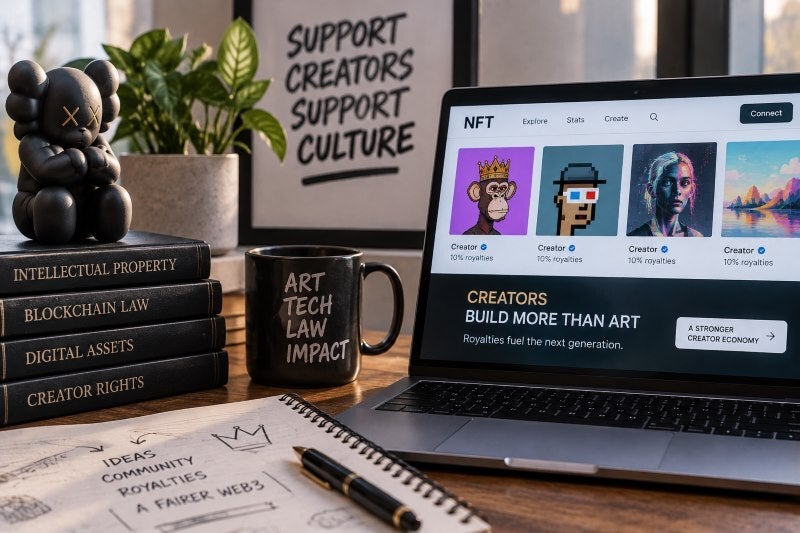
NFT Royalty Disputes can arise when an artist, collection founder, developer, studio, or other rights holder expects compensation from secondary NFT sales but payments are reduced, redirected, blocked, or eliminated. For California creators, the critical question is usually not simply what royalty percentage appears in a smart contract. Legal rights may depend on marketplace terms, written agreements, intellectual property ownership, smart contract design, project governance, and what buyers or collaborators were originally promised.
A marketplace restriction can make the problem even more immediate. Creators who lose listings, access, or revenue may face the same contractual questions addressed in NFT marketplace account suspension disputes, particularly when royalties are frozen together with the account.
Quick answer
NFT creators do not automatically have a universal legal right to receive royalties from every resale. Royalty rights may arise from contracts, marketplace policies, smart contract arrangements, IP licenses, partnership agreements, or other enforceable obligations. If a platform, project, cofounder, or marketplace reduces or redirects royalties contrary to those obligations, potential claims may include breach of contract, accounting, fraud or misrepresentation, and other remedies depending on the facts.
How NFT royalties are supposed to work
NFT projects often establish a percentage of secondary-sale revenue intended for the creator or another designated wallet. The arrangement may be implemented through a marketplace, smart contract, NFT standard, revenue-splitting contract, or off-chain agreement.
ERC-2981, for example, provides a standardized method for an NFT contract to communicate royalty information. However, the technical standard itself does not force every marketplace or buyer to pay the royalty. Whether payment is actually made can depend on the marketplace and transaction structure.
This distinction becomes especially important for NFTs that operate across multiple networks. A creator may have one royalty arrangement on the original chain but encounter different enforcement after bridging the asset. Those ownership and interoperability problems are explored in the firm's discussion of cross-chain NFTs and ownership rights.
NFT Royalty Disputes after a marketplace changes its policy
A common dispute begins when a marketplace changes from mandatory creator fees to optional royalties or introduces a new system that allows traders to avoid paying them.
Whether a creator has a viable claim depends on what the marketplace actually promised. Relevant evidence may include:
- Terms of service in effect when the collection was listed.
- Creator agreements and onboarding materials.
- Royalty percentages displayed on collection pages.
- Emails or announcements about royalty enforcement.
- Marketplace API or smart contract documentation.
- Transaction records showing what was collected and paid.
A platform generally has more room to modify a feature when its contract clearly reserves that discretion. A dispute may be stronger when the creator can point to a specific contractual commitment that the marketplace later failed to honor.
Owning an NFT does not automatically transfer the copyright
Royalty disputes can become confusing because ownership of the NFT token and ownership of the underlying intellectual property are separate questions.
Under federal copyright law, copyright initially belongs to the author or other legally recognized copyright owner, subject to rules such as work made for hire. A transfer of copyright ownership generally requires a written instrument signed by the rights holder or authorized agent.
Buying an NFT therefore does not automatically give the buyer copyright in the artwork merely because the blockchain records ownership of the token. These issues become even more important where an NFT claims to represent rights in a physical asset, as discussed in the legal framework for real-world-asset NFTs.
For virtual-world projects, licensing can become equally complicated because the NFT may grant display, commercial, gaming, or avatar rights without transferring the underlying copyright. Similar questions appear in metaverse and virtual-asset ownership disputes.
What if the smart contract still shows the royalty?
A creator may look at the NFT contract and see a five or ten percent royalty setting, yet discover that secondary sales are occurring without payment.
That is possible because a smart contract can communicate royalty information without necessarily controlling every marketplace transaction. Some platforms may recognize the royalty standard while others structure transfers differently.
The legal analysis should therefore distinguish between what the code does and what the parties separately promised. The broader relationship between automated execution and enforceable agreements is central to smart contract legal disputes involving NFT projects.
When a project team redirects creator royalties
Not every royalty dispute involves a marketplace. Cofounders, developers, DAO members, multisig signers, studios, managers, or collaborators may dispute who should receive the payments.
For example, a project might originally direct secondary royalties to an artist but later change the receiving wallet to a company treasury. Whether that change is lawful can depend on:
- The creator agreement.
- Copyright and IP assignments.
- Operating or partnership agreements.
- DAO governance documents.
- Smart contract administrator rights.
- Revenue-sharing agreements.
- Prior representations to contributors.
Web3 projects frequently mix artwork, software, branding, community management, and smart contract development among several contributors. The broader NFT disputes addressed in Web3 creator and NFT legal disputes illustrate why technical control over a wallet does not necessarily determine who is legally entitled to the revenue.
NFT royalties in gaming and esports projects
Gaming NFTs can create additional royalty complications because the digital asset may involve artwork, characters, skins, game mechanics, marketplace access, or licenses belonging to different parties.
A developer might promise an artist a percentage of every secondary character sale while retaining ownership of the game's broader intellectual property. If the project later moves trading to an internal marketplace that eliminates the royalty, the wording of the agreement becomes critical.
These revenue structures overlap with the issues described in NFT royalty structures in crypto gaming. Similar ownership problems can arise where teams, players, game publishers, artists, and sponsors share rights in NFT collectibles used in crypto esports.
What if royalty calculations depend on random NFT traits?
Some NFT projects use blockchain randomness to determine rarity, attributes, artwork combinations, or distribution. Those traits may affect secondary-market values and, indirectly, creator royalty revenue.
If the randomization process is manipulated or does not operate as represented, royalty losses may become part of a larger dispute involving project design, fairness, disclosure, or technical control. The legal risks surrounding blockchain randomness used for NFT generation can therefore become relevant when the royalty dispute is connected to how the collection itself was created.
Insider conduct and NFT marketplace revenue
Royalty disputes can also overlap with confidential marketplace information. Employees or insiders may know in advance that a collection will be featured, delisted, promoted, or subject to a major platform change.
The legal treatment of such conduct is highly fact-specific. In 2025, the Second Circuit vacated the wire-fraud and money-laundering convictions arising from the widely discussed Chastain NFT marketplace prosecution. Bulldog Law examines that decision in its analysis of the landmark NFT insider-trading case.
A royalty dispute should not automatically be characterized as insider trading or fraud simply because someone had advance information. The particular communications, duties, transactions, and applicable statutes matter.
What legal claims may exist when royalties disappear?
The available legal theories depend on the relationship among the creator, project, marketplace, and other defendants. Potential claims may include:
- Breach of contract when an enforceable agreement required specific royalty payments.
- Accounting when a party controlling sales records or revenue allegedly fails to disclose what was collected.
- Fraud or misrepresentation when royalty promises were allegedly false when made.
- Intellectual property claims when artwork or other protected content is used beyond the scope of a license.
- Business or partnership claims when project participants dispute their respective rights to revenue.
- Declaratory or equitable relief where the parties dispute ownership or ongoing payment rights.
Potential remedies depend on the claim and evidence. A creator should not assume that a displayed smart contract percentage automatically establishes recoverable damages for every resale.
Evidence to preserve in NFT Royalty Disputes
Blockchain records can provide unusually detailed evidence, but creators should preserve off-chain material as well.
- Minting contracts and contract addresses.
- ERC-2981 or other royalty settings.
- Wallet addresses receiving previous royalties.
- Marketplace transaction history.
- Creator and collaboration agreements.
- Copyright assignments or licenses.
- Marketplace terms and archived policy versions.
- Emails, Discord messages, Telegram messages, and project announcements.
- Sales records before and after the disputed change.
- Documents showing how royalty percentages were calculated.
On-chain records can establish transfers and timing, but they may not establish who controlled a wallet or why a change occurred. Understanding how blockchain and NFT evidence can be used in court can be important when preparing a claim or defense.
Does the dispute have to go to arbitration?
Possibly. NFT marketplaces and Web3 services frequently include arbitration provisions, class-action waivers, governing-law clauses, and forum-selection terms in online agreements.
A creator should review those provisions before filing suit because an enforceable clause may require the dispute to proceed privately instead of in court. However, arbitration is not automatically required merely because a company demands it. Questions involving agreement, scope, enforceability, and available emergency relief may need to be evaluated under the rules applicable to crypto and NFT arbitration clauses.
Frequently asked questions about NFT royalties
Does ERC-2981 guarantee that I will receive royalties?
No. ERC-2981 provides standardized royalty information, but the standard itself does not force every marketplace or purchaser to make the payment.
Can a marketplace simply remove creator royalties?
It depends on the marketplace agreement and circumstances. A platform may reserve substantial discretion, while a specific contractual commitment can create a different analysis.
Does selling an NFT transfer my copyright?
Not automatically. Ownership of the NFT and ownership of the underlying copyright are separate legal concepts. Copyright transfers generally require appropriate written documentation.
Can I recover royalties that were redirected to another wallet?
Potentially. The analysis depends on who changed the payment address, what authority that person had, what agreements controlled the revenue, and whether the funds can be traced.
NFT Royalty Disputes lawyers in California
NFT Royalty Disputes can involve much more than a royalty percentage stored in code. Resolving the dispute may require examining marketplace terms, creator agreements, copyright ownership, smart contract controls, wallet history, project governance, and representations made when the collection launched.
Bulldog Law helps creators, collectors, project founders, developers, and businesses evaluate NFT disputes involving royalty payments, marketplace restrictions, intellectual property, smart contracts, and digital-asset ownership. Early review can help preserve transaction history and identify whether the problem is a marketplace policy change, contract dispute, technical issue, or potentially actionable misconduct. No particular recovery or outcome can be guaranteed.