
By the The Bulldog Law Criminal Defense Team • Reviewed by a licensed California criminal defense attorney
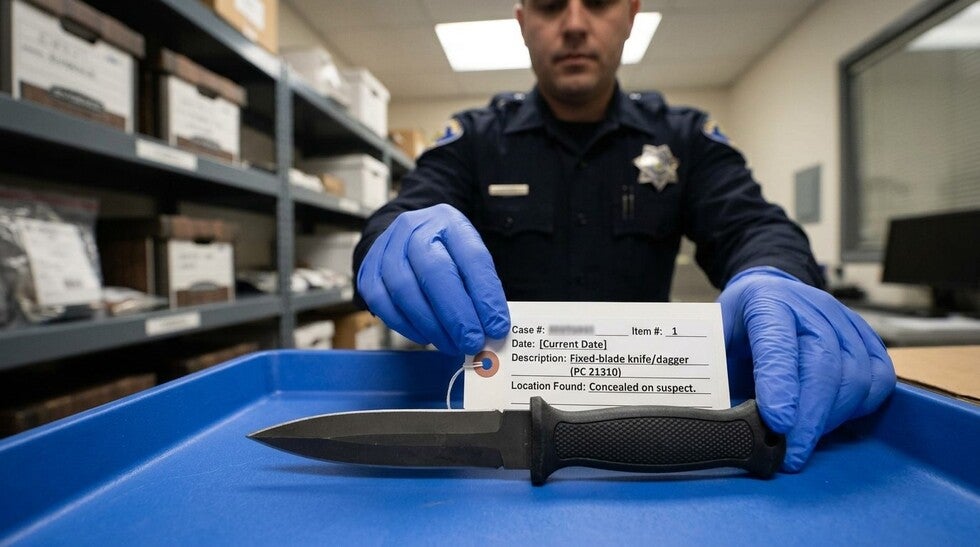
Penal Code § 21310 makes it a WOBBLER misdemeanor up to a year, or felony at 16 months, 2, or 3 years to carry CONCEALED upon your person a “dirk or dagger”: defined (§ 16470) as ANY knife or instrument, with or without a handguard, capable of READY USE as a stabbing weapon that may inflict great bodily injury or death.Read that definition again, because it contains the trap: it covers the kitchen knife, the fishing fillet knife, the work blade, the steak knife ANY fixed blade and the California Supreme Court has held the statute requires NO intent to use the knife as a weapon
The cook walking a wrapped santoku home, the handyman with a utility blade tucked in a waistband, the camper with a sheath knife dropped in a jacket pocket have all produced real prosecutions. The counterweights are the rules nobody teaches: a FIXED blade carried OPENLY in a sheath at the waist is LEGAL any size, machete included (§ 20200 declares sheathed open carry not “concealed”); a FOLDING knife is NOT a dirk or dagger while CLOSED legal in your pocket at any blade length and becomes one only when carried concealed with the blade EXPOSED AND LOCKED open; and the true per-se bans live elsewhere: switchblades over two inches (§ 21510 including butterfly knives, covered in our dedicated guide), plus location rules for schools and public buildings, plus LOCAL ordinances (Los Angeles, for one, restricts openly carrying blades over three inches in public). This guide from The Bulldog Law's defense practice lays out the full carry matrix, the elements and their defenses, and what to do when an ordinary object becomes a felony charge.
The Carry Matrix What's Legal, What's Not
- Fixed blade, OPEN in a waist sheath LEGAL, any size: the statute's own exemption. This is the lawful way to transport and carry fixed blades visible, sheathed, at the waist.
- Fixed blade, CONCEALED anywhere on you the § 21310 crime: pocket, waistband under a shirt, jacket, boot, wrapped in a bag you're wearing concealment plus ready-use capability is the offense, intent irrelevant.
- Folding knife, CLOSED LEGAL concealed, any blade length: pocket clips, pockets, bags a closed folder is not a dirk or dagger by definition.
- Folding knife, OPEN AND LOCKED, concealed becomes a dirk or dagger: the open locked folder tucked away is charged exactly like a fixed blade.
- Switchblades, balisongs, autos over 2” separate per-se rules (§ 21510: carry, possession in public, sale) the butterfly-knife guide covers that family; misdemeanor lane, different elements.
- Locations and locals schools and school grounds (§ 626.10's own offense for many blades), government buildings and secure areas, and city ordinances (blade-length and open-carry limits that vary by city) sit ON TOP of state law - the layer that catches travelers and new residents.
Elements, Defenses and the Innocent-Carry Problem
The prosecution must prove: (1) you carried a knife ON YOUR PERSON; (2) it was SUBSTANTIALLY CONCEALED; (3) it met the dirk/dagger definition capable of ready use as a stabbing weapon; and (4) you KNEW you were carrying it and knew the characteristics that make it a dirk or dagger (that it was a fixed blade, that the folder was locked open) though NOT that you intended anything wrongful.Each element defends: ON YOUR PERSON knives in a car's trunk, glovebox, or toolbox are not person-carry (secure vehicle transport is the lawful answer for kitchen and work blades); SUBSTANTIALLY CONCEALED the partially visible handle, the clipped and visible folder, and the open sheath defeat concealment, with photographs and bodycam deciding.
READY USE - a knife SECURED in a locked case, zip-tied in packaging, or genuinely inaccessible supports a not-ready-for-use argument that the wrapped-but-graspable knife does not, a line worth litigating in transport cases; KNOWLEDGE the forgotten blade in a borrowed jacket, the bag packed by someone else, the folder you didn't know had locked open all fight here; and the SEARCH these charges ride on pat-downs and stop-and-frisks, so the detention's and frisk's legality is the first audit in every file. The INNOCENT-CARRY problem deserves honesty: because intent is not an element, the chef and the camper are technically guilty as charged and their cases get won on the OTHER elements (concealment, ready-use, knowledge), on suppression, and on prosecutorial judgment: early defense presentations (the receipt from the knife store
The job site, the camping permit) produce declinations and reductions precisely because everyone in the courtroom understands the statute over-reaches ordinary life. Where a resolution is needed: misdemeanor outcomes, diversion (§ 1001.95 reaches these), and expungement after with wobbler-level advocacy keeping felony filings rare and reducible. The prevention rule to teach everyone you know: fixed blades ride in the trunk or openly in a waist sheath never wrapped in a pocket, never tucked in a waistband, never loose in a worn bag.
What Happens After a § 21310 Arrest?
A concealed-knife case does not end with the arrest. The next steps depend on why the knife was found, where it was located, whether it was actually concealed, and whether the prosecution can prove that it met the statutory definition of a dirk or dagger.
The defense should first preserve the evidence surrounding the encounter. Body-camera footage, photographs of the knife and sheath, receipts, employment records, travel plans, witness statements, and other evidence may help establish how and why the knife was being carried.
The exact position of the knife can also matter. A photograph showing the knife partially visible may tell a very different story from a police report describing it simply as "concealed."
The Circumstances of the Search Matter
Many § 21310 cases begin with a traffic stop, pedestrian detention, pat-down, or another police encounter.
If officers discovered the knife during a search, the legality of that search should be examined separately from the knife allegation itself.
Important questions can include:
-
Why did the officer stop or detain the person?
-
What caused the officer to conduct a pat-down or search?
-
Was the knife discovered during a lawful search?
-
Did the officer actually see the knife before searching?
-
Where exactly was the knife located?
-
Was the knife inside clothing, a bag, or another container?
If the search was unlawful, the defense may have grounds to challenge the evidence rather than simply arguing about the knife itself.
Ordinary Work and Recreation Can Create Important Evidence
A knife can have an obvious noncriminal explanation.
A chef may have purchased the knife for work. A contractor may have a utility or fixed-blade knife for a job. A fisherman may carry a fillet knife. A camper may have a sheath knife as part of camping equipment.
That explanation does not automatically defeat a § 21310 charge because the statute focuses on the manner of carrying rather than requiring an intent to use the knife unlawfully.
But evidence showing the legitimate circumstances can still matter when evaluating the case, negotiating a resolution, or challenging the prosecution's interpretation of the facts.
Receipts, work orders, uniforms, employment records, camping reservations, fishing permits, photographs, and witness statements can help establish the surrounding circumstances.
Do Not Assume the Knife's Purpose Ends the Case
One common misconception is that a person cannot be prosecuted if the knife was carried for work, cooking, fishing, hunting, or another lawful purpose.
The law is more complicated.
A lawful reason for possessing or using a knife does not necessarily answer whether the knife was carried in a manner prohibited by § 21310. The defense therefore needs to examine the statutory elements rather than relying only on the person's innocent purpose.
At the same time, the lawful purpose can provide important context when determining whether the prosecution has sufficient evidence and what resolution is appropriate.
The Difference Between Possession and Carrying Matters
Simply owning a knife is not the same as violating § 21310.
The statute addresses carrying a qualifying dirk or dagger concealed upon the person. A knife stored at home, properly transported in a vehicle, or otherwise outside the circumstances covered by the statute presents a different legal question.
That distinction is particularly important for people who regularly use knives for employment, outdoor activities, cooking, construction, or other legitimate purposes.
The defense should identify exactly where the knife was located and how it was being transported rather than accepting a general description such as "the defendant had a concealed knife."
What Can Happen to the Case?
Depending on the evidence and the defendant's circumstances, possible outcomes can include dismissal, reduction of the charge, a misdemeanor resolution, diversion where legally available, or litigation of the case through trial.
The best outcome depends on the facts.
A case involving a questionable search may require suppression litigation. A case involving disputed concealment may depend on photographs, body-camera footage, and witness testimony. A case involving a legitimate work or recreational purpose may benefit from presenting that context early.
A defendant should also consider the long-term consequences before accepting a conviction. A weapons conviction can affect employment, professional opportunities, firearm rights, and other legal rights depending on the circumstances.
For that reason, the goal should not simply be to "get the case over with." The defense should first determine whether the prosecution can prove every required element and whether a better resolution is available.
Frequently Asked Questions
Is it illegal to carry a knife in California?
Mostly no California knife law is a placement rule, not a ban: folding knives are legal to carry closed at any blade length; fixed blades are legal carried OPENLY in a waist sheath at any size; and the crime (PC 21310, a wobbler) is carrying a fixed blade or a locked-open folder CONCEALED on your person. The per-se bans are narrow: switchblades and butterfly knives over two inches, plus restricted locations (schools, government buildings) and city ordinances that add local limits. The two habits that keep ordinary people legal: closed folders in pockets, fixed blades in the trunk or an open sheath never hidden on your body, whatever the innocent reason.
What knife length is legal in California?
State law sets NO general blade-length limit the two-inch rule people quote applies only to switchblades (and butterfly knives, which count as switchblades). A closed 5-inch folder is legal in your pocket; a 12-inch fixed blade is legal openly sheathed at your waist. Length limits that DO exist are local and locational: city ordinances (Los Angeles restricts open carry of blades over 3 inches in public, for example), school-grounds rules (2.5 inches for many blades under PC 626.10), and government-building screening. The legal variable in California is CONCEALMENT and TYPE, not inches - which is why the wrapped kitchen knife is a charge and the visible machete, absurdly, is not.
Can I keep a knife in my car?
Yes vehicle storage is the lawful transport answer: PC 21310 punishes concealment ON YOUR PERSON, and knives in the trunk, a toolbox, the cargo area, or otherwise secured in the vehicle are not person-carry. Best practice mirrors firearm transport logic: cased or sheathed, out of immediate grabbing reach, and not on your body when you exit. The traps to avoid: tucking the blade into your waistband or pocket ‘just to carry it inside' (that step creates the crime), and school or government parking zones with their own location rules. For work and kitchen blades, the trunk-and-sheath habit converts a felony-shaped risk into a non-event teach it to every tradesperson and cook you know.
Is a concealed knife charge a felony?
It's a wobbler chargeable as a misdemeanor (up to a year) or felony (16 months to 3 years), decided by circumstances, record, and context, and reducible later under 17(b). What moves cases down or out: innocent-purpose evidence presented early (receipts, job sites, the errand's reality), concealment and ready-use element weaknesses, knowledge defenses, and suppression where the stop or frisk fails. Misdemeanor outcomes, judicial diversion, and dismissals are the realistic range for ordinary-life cases with counsel; felony convictions concentrate in cases with priors or aggravating context. Treat any 21310 filing seriously it's a weapons charge on a record and treat it as winnable, because most of them are.
Section 21310 criminalizes placement, not purpose which means ordinary people commit it by accident and ordinary defense work defeats it by design: elements, suppression, and the receipts of real life. Learn the matrix, ride blades in the trunk, and if the charge lands anyway, make the innocence visible early. The Bulldog Law's defense team handles knife and weapons-carry cases across California. Contact the firm online or call (888) 928-1609.