
Updated October 2026 | The Bulldog Law | California Criminal Defense
A polygraph result cannot be used in a California criminal case. Evidence Code 351.1 excludes the results of any polygraph examination, the examiner's opinion, and any reference to taking, offering to take, or refusing to take one, unless every party stipulates to its admission, which almost never occurs. No law requires a suspect to take one, and a refusal cannot be mentioned at trial. Police ask anyway, because the polygraph is an interrogation tool: the pre-test interview, the examination, and the post-test confrontation in which the examiner announces a failure are designed to produce a confession, and the confession is admissible even though the test is not.
A private polygraph arranged by defense counsel costs a few hundred dollars, is privileged, and can be used to persuade a prosecutor not to file; a failed one is never disclosed. The one place the polygraph is required in California is on probation and parole for registered sex offenders, as part of treatment, with statutory limits on how the answers can be used.
The Bulldog Law's attorneys are asked about polygraphs by two kinds of clients: the one a detective has invited to come in and clear things up by taking a test, and the one who wants to take a test to prove innocence. The answer to the first is no, not without us, and usually not at all. The answer to the second is sometimes, through us, under privilege, with an examiner we choose.
What follows is the law of admissibility, the science and its limits, how police use the test, how the defense uses it, and the sex offender treatment exception. Call (888) 928-1609 or message our team before you agree to anything.
The law: Evidence Code 351.1
Evidence Code 351.1 provides that, notwithstanding any other provision of law, the results of a polygraph examination, the opinion of a polygraph examiner, or any reference to an offer to take, failure to take, or taking of a polygraph examination, shall not be admitted into evidence in any criminal proceeding, including pretrial and post-conviction motions and hearings, or in any trial or hearing of a juvenile for a criminal offense, unless all parties stipulate to the admission of such results. The statute was enacted in 1983 after California courts had wavered on admissibility, and it settled the question completely: without a stipulation, nothing about a polygraph reaches the factfinder, in either direction. A defendant cannot offer a passed test; a prosecutor cannot offer a failed one; neither can mention that the other side refused.
The stipulation exception exists on paper and is almost never used, because neither side will agree in advance to be bound by a result it has not seen. The United States Supreme Court upheld a categorical ban on polygraph evidence against a constitutional challenge in United States v. Scheffer in 1998, holding that a defendant's right to present a defense does not include the right to present unreliable evidence, and the federal courts generally exclude polygraphs under the Daubert reliability standard even where no statute does. In a California courtroom the polygraph does not exist. Our page on hearsay and evidence rules covers the other exclusions that shape what a jury hears.
What the test measures, and how often it is wrong
A polygraph records physiological responses, blood pressure, pulse, respiration, and skin conductivity, while the subject answers a series of questions, and the examiner compares the responses to relevant questions against responses to control questions. The theory is that deception produces measurable stress. The problem is that the instrument measures arousal, not deception, and arousal has many causes: fear of being disbelieved, anger at the accusation, the physical discomfort of the test, and the examiner's manner. The National Academy of Sciences concluded in a 2003 review that the accuracy of polygraph testing in specific-incident settings is well above chance but well below perfection, that the research base is weak, and that the test is especially unreliable as a screening tool. Accuracy figures cited by the industry run from 85 to 95 percent; independent estimates run lower, and the false positive rate, innocent people classified as deceptive, is the figure that matters to a suspect.
Countermeasures, physical and mental techniques to alter the control-question responses, are documented and detectable only sometimes. Examiner bias is documented too: an examiner who has been told by the detective that the subject is guilty scores the charts differently. And the scoring is a judgment, not a readout. The test's defenders are right that it is better than a coin flip; its critics are right that a result that is wrong one time in ten, or one in five, cannot be the basis of a verdict, which is what the Legislature concluded.
How police use it
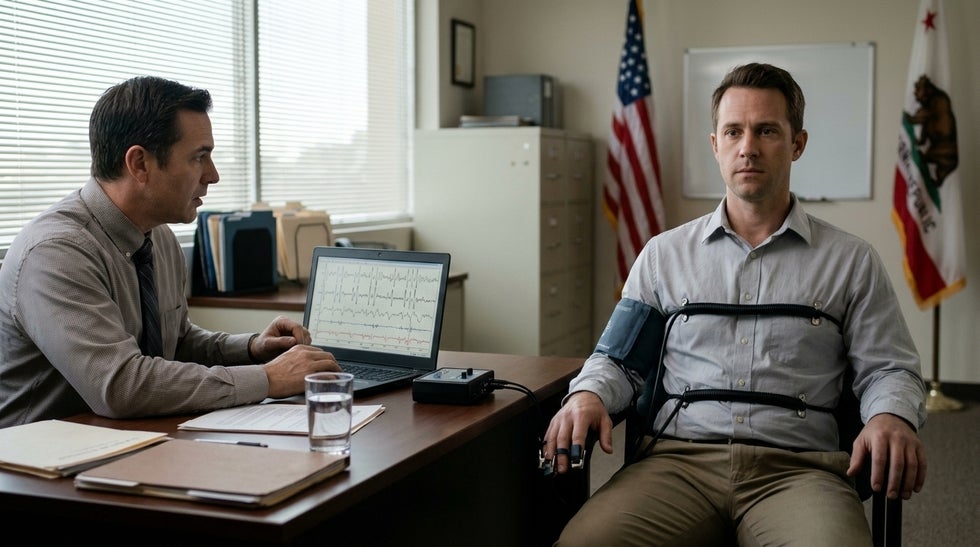
Investigators do not ask a suspect to take a polygraph because they want to know the result. They ask because the process produces statements. The pre-test interview, conducted without Miranda warnings in many cases because the subject came voluntarily, covers the subject's account in detail, and inconsistencies are noted. The examination itself produces a chart. The post-test interview is the point: the examiner tells the subject that the chart shows deception, that the machine does not lie, that the only question is why, and offers the subject the chance to explain, minimize, or confess.
The subject, who believes the test is accurate and has just been told they failed, often does. The confession is admissible; the polygraph that produced it is not, and the jury never learns that the confession followed a claimed failure on a test that may have been scored before the subject sat down.
False confessions following polygraph interrogations are a recognized category in the wrongful conviction research. The technique is lawful; police may lie to suspects about evidence, including about polygraph results, and a confession is not involuntary merely because it followed a false claim of failure. The protection is the one that applies to every interrogation: the right to remain silent and to counsel, exercised before the test, which ends the interview. Our page on whether invoking the Fifth Amendment looks guilty addresses the fear that keeps people from exercising it. A refusal to take a police polygraph is not evidence of anything, cannot be mentioned at trial, and is what our attorneys advise in nearly every case.
How the defense uses it
A polygraph arranged by defense counsel is a different instrument. Our attorneys select the examiner, a licensed forensic polygrapher with no connection to the investigating agency; the examination is conducted under the attorney work-product and attorney-client privileges, so that the result belongs to the defense; and the questions are framed by counsel around the actual disputed facts. If the client passes, the attorney decides whether to use the result: a passed polygraph, presented to a prosecutor with the examiner's report before charges are filed or at a charging review, can persuade the prosecutor to decline, to reduce, or to look again at the complaining witness, because prosecutors use polygraphs in their own decisions and credit them more than the law allows a jury to. If the client fails, the result is privileged, is never disclosed, and the attorney has learned something about the case that shapes the defense without harming the client.
The private polygraph is most useful in cases that turn on credibility with little physical evidence: sexual assault allegations, domestic violence cases with conflicting accounts, accusations by a single witness, and cases in which the client has an alibi or a denial the prosecutor has not credited. It is a tool for the charging decision and the negotiation, in the same way the mitigation packet is a tool for sentencing, and it is never a substitute for the evidence that actually decides cases; a prosecutor who declines to file after a polygraph does so because the case had the weaknesses the polygraph confirmed.
A private examination costs roughly $300 to $800 in California, more for an examiner with forensic credentials and court experience, and takes two to three hours including the pre-test interview. The expense is small relative to the case, and the decision to take one is made with counsel, after the attorney has evaluated whether the client is a suitable subject and whether a pass would change anything.
Where the polygraph is required: sex offender probation and parole
The one setting in which California law mandates polygraph testing is the containment model of sex offender supervision. Under Penal Code 1203.067(b), a person placed on formal probation for a registrable sex offense must participate in a certified treatment program and must waive the privilege against self-incrimination and the psychotherapist-patient privilege to the extent necessary for the program, which includes periodic polygraph examinations about compliance and sexual history. Penal Code 3008 imposes the same on parolees. The examinations are used by treatment providers and probation officers to monitor compliance and to structure treatment, and failing one, or refusing, is treated as a probation violation.
The limits are statutory and constitutional. The California Supreme Court held in People v. Garcia in 2017 that the waiver condition is valid only because the compelled answers, and any evidence derived from them, cannot be used in a new criminal prosecution; the answers may be used to supervise and to revoke probation, not to charge. The polygraph results themselves remain inadmissible under 351.1 in any new case. Our attorneys represent clients in violation proceedings that arise from containment polygraphs, where the issue is usually the examiner's interpretation of a disclosure, and advise clients entering registration and treatment about what the examinations will cover.
Other settings
Federal agencies polygraph applicants and employees for security clearances and law enforcement positions, under rules that have nothing to do with criminal admissibility; a failed pre-employment polygraph ends an application but is not evidence of a crime. The Employee Polygraph Protection Act bars most private employers from requiring polygraphs of employees or applicants. In federal criminal cases, agents use polygraphs as the FBI and DEA have for decades, as interrogation and cooperator-testing tools, and the results are excluded at trial under Daubert in nearly every circuit. And in civil and family cases in California, the 351.1 bar does not apply by its terms, but courts exclude polygraph evidence under the general reliability rules, and a polygraph offered in a custody dispute is given the weight a judge thinks it deserves, which is usually none.
What to do when asked
A detective who asks you to take a polygraph is asking you to be interrogated. Decline politely, say you want to speak to a lawyer, and do not explain why. A prosecutor who offers a polygraph as a condition of a favorable disposition is offering a stipulated test, and the decision whether to take it is made with counsel after the terms, the examiner, and the questions are negotiated. A probation officer who schedules a containment polygraph is enforcing a condition the court imposed, and the examination is attended with an understanding of what is privileged and what is not. And a person who wants to prove innocence should call a lawyer first, because the test that proves innocence is the one the lawyer arranges, and the test that produces a confession is the one the police do.
Frequently asked questions
Are polygraph tests admissible in court in California?
No. Evidence Code 351.1 bars the results of a polygraph examination, the opinion of the examiner, and any reference to an offer to take, failure to take, or taking of a polygraph from any criminal proceeding, unless all parties stipulate to its admission. That stipulation almost never happens. Neither a pass nor a fail can be mentioned to the jury, and a prosecutor who referred to one would cause a mistrial.
Can police make you take a lie detector test?
No. There is no law in California or anywhere in the United States that requires a suspect to take a polygraph, and refusing cannot be used against you in court. Police ask because the test is an interrogation tool: the questioning before and after the examination, and the examiner's claim that you failed, are designed to produce a confession, and the confession, not the chart, is what ends up in evidence.
How much does a polygraph test cost?
A private polygraph examination by a licensed examiner typically costs $300 to $800 in California, with experienced forensic examiners charging more for criminal matters. The fee covers a pre-test interview, the examination, and a written report. A test arranged by the defense through counsel is privileged and confidential; a test arranged by police is free and is not.
Should I take a polygraph if I am innocent?
Not a police polygraph, and not without a lawyer. Innocent people fail polygraphs at meaningful rates, because the test measures anxiety, not truth, and the result is reported by an examiner who works for the investigating agency. A private polygraph arranged by your attorney, with a defense-selected examiner, under privilege, can be useful: if you pass, your attorney may choose to share the result with the prosecutor to influence a charging decision; if you fail, no one ever learns of it.
Why do prosecutors and police use polygraphs if they are not admissible?
Because they work as leverage. A polygraph is used to screen suspects, to pressure a suspect into confessing after being told they failed, to test a cooperating witness, to decide whether to file charges, and, under California law, as a condition of probation or parole for sex offenders. The results guide decisions outside the courtroom; they simply cannot be presented to a jury.
Related reading from our attorneys
- Miranda rights: what they mean and why they matter
- Does pleading the Fifth make you look guilty?
- Hearsay and evidence rules in California criminal cases
Asked to take a lie detector test? The answer is a phone call, not a chart
The Bulldog Law's defense attorneys advise clients on police polygraph requests, arrange privileged defense examinations where they help, and defend probation violations arising from containment polygraphs, in cases across California. Visit our criminal defense page, call (888) 928-1609, or reach us online.