
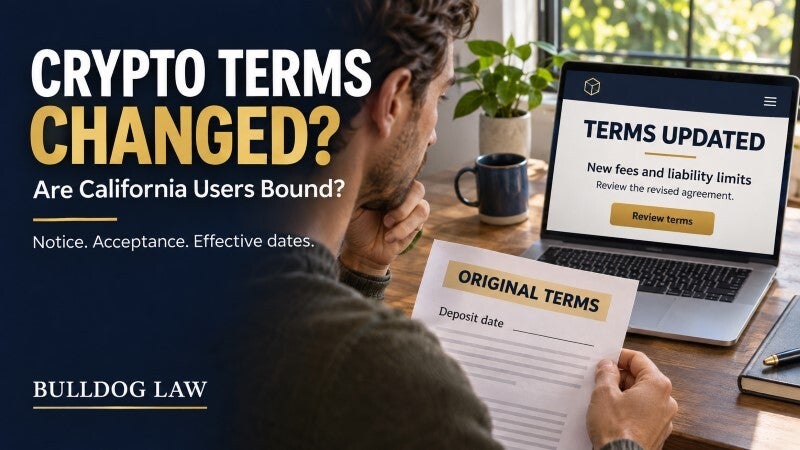
You deposit cryptocurrency under one agreement, then discover new withdrawal fees or a clause limiting the platform's responsibility for losses. Crypto exchange terms changes in California raise a question: which version actually governs your account? The answer depends on the original agreement, notice, acceptance, timing, and the provision being enforced. A newer document on the exchange's website does not settle those issues by itself.
Quick answer
California users are not automatically bound whenever an exchange posts revised terms. An enforceable modification generally requires a valid contractual basis, adequate notice, and assent. Clear acceptance or continued use after proper notice may support enforcement, depending on the circumstances. Changes affecting future services require a different analysis from provisions aimed at completed transactions or existing claims. Preserve both contract versions and the notices before accepting the platform's explanation.
Crypto exchange terms changes in California start with the original agreement
Locate the agreement accepted when you opened the account and any later version accepted before depositing. Identify the contracting company, covered services, governing law, and amendment procedure. A global platform may use different entities and agreements for different products.
Check incorporated documents, including fee schedules and product-specific terms. A general account agreement may not answer every question about crypto custody obligations. Separate terms may also govern liquid staking arrangements.
California Civil Code section 1698 addresses modification of written contracts. The analysis still requires determining whether the parties agreed to the particular change. Language reserving a right to amend does not eliminate every question about notice, scope, or enforceability.
Was the notice clear enough?
In Douglas v. Talk America, the Ninth Circuit rejected the idea that customers must continually inspect a website to discover contract revisions. Continued use could support assent only after proper notice of proposed changes.
Stover v. Experian likewise illustrates why a website visit does not necessarily establish acceptance of updated terms. Although these cases involved other services, their contract principles are relevant when evaluating exchange amendments.
Preserve the actual email, banner, or app screen. Ask:
- Did it clearly announce contractual changes?
- Could users access the revised terms before the effective date?
- Did it explain what action would indicate acceptance?
- Did the platform follow the original agreement's notice procedure?
- Can the exchange establish which notice reached your account?
A message advertising “product improvements” may present different notice issues from an explicit fee-change announcement. For paid memberships, changes may also implicate rules governing crypto subscriptions and automatic renewals.
Did you actually accept the change?
A clearly labeled acceptance button linked to accessible terms can provide stronger evidence than a buried website link. However, the exchange should connect the acceptance record to the relevant version and account.
Failure to read clearly presented terms does not necessarily defeat assent. Conversely, the platform cannot simply assume that every login, passive balance, or support request accepted every amendment. The screen's wording and the user's conduct matter.
If accepting new terms was required to withdraw existing assets, preserve that sequence. It may affect the analysis, but it does not automatically invalidate the agreement. A written objection can document your position without necessarily preventing later conduct from being treated as acceptance.
Effective dates and retroactive changes
Build a timeline covering the deposit, notice, acceptance, effective date, disputed charge, and any loss. The date a document was uploaded may differ from when it became binding on your account.
Suppose an exchange announces a future monthly custody fee. Applying that fee prospectively to assets already deposited is not necessarily the same as charging for months that already passed. The original promises and amendment process remain important.
Similarly, a new liability cap introduced after an outage raises different questions from one accepted before the incident. In crypto platform outage claims, identifying when the alleged loss occurred can help determine which agreement matters.
Changes to collateral thresholds may also affect crypto loan liquidation disputes. Distinguish amendments governing future exposure from attempts to justify an action already taken.
Can new fees or liability limits be challenged?
Compare the provisions word for word. Identify changes to amounts, calculation methods, exclusions, damages caps, notice requirements, and available remedies. An unfavorable provision is not automatically unlawful.
Under California Civil Code section 1670.5, courts can decline to enforce or limit unconscionable provisions. That inquiry considers the contracting process and the substance of the terms; dissatisfaction with a price increase alone does not establish unconscionability.
Civil Code section 1668 also restricts contractual attempts to escape responsibility for conduct including fraud and willful injury. Its application depends on the claim and provision. Neither clicking “accept” nor labeling a clause a “risk disclosure” automatically resolves enforceability.
Evidence to preserve before the terms disappear
Save complete copies rather than isolated screenshots. Preserve:
- Original and revised agreements, including linked fee schedules.
- Update emails, attachments, app notices, and acceptance screens.
- Deposit records, charges, trades, and withdrawal attempts.
- Support messages explaining the change or promising an exception.
- A dated comparison showing the provisions in dispute.
Blockchain transaction evidence can establish transfers, but ordinarily does not show which legal terms appeared on a screen. Contract records are therefore essential to preparing for cryptocurrency litigation.
Responding to a disputed amendment
Ask the platform to identify the governing version, notice date, acceptance record, and basis for applying the provision to your transaction. Describe the disputed charge or loss precisely. Request preservation of relevant account and notification records.
Where a claim proceeds depends on the agreement and applicable law. Jurisdiction in digital-asset disputes requires separate review; living in California does not automatically resolve every forum question. Likewise, exchange arbitration provisions should be evaluated without assuming the newest version controls.
If the platform offers reimbursement, examine any accompanying release. A cryptocurrency settlement agreement should clarify which charges and claims it resolves.
Frequently asked questions
Does depositing lock in the original terms forever?
No. Valid amendments may govern future services or transactions. The question is whether this amendment was validly adopted and reaches the disputed event.
Does an automated fee deduction prove I agreed?
No. Technical execution and contractual authorization are different issues. This distinction also matters in disputes involving automated agreements.
Does inadequate notice mean the entire agreement disappears?
Not necessarily. An earlier version may remain controlling, or only a particular amendment may be unenforceable. The remedy depends on the agreement, claim, and evidence.
Lawyers for crypto exchange terms changes in California
Bulldog Law helps customers evaluate contract versions, amendment notices, disputed fees, and liability provisions. A focused review can identify the applicable agreement and assess whether the platform's proposed interpretation is supported by the record.