
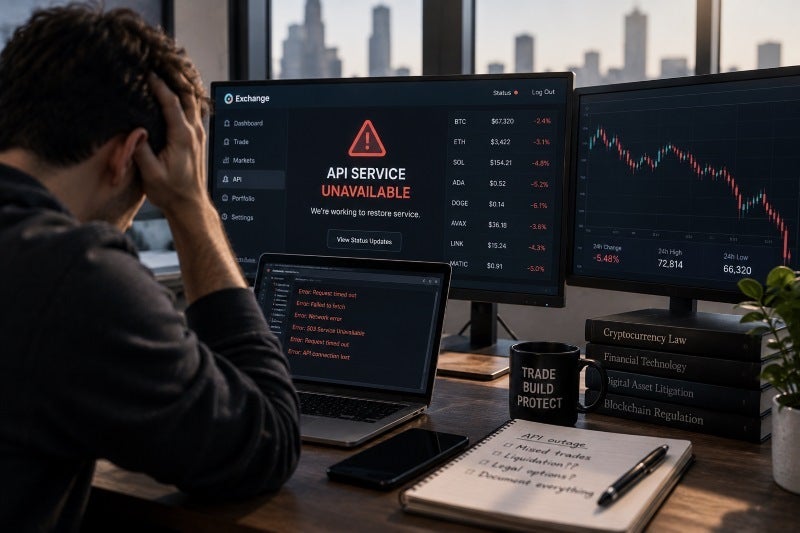
Crypto API Outage Claims can arise when an exchange, trading platform, broker, or digital-asset service becomes unavailable while customers are trying to place, cancel, or modify trades. An API failure may prevent a trading bot from closing a leveraged position, leave orders active during a market crash, block access to price data, or cause automated strategies to execute incorrectly. A financial loss alone, however, does not automatically make the platform legally responsible.
For California traders and crypto businesses, the central questions are usually what the platform promised, why the outage occurred, whether the user agreement limits liability, and whether the trader can prove that the downtime actually caused the claimed loss. Those issues fit within the broader framework of financial technology disputes involving digital assets.
Quick answer
A crypto platform may potentially face liability for API downtime when the outage violates an enforceable contractual obligation, involves misleading representations, or results from other legally actionable conduct. Recovery is not automatic. Exchange agreements commonly contain uptime disclaimers, liability caps, arbitration clauses, and exclusions for lost trading profits. A claimant must also show that the outage, rather than ordinary market movement or the trader's own strategy, caused the loss.
How Crypto API Outages Cause Trading Losses
Professional and retail traders increasingly interact with exchanges through application programming interfaces rather than manually clicking buy and sell buttons. An API may allow software to obtain prices, submit orders, cancel orders, monitor balances, or execute an automated trading strategy.
Problems can arise when:
- Order-entry endpoints stop responding.
- Cancel requests fail while existing orders remain live.
- Price or order-book data becomes delayed.
- The platform reports incorrect balances.
- Authentication systems reject valid API keys.
- Rate limits change unexpectedly.
- WebSocket data feeds disconnect.
- An exchange remains online while API trading becomes unavailable.
The resulting loss can resemble a custody problem when users cannot access or move assets at all. In that situation, the analysis may overlap with crypto custody disputes involving exchanges and wallet providers.
Crypto API Outage Claims Usually Begin With the Contract
The user agreement, API terms, institutional trading agreement, service-level agreement, and other incorporated policies are often the starting point.
A contract may address:
- Whether continuous availability is promised.
- Scheduled and emergency maintenance.
- API rate limits and trading restrictions.
- Responsibility for third-party infrastructure.
- Force majeure or extraordinary market conditions.
- Maximum recoverable damages.
- Exclusions for lost profits or trading opportunities.
- Dispute-resolution procedures.
A retail exchange that expressly states that access may become unavailable during periods of volatility presents a different case from an institutional API provider that contractually guarantees a defined level of uptime.
Similarly, an outage should be distinguished from an individualized restriction. If the exchange intentionally locks one customer's trading or withdrawals while the rest of the platform remains available, the issues may instead resemble a crypto exchange account freeze dispute.
Can a Trader Recover Lost Profits?
Possibly, but lost-trading-profit claims can be difficult.
California contract law can permit recovery of lost profits when the claimant establishes them with reasonable certainty and satisfies the other requirements governing contract damages. Speculative losses are much harder to recover.
For example, a trader who says, “I would have sold at the exact market top and bought again at the bottom,” may face substantial causation and damages problems.
A stronger record might exist when an automated strategy generated a documented sell instruction at a particular time, the exchange received or rejected the API request during a confirmed outage, and contemporaneous records show what the order would have done under normal operation.
API Failure Does Not Automatically Mean Negligence
A negligence claim may seem natural when software stops working, but California generally limits negligence recovery for purely economic losses, particularly where the alleged duties arise from a contractual relationship.
That makes the contractual promises and any independent legal duties important. A trader cannot assume that describing an outage as negligent avoids limitations contained in the parties' agreement.
The analysis may be different if the alleged conduct involves fraud, intentional wrongdoing, unauthorized computer activity, or another independent basis for liability.
What if Incorrect API Data Caused the Loss?
An outage and a bad-data event are related but different problems. Sometimes the API remains available but provides stale, incomplete, or incorrect information.
If automated systems rely on inaccurate pricing data, the result may include incorrect orders, liquidations, or risk calculations. Similar causation questions arise in blockchain oracle failures involving incorrect data.
The investigation should determine whether the incorrect information originated with the exchange, an outside market-data provider, an oracle, the trader's own software, or a connectivity problem between systems.
Automated Trading Makes Causation More Complicated
API traders may use bots that make hundreds or thousands of decisions according to predefined rules. After an outage, determining what would have happened without the failure can require reconstructing the strategy.
Evidence may include source code, bot logs, rejected API calls, timestamps, order histories, server records, and market data from the relevant period.
This problem resembles other disputes involving automated crypto transactions. For example, DeFi liquidation bot and MEV disputes also require separating normal automated execution from losses allegedly caused by improper conduct or system failure.
Market Makers and Institutional Traders May Have Different Rights
Institutional users may have negotiated terms that differ substantially from standard retail agreements. A market maker may rely on API access to maintain quotes, hedge inventory, or satisfy obligations to token projects or trading venues.
If downtime prevents performance under another contract, the dispute can involve several layers of causation. A token project might claim its market maker failed to maintain liquidity, while the market maker argues that an exchange API outage made performance impossible.
The underlying obligations should be compared with the terms of crypto market maker agreements, including provisions governing exchange access, outages, liquidity targets, and extraordinary market events.
Trading Suspensions and Delistings Are Different From Outages
A technical outage generally involves an unintended loss of functionality. A trading suspension or delisting is normally an intentional platform decision.
The distinction matters. If the exchange deliberately ends trading in a token, the relevant issues may involve notice, withdrawal rights, listing agreements, or disclosures rather than API performance. Those questions are addressed more directly in exchange delisting disputes involving token projects and investors.
A trader should preserve any exchange notice showing whether the event was characterized as maintenance, degraded service, a security incident, a trading halt, or a delisting.
What if an API Outage Prevents an OTC Settlement?
Not every crypto trade occurs through an exchange order book. OTC transactions may depend on exchange APIs for pricing, hedging, collateral checks, or settlement.
If a technical failure prevents one side from obtaining assets or completing an agreed transaction, the parties may dispute whether the event excused performance or created damages. These questions can overlap with crypto OTC trade disputes involving failed settlements.
What Evidence Should Be Preserved After an API Outage?
API disputes are highly dependent on timing. A trader should preserve evidence before logs rotate or dashboards change.
- API request and response logs.
- Error codes and timestamps.
- Order submission and cancellation records.
- Bot and server logs.
- Exchange status-page notices.
- Screenshots and screen recordings.
- Support tickets and emails.
- Account and trade history.
- Relevant market-price data.
- API documentation in effect on the date of the outage.
- User agreements and service-level agreements.
Blockchain data may show resulting transactions, but the key dispute may involve what failed off-chain before those transactions occurred. Understanding how crypto evidence is authenticated and used in court can help organize both blockchain and platform records.
Can the Exchange Force Arbitration?
Possibly. Many crypto platforms use arbitration agreements, jury-trial waivers, class-action waivers, forum-selection provisions, and governing-law clauses.
A trader should review those provisions before filing suit. Whether arbitration is required depends on whether an enforceable agreement exists and whether the outage claim falls within its scope. These issues are examined more fully in crypto arbitration clauses used by exchanges and Web3 platforms.
What if the Outage Signals a Larger Platform Failure?
A short outage may simply be a technical event. Repeated outages accompanied by frozen withdrawals, missing balances, unanswered support requests, or liquidity problems can indicate something broader.
When a platform can no longer satisfy customer withdrawals because of financial distress, contractual outage claims may become secondary to questions about asset ownership and creditor status. The rights of customers in that situation are discussed in crypto exchange bankruptcy and customer-fund disputes.
Frequently Asked Questions About Crypto API Outage Claims
Can I sue an exchange because its API went down?
Potentially, but downtime alone does not establish liability. The agreement, reason for the outage, applicable limitations, causation, and provable damages all matter.
Can I recover the profit I would have made from a trade?
Possibly, but lost-profit claims generally require reliable evidence rather than hindsight about what the trader might have done. Contractual exclusions may also restrict recovery.
Does an exchange status page prove my claim?
It can be useful evidence that a service problem occurred, but it does not by itself establish breach, causation, or the amount of damages.
What if my bot malfunctioned instead of the exchange?
Liability may shift depending on whether the problem originated in the platform API, the trader's software, an internet provider, a third-party data service, or another component.
Crypto API Outage Claims lawyers in California
Crypto API Outage Claims require more than showing that an exchange went offline during a volatile market. A meaningful analysis should reconstruct the failed requests, determine what the contract promised, identify the technical source of the outage, and calculate whether the claimed trading loss can be established without speculation.
Bulldog Law helps traders, crypto businesses, exchanges, market participants, and digital-asset users evaluate disputes involving API downtime, failed orders, automated trading systems, platform access, and digital-asset losses. When the problem extends beyond one API event, broader smart contract and crypto platform disputes may also need to be evaluated. No particular recovery or outcome can be guaranteed.