
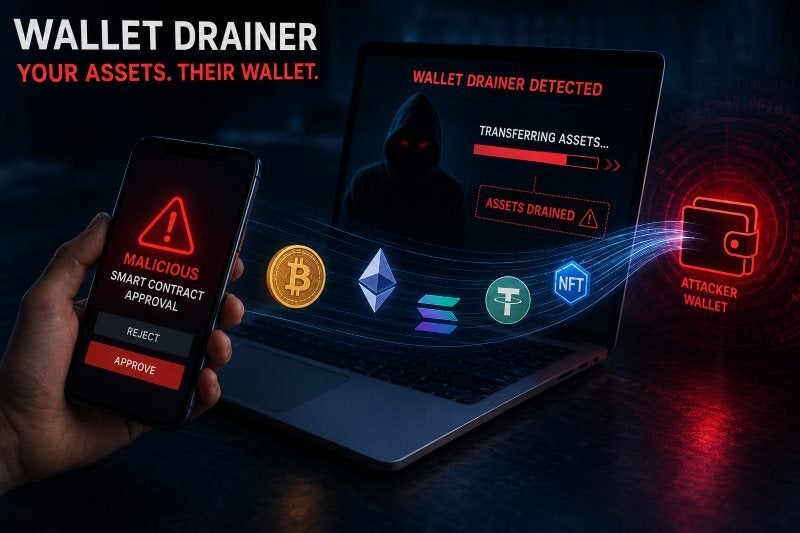
Crypto Wallet Drainers are malicious tools that trick a victim into approving a transaction, signing a message, or connecting a wallet to a fraudulent decentralized application. Once the victim authorizes the interaction, the attacker may use that approval to transfer tokens, NFTs, stablecoins, or other digital assets out of the wallet.
For many victims, the worst moment comes after the transaction is visible on-chain. The transfer may look final, the attacker may move assets through multiple wallets, and support channels may say the blockchain cannot be reversed. That does not mean the victim has no legal rights. A wallet drainer attack may support civil claims, law enforcement reports, exchange notices, tax-loss documentation, and recovery efforts, depending on the facts.
Crypto Wallet Drainers and how malicious smart contracts work
A wallet drainer usually does not need the victim's seed phrase. Instead, the attacker relies on deception. The victim may believe they are minting an NFT, claiming an airdrop, connecting to a DeFi protocol, verifying a wallet, approving a token swap, or signing a harmless message. In reality, the transaction may grant broad spending permission or trigger a transfer.
Common wallet drainer scenarios include fake airdrop sites, cloned protocol pages, compromised social media accounts, malicious sponsored search results, phishing links in Discord or Telegram, fake wallet support accounts, and fraudulent NFT mint pages. Some attacks are targeted. Others are automated campaigns designed to drain any wallet that connects.
The legal issue is not simply that a smart contract performed code. The question is whether the victim was deceived, whether the attacker obtained unauthorized control over property, whether any platform or intermediary had duties that were violated, and whether traceable assets moved through accounts that can be frozen, subpoenaed, or linked to identifiable people.
Wallet drainer cases often overlap with other crypto fraud patterns. A victim who was groomed into connecting a wallet after weeks of trust-building may be dealing with the same social-engineering structure seen in pig butchering crypto scam recovery strategies. A victim who was directed to a fake trading platform may face issues similar to fake crypto exchange fraud claims.
Your immediate legal priorities after a wallet drainer attack
Speed matters after a malicious smart contract attack. The victim should not confront the attacker, send more crypto, or pay anyone who promises instant recovery. The first priority is preserving evidence before links disappear, websites go offline, chat accounts are deleted, or transaction paths become harder to follow.
Victims should preserve:
- Wallet addresses involved in the attack
- Transaction hashes, block numbers, token IDs, timestamps, and network names
- Screenshots of the malicious website, social media message, email, or chat
- Browser history, wallet pop-ups, signature requests, and approval screens
- Exchange records showing purchases, transfers, withdrawals, and deposits
- Communications with support teams, moderators, influencers, or alleged project staff
- Any security alerts, antivirus logs, or wallet notifications
The victim should also revoke suspicious token approvals, move remaining assets to a new wallet, rotate passwords, secure email accounts, enable strong multi-factor authentication, and check whether the seed phrase or device was compromised. These steps are not a substitute for legal action, but they may prevent a second loss.
After evidence is preserved, the next step is to evaluate recovery paths. Bulldog Law's discussion of legal options for stolen cryptocurrency victims explains why on-chain tracing, exchange escalation, and civil remedies should be considered together rather than treated as separate problems.
Crypto Wallet Drainers and civil claims in California
California victims may have several potential civil claims after a wallet drainer attack, depending on the facts. These claims can include fraud, conversion, civil theft, unjust enrichment, negligence, aiding-and-abetting theories, and computer-access claims. Not every case supports every claim, and identifying a wallet address is not the same as identifying a defendant who can be sued.
California Penal Code section 502, often called the Comprehensive Computer Data Access and Fraud Act, can provide civil remedies when a person suffers loss because of unauthorized access or misuse of computer data, systems, or networks. In some wallet drainer cases, this may be relevant if the attack involved unauthorized access, malicious code, or misuse of data. In other cases, the defendant may argue that the victim technically approved the transaction, even though the approval was induced by deception. That is why the exact signature screen, website language, contract function, and surrounding communications matter.
California civil theft theories may also be considered where property was obtained by theft or fraud. Penal Code section 496 can allow civil remedies in certain stolen-property cases, including treble damages and attorney fees when the legal requirements are met. Courts do not apply these remedies automatically, and the victim must prove the necessary elements.
Federal law may also matter. The Computer Fraud and Abuse Act can apply to certain unauthorized access cases involving protected computers, but it is not a perfect fit for every blockchain loss. A malicious smart contract case should be reviewed carefully before assuming that a federal hacking claim exists.
Where wallet drainer cases are reported and handled
A wallet drainer case may involve several tracks at once. A victim may file a report with the FBI's Internet Crime Complaint Center, notify the Federal Trade Commission, submit a local police report, contact exchanges or hosted wallet providers, and pursue a civil lawsuit in state or federal court. These institutions are neutral government or private entities, and Bulldog Law has no affiliation, endorsement, partnership, or special access with them.
Reports should be detailed. A strong report usually includes wallet addresses, transaction hashes, dates, amounts, token names, platform names, website domains, screenshots, email addresses, phone numbers, chat handles, and a clear timeline. Vague reports are less useful. The goal is to give law enforcement, exchanges, and counsel enough information to understand how the drain happened and where the assets moved.
Civil litigation may be filed against known defendants, anonymous defendants, or entities that allegedly contributed to the loss. In some cases, a lawyer may seek subpoenas to exchanges, domain registrars, hosting providers, social media platforms, payment processors, or other intermediaries. In urgent cases, a court may be asked to consider temporary restraining orders, asset-preservation orders, or other equitable relief, but those remedies are fact-specific and never guaranteed.
Exchange notices should be precise and immediate. If stolen assets are traced to a centralized exchange, the victim may ask the exchange to preserve records, freeze suspicious funds if legally available, and respond to lawful process. The exchange may require a law enforcement request, subpoena, court order, or other documentation before releasing information.
Tax issues after Crypto Wallet Drainers steal digital assets
Crypto Wallet Drainers can create tax problems in addition to the theft itself. The IRS treats digital assets as property for federal tax purposes, and taxpayers may need to report digital asset income, sales, exchanges, rewards, and other transactions. A theft does not automatically erase reporting obligations for earlier activity in the wallet.
Tax treatment after a wallet drain is fact-specific. Victims should not assume that the stolen amount is immediately deductible, that the loss can be reported as a capital loss, or that no reporting is required because the assets are gone. The analysis may depend on whether the assets were held for investment, whether there was a closed transaction, whether a theft loss is available, the victim's basis, the tax year, and whether future recovery is possible.
Strong tax documentation starts with the same evidence used for legal recovery. Victims should preserve acquisition records, cost basis, wallet histories, exchange statements, staking or DeFi records, and the transaction hash showing the drain. Bulldog Law's resource on reporting cryptocurrency losses on a tax return addresses why the character and documentation of the loss matter.
Crypto tax reporting is becoming more structured. Broker reporting on Form 1099-DA can affect how transactions appear to the IRS, and victims should compare any third-party form against the full wallet record rather than assuming the form tells the whole story. Bulldog Law's explanation of Form 1099-DA crypto tax reporting rules is especially important for investors whose drained wallets also had exchange activity.
Victims with active trading, staking, yield farming, or liquidity-pool positions may need a broader tax review. A drainer may steal tokens that were originally received as rewards, obtained through swaps, or connected to DeFi positions. Bulldog Law's analysis of tax rules for staking rewards and DeFi tax reporting for swaps, yield farming, liquidity pools, and lending explains why the source of the asset can affect the reporting picture.
The IRS may question missing, inconsistent, or incomplete digital asset reporting. If the victim later receives a notice or examination request, the response should be organized, accurate, and supported by records. Bulldog Law's discussion of crypto tax audit defense after IRS contact explains why victims should not ignore tax correspondence. For forward-looking planning, crypto taxes in 2026 for investors highlights reporting issues that can affect wallets with both legitimate and fraudulent transactions.
Who may be responsible after a malicious smart contract attack
The attacker is the primary wrongdoer, but recovery analysis often looks beyond the first wallet that received the stolen assets. The question is whether any identifiable person or entity helped cause the loss, controlled stolen funds, ignored red flags, or failed to follow duties owed to the victim.
Potential targets may include:
- The person who created or operated the malicious website
- The person who promoted the fake mint, airdrop, or DeFi opportunity
- Accounts that received, laundered, or cashed out stolen assets
- Centralized exchanges that received traceable funds and have customer records
- Insiders who compromised a legitimate project's social media or website
- Service providers whose negligence contributed to account takeover or access
Some crypto thefts begin outside the smart contract. For example, a SIM swap may allow an attacker to take over email, exchange accounts, or wallet recovery tools before assets are drained. Bulldog Law's page on liability after SIM swap crypto theft addresses why telecom, account-security, and authentication facts can matter.
Liability is not automatic. A platform is not responsible merely because stolen crypto passed through it. A promoter is not always liable because a third party posted a bad link in a comment section. The facts must support duty, causation, knowledge, control, participation, or another recognized legal basis.
Recovery scams after wallet drainer attacks
Victims of wallet drainers are often targeted again. After a theft, scammers may monitor public posts, blockchain activity, Telegram groups, Discord servers, or complaint forums. They may claim to be blockchain investigators, ethical hackers, exchange employees, law enforcement contacts, or recovery agents.
Common warning signs include guaranteed recovery, demands for upfront crypto payments, claims of secret access to exchanges, fake court documents, pressure to keep the recovery private, requests for seed phrases, or instructions to connect a wallet to another “recovery” smart contract. A legitimate recovery effort should not require the victim to expose a seed phrase or sign unexplained transactions.
Secondary fraud can be financially and emotionally devastating. Bulldog Law's crypto recovery scam warning for victims explains how scammers exploit people immediately after a theft, when urgency and panic are highest.
Crypto Wallet Drainers lawyers in California
Bulldog Law helps California clients evaluate legal rights after crypto wallet drainer attacks, malicious smart contract approvals, phishing campaigns, fake DeFi platforms, and related digital asset theft. The firm focuses on evidence preservation, transaction analysis, exchange notices, law enforcement reporting, civil recovery options, and tax-sensitive documentation.
A wallet drainer attack can feel irreversible, but victims should not assume that nothing can be done. The faster the evidence is preserved and the transaction path is reviewed, the more options may remain. Bulldog Law can help assess whether the facts support recovery efforts, litigation, platform escalation, or coordinated tax and legal strategy.