
Updated September 2026 | The Bulldog Law | California Domestic Violence Defense
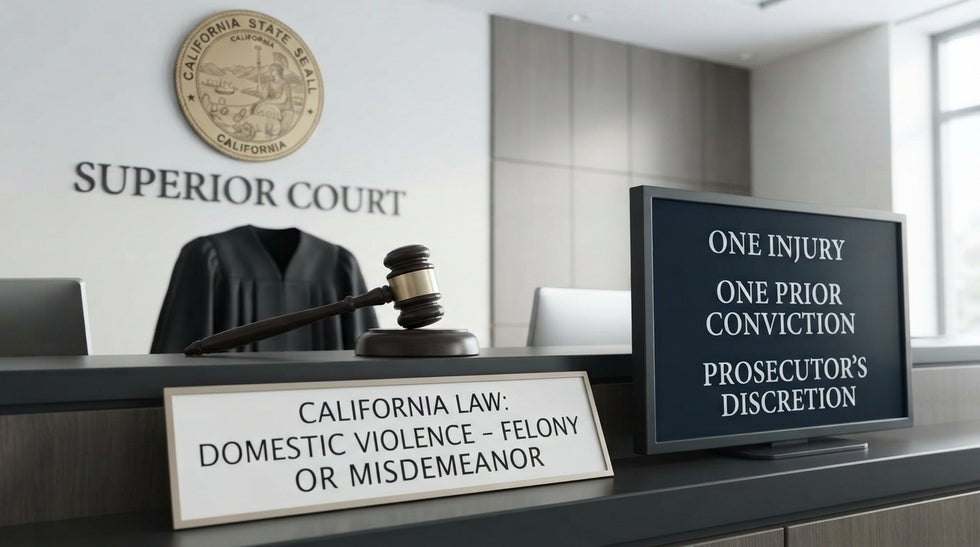
Domestic violence in California is not one crime; it is a category of crimes committed against a spouse, partner, ex, co-parent, or cohabitant, and most of the statutes in the category are wobblers, meaning the prosecutor chooses between a felony and a misdemeanor. The most common felony is corporal injury to a spouse or partner under Penal Code 273.5, which requires a visible injury and carries two, three, or four years in prison as a felony or up to one year in jail as a misdemeanor. The most common misdemeanor is domestic battery under Penal Code 243(e)(1), which requires no injury at all and carries up to a year. Injury, prior convictions, weapons, strangulation, and a violated protective order push a case toward the felony filing. What does not change with the level is the package that follows any domestic violence conviction: three years of probation, a 52-week batterer's program, a protective order, and a lifetime ban on firearms.
The Bulldog Law's domestic violence attorneys answer the felony question at the first meeting because it changes everything that follows: the bail, the plea options, whether a conviction can be reduced later, and, for non-citizens, whether the case is survivable at all. The answer usually cannot be read off the arrest report, because the same facts, an argument, a shove, a scratch, are filed as a felony in one county and a misdemeanor in the next, and the filing decision is made by a deputy district attorney who has never met the client. What follows is how the decision is made, what each level actually carries, and what a defense lawyer does to move a case from one side of the line to the other. Call (888) 928-1609 or message our team.
Domestic violence is a category, and most of it wobbles
California defines a domestic violence offense by the relationship, not the act. Family Code 6211 lists the relationships: current or former spouses and domestic partners, people who live or lived together, people who are or were dating or engaged, people who have a child together, and certain relatives. A crime committed against any of them is domestic violence for purposes of the sentencing package described below, whatever statute it is charged under. The statutes that carry the domestic violence label most often, and how each one is classified:
|
Statute |
Conduct |
Felony or misdemeanor |
|
PC 273.5 corporal injury |
Willful infliction of a traumatic condition (any wound or injury) on an intimate partner |
Wobbler: 2, 3, or 4 years prison, or up to 1 year jail |
|
PC 243(e)(1) domestic battery |
Offensive or harmful touching of an intimate partner, no injury required |
Misdemeanor only: up to 1 year jail |
|
PC 422 criminal threats |
Threat of death or great bodily injury that causes sustained fear |
Wobbler: up to 3 years; a strike as a felony |
|
PC 646.9 stalking |
Repeated harassment or following with a credible threat |
Wobbler; felony if a protective order was in place or a prior exists |
|
PC 273.6 protective order violation |
Violating a restraining, protective, or stay-away order |
Misdemeanor; wobbler for a second violation involving violence within 7 years |
|
PC 236 false imprisonment |
Restraining or confining the partner |
Misdemeanor; felony if by violence, menace, fraud, or deceit |
|
PC 591 / 591.5 phone line |
Damaging or removing a phone to prevent a call for help |
PC 591 wobbler; PC 591.5 misdemeanor |
|
PC 273a child endangerment |
Child present and placed at risk during the incident |
Wobbler when risk of great bodily harm; misdemeanor otherwise |
The two statutes at the top of the table decide most cases, and the line between them is an injury. Our attorneys cover the elements of Penal Code 273.5 and the elements of domestic battery in detail elsewhere; the point here is that the officer's photograph of a red mark is the difference between a misdemeanor-only charge and a wobbler that can be filed as a felony. A traumatic condition means any wound or bodily injury, minor or serious, caused by physical force: a bruise, a scratch, a swollen lip. No injury, no 273.5.
What pushes a domestic violence case to a felony
Prosecutors in California file wobblers as felonies or misdemeanors according to office policy and the facts, and the facts that move a domestic violence case up the ladder are consistent across counties.
The injury. A visible or documented injury makes 273.5 available. A serious one, a fracture, stitches, a concussion, makes the felony filing nearly automatic and adds a great bodily injury enhancement under Penal Code 12022.7 of three to six years, which also turns the conviction into a strike and a violent felony with 85 percent custody credits. Strangulation is treated as a serious injury even without visible marks, and California courts have upheld great bodily injury findings on strangulation evidence alone.
The history. Penal Code 273.5 raises the felony sentence to two, four, or five years for a defendant with a prior domestic violence conviction within seven years, and a prior of any kind makes a misdemeanor filing on a new 273.5 unlikely. Prior arrests without convictions, prior protective orders, and prior calls to the residence all appear in the filing deputy's file.
The aggravators. A weapon, even a household object used as one, adds an assault with a deadly weapon count under Penal Code 245, a wobbler that is usually filed as a felony. A violated protective order adds 273.6 and signals to the prosecutor that the misdemeanor tools have failed. A child who witnessed the incident adds 273a. A threat during the incident adds 422, which as a felony is a strike. Each additional count is leverage in the plea negotiation and a reason the case was filed at the felony level in the first place.
The county. Filing policy varies. Some district attorney's offices file every 273.5 with a photographed injury as a felony and negotiate down; others file misdemeanors on first offenses with minor injuries as a matter of policy. Our attorneys know the practice in the counties where they appear, and the first conversation with the filing deputy, before charges are formally filed, is often where the level is decided.
What a misdemeanor domestic violence conviction carries
The sentence on a misdemeanor domestic violence conviction is usually probation rather than jail, but the probation is unlike any other. Penal Code 1203.097 requires, for any conviction of a crime against a Family Code 6211 partner, whether felony or misdemeanor and whatever the code section: a minimum three-year probation term; a criminal protective order, which can bar all contact with the partner, including a spouse the defendant lives with, for the duration; completion of a 52-week batterer's intervention program, attended weekly, at the defendant's expense; a minimum of 48 hours in jail on a second or later conviction, and 30 days where probation is later violated; a payment to a domestic violence shelter fund; and community service or restitution. The program alone runs a year and typically costs several thousand dollars, and missing sessions is a probation violation. Even a plea to a non-domestic offense such as disturbing the peace carries these terms if the court finds the incident involved a 6211 relationship, unless the plea agreement expressly provides otherwise.
Outside the courtroom, the misdemeanor carries two consequences that most defendants do not learn until later. The firearm ban: federal law prohibits anyone convicted of a misdemeanor crime of domestic violence from possessing a firearm for life, and since 2019 California's own ban for misdemeanor 273.5 and 243(e)(1) convictions is also lifetime, a consequence our firearm defense attorneys see people discover during a background check years later. And immigration: federal law makes a conviction for a crime of domestic violence deportable regardless of whether it was a felony or a misdemeanor, and our immigration attorneys treat a misdemeanor 273.5 plea as seriously as a felony one.
What a felony domestic violence conviction carries
A felony 273.5 carries two, three, or four years in state prison, or two, four, or five with a qualifying prior, plus the 1203.097 package if probation is granted instead. Felony probation is common on a first felony domestic violence conviction with no great bodily injury, and a year in county jail as a condition of probation is a frequent outcome. With a great bodily injury enhancement, probation is barred and the conviction is a strike.
A felony conviction also brings the consequences that attach to any felony: loss of the right to vote while in custody or on parole, exclusion from many jobs and licenses, and a record that, unlike a misdemeanor, can be seen by employers who are not permitted to ask about misdemeanor arrests. Our page on the general difference between felonies and misdemeanors covers those. Two doors exist. A felony 273.5 without an enhancement is a wobbler, so the judge can reduce it to a misdemeanor under Penal Code 17(b), at sentencing or after probation is successfully completed, and the reduced conviction is then treated as a misdemeanor for nearly all purposes, though not for the firearm ban. And after probation, the conviction, at either level, is eligible for dismissal under Penal Code 1203.4, which our page on what expungement means explains.
How defense attorneys move a case across the line
The injury evidence. Whether an injury existed, whether it was caused by the defendant, and whether it was the result of unlawful force rather than self-defense or an accident decide whether 273.5 applies at all. Photographs taken hours later, medical records that describe no injury, and injuries on the defendant that the report omitted are the material. Where the injury is disputed, the case belongs at the misdemeanor level or below, and prosecutors who filed a felony on a photograph will often amend once the medical records arrive.
The pre-filing conversation. Between arrest and the filing decision, a defense attorney can present the filing deputy with the defendant's history, the context, and the evidence the police report left out, and can propose a misdemeanor filing or no filing. In counties where the felony decision is discretionary, this is where it is most often won.
The partner's account. Domestic violence prosecutions frequently proceed without the partner's cooperation, because prosecutors use the 911 call, the officer's body camera, and the photographs instead. But a partner who does not want to proceed, who describes the incident differently than the report, or who initiated the violence changes the felony calculus even when the case continues; our page on what happens when a victim refuses to testify explains the mechanics. Where the client was the one being abused, the evidence our attorneys describe on our intimate partner battering page can be the whole defense.
The plea. Where a conviction cannot be avoided, the goal is the least consequential code section: 243(e)(1) rather than 273.5, or a non-domestic offense, disturbing the peace, trespass, simple battery, that avoids the immigration and firearm consequences, with the 1203.097 terms negotiated expressly. A West plea is available where the client will not admit conduct, and the mitigation packet is prepared for the sentencing that follows any plea.
Bail and the first days. Domestic violence arrests in California are made on probable cause without a warrant, an emergency protective order is issued at the scene, and bail on a felony 273.5 is set from the county schedule at a level that often surprises families; our page on bail money explains what to consider before posting it. The arraignment is where the criminal protective order is set, and whether it allows peaceful contact or none is argued there, which for a couple with children and one household is often the most urgent question in the case.
Frequently asked questions
Is domestic violence a felony in California?
It can be either. Domestic violence is a category, not a single crime, and most of the statutes inside it are wobblers that prosecutors can file as a felony or a misdemeanor. The most common felony charge is corporal injury to a spouse or partner under Penal Code 273.5, which requires a visible injury. The most common misdemeanor is domestic battery under Penal Code 243(e)(1), which requires only offensive touching. The same incident can be charged either way depending on the injury, the history, and the county.
What makes domestic violence a felony instead of a misdemeanor?
Injury, history, and aggravating facts. A traumatic condition, any wound or bodily injury, bruising included, moves the case from 243(e)(1) to 273.5, a wobbler. Prior domestic violence convictions within seven years raise the 273.5 sentence and push prosecutors toward a felony filing. A weapon, strangulation, great bodily injury, a violated protective order, or a child present each adds enhancements or separate felony counts. A first incident with no injury and no history is almost always filed as a misdemeanor.
What happens on a first-offense domestic violence charge in California?
Usually a misdemeanor filing, probation rather than jail, and a set of mandatory conditions that apply whether the charge is a felony or a misdemeanor: at least three years of probation, a 52-week batterer's intervention program, a criminal protective order, fees, and community service. Jail is uncommon on a first misdemeanor with no injury. A first felony under 273.5 with a real injury can still result in probation, but custody is on the table, and the felony record is the lasting consequence.
Can a felony domestic violence charge be reduced to a misdemeanor?
Yes, in two ways. Before or at the plea, the prosecutor can agree to file or amend the charge as a misdemeanor, or the judge can reduce a wobbler at the preliminary hearing. After a felony conviction with probation, Penal Code 17(b) allows the court to reduce the felony to a misdemeanor on motion, typically once probation has been completed successfully. Corporal injury under 273.5 is eligible for both routes; a 273.5 with a great bodily injury enhancement is not.
Does a misdemeanor domestic violence conviction take away gun rights?
Yes, for life. Federal law bars anyone convicted of a misdemeanor crime of domestic violence from possessing firearms, with no expiration, and California law since 2019 imposes a lifetime ban for misdemeanor 273.5 and 243(e)(1) convictions as well. Expungement does not restore the right. The firearm consequence is one of the reasons defense attorneys negotiate for a plea to a non-domestic offense when the facts allow it.
Related reading from our attorneys
- Penal Code 273.5: corporal injury to a spouse or partner
- Domestic battery: charges and defenses
- Violating a restraining order under Penal Code 273.6
Charged with domestic violence? The level is decided early, and it can be argued
The Bulldog Law's domestic violence defense attorneys represent clients from the arrest through the filing decision, arraignment, and resolution in courts across California, and handle the immigration and firearm consequences in-house. Visit our criminal defense page, call (888) 928-1609, or reach us online.