
Updated October 2026 | The Bulldog Law | California Record Clearing
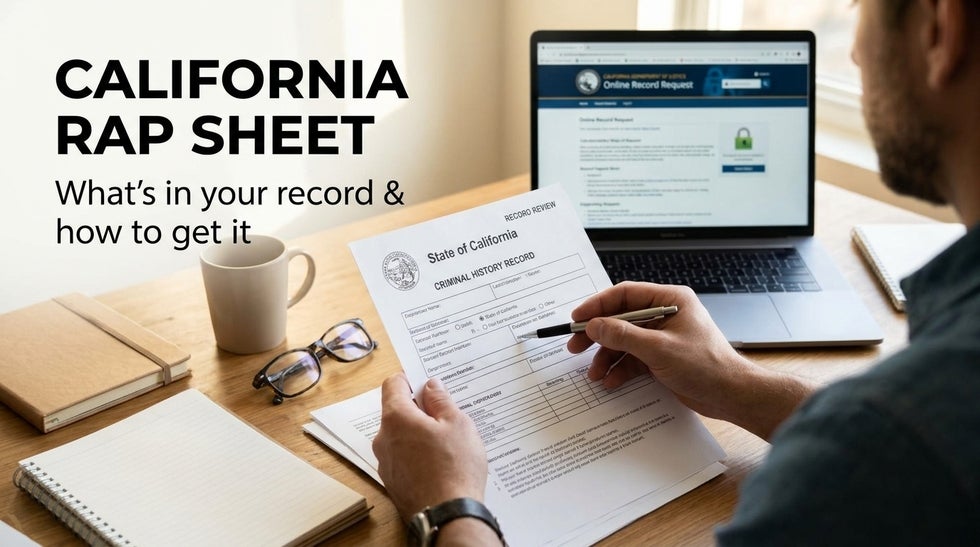
A rap sheet is a criminal history record; the letters stand for Record of Arrests and Prosecutions. In California the official rap sheet is the Criminal Offender Record Information, or CORI, that the Department of Justice compiles under Penal Code 11105 from fingerprint submissions by every police agency, prosecutor, and court in the state. It lists each fingerprinted arrest, the charges, what the court did with them, every conviction and sentence, probation, and custody, and it keeps entries for life unless they are sealed. You can get a copy of your own record through the DOJ's record review process, by Live Scan fingerprinting and a $25 fee, and you have a statutory right to correct what is wrong on it. Employers, with limited exceptions, cannot see the DOJ record at all; what they see is a commercial background check built from court files, which California law restricts in ways the DOJ record is not.
The Bulldog Law's attorneys pull a client's rap sheet at the start of nearly every case, because the record decides bail, charging, sentencing exposure, immigration risk, and eligibility for diversion and record clearing, and because the record is wrong more often than people expect. We also help clients who have no pending case and simply need to know what an employer, a licensing board, or an immigration officer will see. What follows is what the record contains, how to obtain it, who is allowed to see it, how to correct it, and what expungement and sealing actually do to it. Call (888) 928-1609 or message our team.
What is on a California rap sheet
The DOJ record is organized by arrest cycle. Each cycle begins with a fingerprinted arrest or a court-ordered fingerprinting and records the arresting agency, the date, and the charges as booked; the prosecutor's filing decision, including rejections; the court, the case number, and the charges as filed; and the disposition, which may be a dismissal, an acquittal, a diversion, or a conviction with the sentence. The record also shows probation grants and terminations, state prison and county jail commitments, parole and post-release supervision, registration requirements, and, since 2023, automatic Clean Slate relief notations. It does not include infractions, most traffic matters, juvenile adjudications (which are kept separately and are confidential), or arrests for which no fingerprints were taken, such as many citations and releases. Our page on what is in your California criminal record goes through each entry type in detail, and our discussion of the CLETS advisory committee covers who governs access. Penal Code 11105 is the statute that creates the record and defines who may receive it.
The FBI record is separate
The FBI maintains a national criminal history, the Identity History Summary, compiled from fingerprint submissions by every state and federal agency. It is what federal employers, immigration authorities, and federal firearm checks consult, and it can differ from the California record because dispositions reported to the DOJ are not always forwarded. A person can request their own FBI record directly from the FBI or through an FBI-approved channeler for a fee of $18, by fingerprint card or electronically, and an error on the FBI record is corrected by correcting the state record that fed it. For non-citizens, the FBI record is the one that matters most, and our immigration attorneys review it alongside the California record before any application or any plea.
How to get your own rap sheet: DOJ record review
Penal Code 11120 through 11127 give every person the right to see their own state record and the process is called record review. The Department of Justice publishes the current forms and fees. The steps are these. Download and complete the Request for Live Scan Service form for record review, BCIA 8016RR, checking the record review box; the form identifies you as the applicant and the DOJ as the recipient. Take the form and a photo ID to a Live Scan fingerprinting site, which may be a police department, a sheriff's office, or a private operator, and pay the DOJ processing fee of $25 plus the site's rolling fee, which varies from about $10 to $40. A person who meets the income guidelines can apply for a fee waiver with the DOJ's form. The site transmits your fingerprints electronically; the DOJ runs them against the record and mails the result to the address on the form, ordinarily within two to four weeks. The record is mailed only to you, and the DOJ will not release it to a third party or by email. A person outside California can submit fingerprint cards by mail. An attorney can obtain a client's record with the client's authorization, which is how our attorneys obtain it in a pending case, and the court file in a pending case will contain the prosecution's copy, which the defense is entitled to see.
Who can see it
The California rap sheet is confidential, and the people and agencies entitled to receive it are listed in Penal Code 11105. The table shows what each kind of reviewer actually sees.
|
Who |
What they see |
Legal limits |
|
You |
Your complete DOJ record, through record review |
PC 11120 to 11127; mailed only to you |
|
Law enforcement, prosecutors, courts |
Complete DOJ record, including sealed entries in most cases |
PC 11105(b) |
|
Licensing boards, schools, health care, child and elder care, and other statutorily authorized employers |
DOJ record limited to the convictions and pending arrests relevant to the position, through a Live Scan check |
PC 11105(b) to (m); each agency's authorizing statute |
|
Firearm dealers and the DOJ firearm bureau |
Prohibiting convictions, commitments, and orders |
PC 28220; see our firearm eligibility page |
|
Most private employers |
Not the DOJ record; a commercial background check compiled from court indexes |
Civil Code 1786.18 (seven-year limit on convictions); Labor Code 432.7 (no non-conviction arrests, no sealed or diverted cases); Gov Code 12952 (Fair Chance Act, check only after a conditional offer) |
|
Landlords |
Commercial background check only |
Same Civil Code and local fair-chance housing ordinances |
|
Immigration authorities |
FBI record plus certified court dispositions |
Federal law; sealing and expungement do not remove convictions for immigration purposes |
|
The public |
Court index entries at the courthouse or online, case by case |
No access to the DOJ record; sealed cases removed from the index |
The practical point is that a private employer's background check is narrower than the record itself. California limits reportable convictions to seven years, bars reporting of arrests that did not end in conviction and of cases sealed or resolved by diversion, and under the Fair Chance Act prohibits an employer with five or more employees from asking about or considering criminal history until after a conditional offer, and then requires an individualized assessment and a chance to respond before the offer is withdrawn. A client who is worried about what an employer will see usually needs a court-index check and a review of the seven-year window, not the DOJ record; a client applying for a license, a school or health care job, or a security clearance needs the DOJ record, because those reviewers see it.
Correcting the record
Rap sheets are wrong often, and the errors are of predictable kinds: an arrest with no disposition because the court never reported the dismissal; a conviction that was reduced to a misdemeanor or dismissed under Penal Code 1203.4 but still shows the original felony; a charge listed as booked rather than as filed; a cycle that belongs to a different person with the same name and birthdate, or to someone who used the client's identity. Penal Code 11126 gives the person the right to challenge the record. The process is to obtain the court's certified disposition, complete the DOJ's Claim of Alleged Inaccuracy or Incompleteness, form BCIA 8706, attach the documents, and submit it to the DOJ Record Review Unit; the DOJ must investigate and respond in writing, and if it does not correct the record the person may petition the superior court. For a missing disposition, the faster route is often to ask the court clerk to transmit the disposition to the DOJ directly, which clerks are required to do under Penal Code 13151. A record that includes another person's arrests may require a declaration of identity theft and, in some cases, a court order under Penal Code 851.8 finding the person factually innocent. Our attorneys handle the correction as part of any record-clearing engagement, because sealing and expungement orders only work on entries that are accurate to begin with.
What expungement and sealing do to the record
The record is permanent, but California offers several forms of relief that change what it shows and who can see it, and they differ in important ways. An expungement under Penal Code 1203.4 does not delete the conviction; the entry remains with the notation that the plea was withdrawn and the case dismissed, and the conviction still counts as a prior, still must be disclosed for public office and state licensing, and still exists for immigration. Arrest sealing under Penal Code 851.91 and diversion sealing under Penal Code 1001.9 remove the arrest from the record that employers, licensing boards other than those in a short list, and background check companies can see, while law enforcement and the courts keep access. The Clean Slate law, Penal Code 1203.425, now seals most arrests that did not result in conviction and most misdemeanor and non-serious felony convictions automatically once the waiting period runs, and the DOJ annotates the record accordingly, though the relief is not uniform and many records have not been processed. A certificate of rehabilitation and a pardon add notations rather than removing entries. Our 2022 discussion of cleaning up a California criminal record walks through which relief fits which entry, and the first step in every case is the record review described above, because a person cannot choose the right relief without seeing exactly what the record says.
Frequently asked questions
What is a rap sheet?
A rap sheet is a person's criminal history record. "RAP" stands for Record of Arrests and Prosecutions. In California the official rap sheet is the Criminal Offender Record Information, or CORI, maintained by the Department of Justice under Penal Code 11105, and it lists every arrest reported by fingerprint, the charges, the court dispositions, convictions, sentences, probation, and custody. The FBI maintains a separate national record called an Identity History Summary that compiles reports from every state.
How do I get a copy of my rap sheet in California?
Through the Department of Justice record review process under Penal Code 11120 to 11127. You complete the Request for Live Scan Service form for record review (BCIA 8016RR), take it to a Live Scan fingerprinting site, pay the DOJ fee of $25 plus the site's rolling fee, and the DOJ mails your record to the address you provide, usually within a few weeks. A fee waiver is available for people who meet income guidelines. Only you, or your attorney with your authorization, can obtain your full record this way; the DOJ does not give it to employers or the public.
Does a rap sheet show dismissed charges and arrests without conviction?
Yes. The California rap sheet records every fingerprinted arrest whether or not it led to a charge or a conviction, and it shows the disposition where one was reported: dismissed, acquitted, rejected by the prosecutor, or convicted. Arrests with no disposition reported appear as open entries, which is one of the most common errors on a record and one that can be corrected by submitting the court's disposition. An arrest that was sealed under Penal Code 851.91 or automatically under the Clean Slate law is removed from the record that most agencies can see.
Can employers see my rap sheet?
Not the DOJ rap sheet itself, in most cases. Penal Code 11105 limits the state record to law enforcement, courts, and agencies and employers that are authorized by statute to receive it, which includes licensing boards, schools, health care, child and elder care, and law enforcement employers that run fingerprint checks. Most private employers use commercial background check companies that pull court records directly, which are limited by California law to seven years for convictions, cannot report arrests that did not lead to conviction, and under the Fair Chance Act cannot be run until after a conditional job offer.
How do I fix an error on my rap sheet?
By filing a Claim of Alleged Inaccuracy or Incompleteness, form BCIA 8706, with the Department of Justice under Penal Code 11126, with the court documents that show the correct disposition. The DOJ must investigate and respond, and if it refuses to correct the record the person can seek a court order. The most common corrections are missing dispositions on arrests that were dismissed or never charged, convictions that were reduced or expunged but still show the original entry, and entries belonging to someone else with a similar name or a stolen identity.
Does an expungement remove a conviction from my rap sheet?
No. A Penal Code 1203.4 expungement does not erase the conviction; it updates the entry to show that the plea was withdrawn and the case dismissed. The conviction still appears on the DOJ record with that notation, still counts as a prior for sentencing, and still must be disclosed for licensing, public office, and some other purposes. Sealing under Penal Code 851.91, diversion sealing under 1001.9, and automatic Clean Slate relief under Penal Code 1203.425 go further, removing the entry from the record that most agencies and background check companies can see, though law enforcement and some agencies retain access.
Related reading from our attorneys
- What is actually in your California criminal record
- California's Clean Slate law and automatic record sealing
- What expungement means and how to get one
Need to know what your record says, or fix what it says wrong?
The Bulldog Law's criminal defense attorneys obtain and review DOJ and FBI records, correct errors, and handle expungement, sealing, and Clean Slate petitions across California, with the immigration review done in-house. Call (888) 928-1609 or reach us online.