
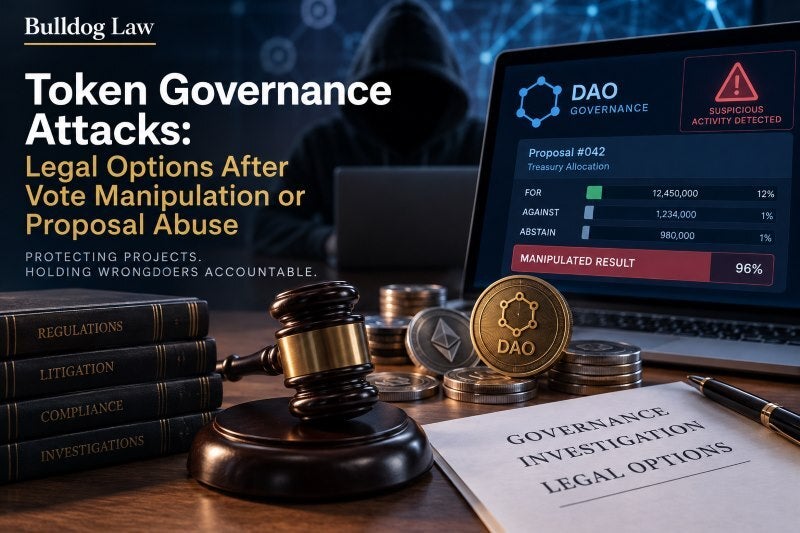
Token Governance Attacks can allow a person or coordinated group to influence a DAO or blockchain protocol long enough to pass a proposal, redirect treasury assets, change smart contract parameters, weaken security controls, or benefit favored wallets. But a controversial governance vote is not automatically illegal. The legal question is whether the conduct violated enforceable governance rules, contractual obligations, fiduciary or partnership duties where they exist, fraud laws, market rules, or other applicable legal requirements.
For projects and token holders facing a disputed vote, the first step is usually understanding the organization's structure and the rights actually attached to governance tokens. Those issues frequently overlap with DAO disputes involving governance votes and treasury control.
Quick answer
Legal options after a manipulated governance vote may include challenging the validity of the proposal, seeking emergency injunctive relief, pursuing breach-of-contract or fraud claims, tracing transferred assets, or asserting claims against participants who exceeded their authority. The available remedy depends on how voting power was acquired, the DAO's legal structure, what the governance documents require, and whether the disputed proposal has already been executed.
What Are Token Governance Attacks?
Blockchain governance systems allow token holders to propose and vote on changes affecting a protocol. Depending on the system, voters may control treasury spending, fee structures, upgrades, collateral rules, token emissions, administrators, or other critical decisions.
A governance attack occurs when someone allegedly exploits that process to obtain an outcome that would not have occurred under the intended rules or expectations of the system.
Examples may include:
- Borrowing or temporarily acquiring large amounts of governance tokens to dominate a vote.
- Splitting voting power among multiple wallets to manipulate identity-based limits.
- Submitting a proposal whose code performs something different from its description.
- Manipulating quorum or voting deadlines.
- Using delegated votes without proper authority.
- Coordinating undisclosed payments for votes.
- Passing a proposal that sends treasury assets to insiders.
- Using administrator keys to override the result of a legitimate vote.
Projects designing voting systems should clearly define what governance tokens actually permit. The distinction between voting power and enforceable legal rights is discussed further in token governance rights and compliance strategies.
When Vote Manipulation Becomes a Legal Dispute
There is no single cause of action called a governance attack. A claimant generally must connect the conduct to an existing legal right or obligation.
A legal dispute may become stronger when there is evidence that someone:
- Violated written governance or contractual rules.
- Misrepresented what a proposal would accomplish.
- Concealed a financial conflict of interest.
- Used unauthorized credentials or administrator access.
- Diverted treasury assets for personal benefit.
- Manipulated a relevant market to obtain governance power.
Creating multiple wallets is not automatically unlawful. However, when a system attempts to limit participation by identity, coordinated wallet creation may raise questions similar to Sybil attacks in cryptocurrency networks.
Can a Manipulated DAO Vote Be Reversed?
Sometimes, but blockchain execution can make the practical problem difficult. A governance vote may authorize a transaction that executes automatically once a timelock expires. If assets have already moved to outside wallets, simply declaring the proposal invalid may not technically restore them.
Projects may have emergency councils, guardian contracts, pause functions, multisig requirements, or other mechanisms capable of delaying execution. Whether those mechanisms can legally be used depends on the governing documents and circumstances.
When smart contract execution conflicts with what participants contend was legally authorized, the dispute can resemble other smart contract platform disputes in California.
Emergency Injunctions and Asset Preservation
If a disputed proposal is about to transfer substantial assets, a claimant may consider seeking temporary or preliminary injunctive relief. Courts do not issue such orders automatically. The applicable standards generally require a showing supporting emergency intervention, and jurisdiction over the defendants or property must exist.
Timing matters. A timelock of several days may provide an opportunity to investigate before execution, while an immediately executable proposal may leave fewer options.
If the incident resulted from a coding weakness that previously underwent a professional review, the dispute may also raise questions about liability after a smart contract security audit.
Token Governance Attacks and Market Manipulation
Some attacks depend on acquiring temporary voting power through market activity. For example, a participant might borrow tokens, influence the vote, execute a profitable proposal, and then unwind the position.
That sequence is not automatically unlawful merely because it exploited an economic design weakness. Whether manipulation laws apply depends on the asset, market, conduct, intent, deception, and statutory requirements.
If the conduct includes deceptive trading or manipulation of a commodity market, federal commodities law may become relevant. Projects confronting this issue should distinguish ordinary trading activity from conduct addressed by cryptocurrency market-manipulation rules under the Commodity Exchange Act.
Can DAO Members or Token Holders Be Personally Liable?
Potentially, but participation in token governance does not create automatic personal liability in every DAO.
The answer may depend on whether the DAO has a formal entity, how participants share control and economic benefits, where the organization operates, and what role a particular defendant played.
California litigation involving the bZx DAO has shown that governance rights and profit-sharing allegations can support arguments that a DAO functions as a general partnership. Separately, a federal court in California held that Ooki DAO could be sued and held liable as a person under the Commodity Exchange Act.
Those decisions are highly fact-specific and should not be interpreted to mean that every person who owns or votes a governance token is automatically liable for everything a protocol does.
What if an Insider Controls the Admin Keys?
Some protocols market themselves as decentralized while founders, developers, foundations, or multisig signers retain substantial emergency powers.
If an administrator overrides governance, changes voting parameters immediately before a proposal, blocks an approved vote, or transfers treasury assets despite the voting result, actual control can become more important than the project's public description.
Control over administrator credentials may create issues similar to private-key disputes involving founders and project insiders.
Could Securities Laws Apply?
Possibly, but governance tokens should not automatically be described as securities. Current federal guidance emphasizes that the legal analysis can depend on both the crypto asset and the transaction in which it is offered or sold.
If a governance token is offered as part of an investment arrangement subject to federal securities laws, materially false statements, undisclosed conflicts, or manipulative activity may create additional regulatory concerns.
The appropriate analysis may therefore require reviewing digital-asset securities issues and investment-contract principles.
What Evidence Should Be Preserved?
Governance disputes can be unusually evidence-rich because many actions occur on-chain. Parties should consider preserving:
- Governance proposal text and embedded code.
- Wallet addresses associated with voting.
- Voting snapshots and delegation records.
- Token transfers before and after the vote.
- Flash-loan or borrowing transactions.
- Treasury transfers.
- Multisig and administrator transactions.
- Discord, Telegram, forum, and email discussions.
- Governance documentation in effect at the time.
- Public statements describing the proposal.
Blockchain records can establish timing and asset movement, but additional evidence may be necessary to connect wallets with particular people and explain why transactions occurred. Those evidentiary issues are discussed in how blockchain evidence is used in court.
What if an Insider Reports the Manipulation?
Employees, developers, delegates, treasury managers, and service providers may sometimes possess evidence that is unavailable publicly, including private discussions about vote coordination, undisclosed payments, or intentionally misleading proposal descriptions.
Depending on the alleged violation, reporting options may exist through regulators or other channels. Individuals considering disclosure should evaluate confidentiality obligations and legal protections before releasing sensitive material. These issues may overlap with crypto whistleblower claims involving fraud and market manipulation.
Where Token Governance Attacks May Be Litigated
A dispute may proceed in California Superior Court, federal court, arbitration, or another forum depending on the parties, claims, governing agreements, and location of relevant conduct.
DAOs create particular jurisdiction problems because voters, developers, servers, foundations, and assets can be distributed globally. A claimant may therefore need to determine where defendants can be sued and where digital assets can potentially be reached. Those questions are central to jurisdictional challenges in digital-asset disputes.
Could a Governance Attack Create Criminal Exposure?
Possibly, but exploiting a poorly designed voting system is not automatically a crime. Criminal exposure depends on the conduct and applicable statute.
Unauthorized computer access, fraud, theft, deceptive market manipulation, or intentional misappropriation may lead to criminal investigations when their statutory elements are present. A technical exploit should therefore be analyzed separately from the legal characterization of the conduct.
Similar distinctions arise when examining criminal liability following attacks on blockchain networks.
Token Governance Attacks lawyers in California
Token Governance Attacks can involve far more than determining which wallet cast the most votes. A meaningful legal analysis may require examining how voting power was acquired, whether governance procedures were followed, who controlled implementation, where treasury assets moved, and whether participants made misleading statements or exceeded their authority.
Bulldog Law helps clients evaluate cryptocurrency and blockchain disputes involving DAOs, governance tokens, proposal abuse, smart contracts, treasury control, and digital-asset losses. Early review can help preserve evidence and determine whether emergency relief, litigation, arbitration, negotiation, or another strategy may be appropriate. No particular recovery or outcome can be guaranteed.