
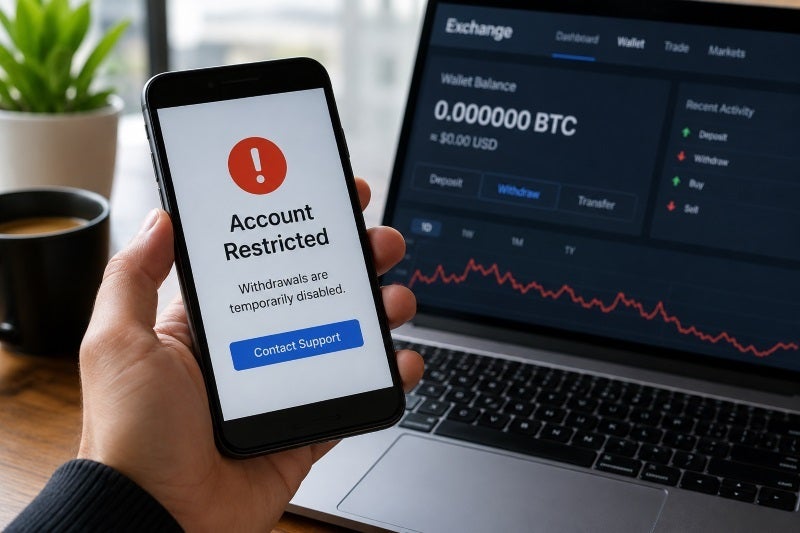
A crypto exchange account freeze can happen suddenly. One day, withdrawals work. The next day, the platform says your account is under review, your assets are temporarily restricted, or support cannot provide details. For California customers, the legal answer depends on the exchange's terms of service, the reason for the freeze, the type of assets involved, and whether law enforcement, regulators, sanctions screening, fraud controls, or bankruptcy concerns are in the background.
A freeze does not always mean the exchange stole the funds, and it does not always mean the customer did anything wrong. But it is also not something to ignore. A locked cryptocurrency account can affect trading deadlines, tax reporting, business operations, criminal exposure, and the ability to recover stolen or disputed assets.
Why a crypto exchange account freeze may happen without notice
Many crypto exchanges reserve broad rights in their user agreements to suspend accounts, delay withdrawals, reverse certain transactions, or restrict access during a compliance, security, or legal review. Whether those rights are enforceable depends on the wording of the agreement, how the user accepted it, the exchange's conduct, and the applicable law.
Common reasons for a frozen crypto account include:
- Incomplete or inconsistent identity verification information
- A flagged deposit, withdrawal, wallet address, IP address, or device
- Suspicion that funds are connected to fraud, theft, sanctions, hacks, ransomware, or money laundering
- A dispute involving unauthorized access or account takeover
- A subpoena, warrant, preservation request, restraining order, or forfeiture issue
- Possible market manipulation, insider trading, pump and dump activity, or suspicious token promotion
- Technical problems, chain congestion, smart contract issues, or internal risk controls
- Exchange insolvency, withdrawal pauses, bankruptcy planning, or liquidity problems
Exchanges often give little detail at first. In some situations, advance notice could help a fraudster move assets, destroy evidence, or evade a legal hold. In other situations, poor customer service or vague automation may leave a legitimate customer without a meaningful explanation.
Is it legal for an exchange to freeze withdrawals?
It can be legal for a crypto exchange to freeze withdrawals temporarily, especially when the exchange is responding to fraud alerts, account security issues, sanctions screening, law enforcement process, or anti-money laundering concerns. That does not mean every freeze is lawful, reasonable, or properly handled.
The key questions usually include:
- What does the user agreement say about account suspension, withdrawal delays, arbitration, venue, and limitation of liability?
- Did the exchange follow its own procedures?
- Did the customer receive any meaningful notice or opportunity to provide documents?
- Is the exchange holding fiat currency, crypto, staking rewards, airdropped tokens, or disputed proceeds?
- Is the account freeze tied to a government request, private complaint, blockchain analytics flag, or internal compliance review?
- Has the exchange allowed trading while blocking withdrawals, or has it restricted the entire account?
If the platform is regulated in California or serves California residents, state consumer protection rules may matter. California's Digital Financial Assets Law is also becoming important for many companies that engage in covered digital asset business activity with California residents. The exact rules depend on timing, licensing status, exemptions, and the type of service offered.
When a freeze is connected to fraud, hacks, or wallet activity
An exchange may freeze an account after receiving notice that assets are stolen, disputed, or traceable to a compromised wallet. This can happen when a victim reports a hack, when blockchain analytics flags a wallet, or when funds move through multiple accounts after a scam.
Customers should be careful about how they explain the transaction history. If your account received funds from a third party, a decentralized exchange, a bridge, a mixer, a gambling platform, or a high-risk wallet, the exchange may ask for source-of-funds documentation. A rushed or inaccurate response can make the problem worse.
Account freezes sometimes follow wallet drainers or malicious approvals. A user who signed a bad smart contract may need to document the wallet history, revoke approvals, preserve transaction hashes, and separate the exchange dispute from the underlying malicious smart contract attack.
A freeze can also occur after a mistaken transfer. When someone sent crypto to the wrong wallet address, recovery may depend on whether the receiving wallet belongs to an exchange, whether the asset is recoverable on that chain, and whether the platform is willing or legally required to assist.
Be skeptical of anyone who claims they can quickly unfreeze an account through special access. Victims of frozen account disputes are common targets for a secondary crypto recovery scam, especially when the victim is desperate to regain access to high-value assets.
When law enforcement or regulators are involved
A private exchange freeze is different from a government seizure. A platform may restrict an account because its compliance team is reviewing a transaction. A government seizure, by contrast, may involve a warrant, forfeiture process, restraining order, subpoena, or other legal tool.
If police or federal agents are involved, the customer needs to know whether the exchange is merely preserving assets or whether the government has actually seized them. Issues involving whether police or federal agents can seize cryptocurrency raise separate questions about probable cause, blockchain tracing, warrants, custody of private keys, and forfeiture deadlines.
Federal matters may involve agencies such as the Department of Justice, IRS Criminal Investigation, Homeland Security Investigations, the FBI, the SEC, the CFTC, FinCEN, or OFAC. These institutions should be treated neutrally and seriously. A customer should not assume the exchange is bluffing, but should also not assume that every support message reflects a valid seizure order.
When the government seizes Bitcoin in a criminal case, the next steps may involve notice, claims, motions, plea negotiations, forfeiture litigation, or third-party ownership disputes. Missing a deadline can affect recovery rights.
Red flags that can create criminal exposure
A frozen exchange account can become more serious when the transaction history suggests fraud, sanctions issues, false statements, stolen funds, or laundering. Customers should avoid guessing, deleting records, moving related funds, or submitting altered screenshots.
Possible red flags include:
- Large deposits followed by rapid withdrawals
- Transfers through mixers, tumblers, privacy tools, or high-risk bridges
- Incoming funds from ransomware, darknet markets, phishing wallets, or known scam addresses
- Multiple new accounts using shared devices, IP addresses, or payment methods
- False KYC information or inconsistent source-of-funds explanations
- Trading patterns tied to insider announcements, token launches, or promotional groups
A compliance freeze can overlap with crypto money laundering red flags, especially when the exchange believes the account was used to conceal the source, owner, or path of funds. In fraud cases, prosecutors may focus on messages, investment claims, wallet flows, and exchange records to build a federal crypto wire fraud case.
Freezes tied to token trading, promotions, and market activity
Not every account freeze involves stolen funds. Some freezes arise from trading behavior, token promotions, suspicious liquidity events, or regulatory concerns. Exchanges may restrict accounts involved in coordinated trading, suspicious token listings, wash trading, misleading promotions, or unusually timed purchases before major announcements.
For example, a customer whose account is connected to a crypto pump and dump investigation may face both platform restrictions and possible regulatory scrutiny. A founder, promoter, or early investor may also face civil claims if a failed project leads to claims against crypto founders and promoters.
Meme coin activity can create additional risk because online hype, influencer posts, liquidity controls, wallet concentration, and trading timing may all be reviewed after losses occur. An exchange freeze may be only one part of broader meme coin market manipulation issues.
Airdrops and insider information can also trigger questions. Exchanges may review accounts that receive unusual allocations, trade before announcements, or move tokens soon after distribution. The legal analysis may involve token airdrop compliance risks or whether confidential token information legal risk affected trading decisions.
How to respond to a crypto exchange account freeze notice
A customer's first response matters. Exchanges often create internal records of every support ticket, email, chat message, uploaded document, and attempted login. Those records may later be used in arbitration, civil litigation, regulatory review, or a criminal investigation.
Practical steps include:
- Save the freeze notice, support tickets, emails, screenshots, and account activity logs.
- Export transaction histories, wallet addresses, order history, deposits, withdrawals, and tax records if the platform allows access.
- Identify every wallet and exchange account involved in the disputed transaction path.
- Preserve communications with counterparties, investors, customers, promoters, or recovery companies.
- Do not submit false documents, altered screenshots, fake invoices, or misleading source-of-funds statements.
- Do not threaten support staff, admit facts you do not understand, or make assumptions about criminal intent.
- Review the user agreement for arbitration, notice requirements, deadlines, governing law, and class action waiver language.
- Get legal advice before responding if the freeze mentions law enforcement, subpoenas, sanctions, money laundering, fraud, or forfeiture.
If the exchange only asks for routine KYC information, the matter may be resolved through documentation. If the exchange asks for source of funds, business records, wallet explanations, or details about third-party transactions, the response should be accurate, complete, and carefully framed.
Where frozen crypto account disputes are handled in California
Frozen crypto account disputes can be handled in several places depending on the facts. Many exchange user agreements require arbitration rather than court. Some disputes may proceed in California state court, federal court, bankruptcy court, or through a regulatory complaint process.
For civil lawsuits in Los Angeles County, cases may be filed in the Superior Court of California, County of Los Angeles, which includes Stanley Mosk Courthouse at 111 North Hill Street, Los Angeles, CA 90012. Civil claims may involve breach of contract, conversion, negligence, fraud, unfair business practices, or requests for injunctive relief, depending on the facts and the contract.
Federal cases in Southern California may proceed in the United States District Court for the Central District of California, including the First Street courthouse at 350 West 1st Street, Los Angeles, CA 90012. Northern California matters may proceed in the United States District Court for the Northern District of California, including the San Francisco courthouse at 450 Golden Gate Avenue, San Francisco, CA 94102. Federal court may be involved when the dispute includes federal securities issues, federal law enforcement seizure, diversity jurisdiction, bankruptcy, or federal statutory claims.
Regulatory complaints may also be submitted to agencies such as the California Department of Financial Protection and Innovation when the company or conduct falls within the agency's authority. A complaint is not the same as a lawsuit, and it does not guarantee recovery, but it may create a record and prompt communication with the platform.
What if the exchange freezes everyone's withdrawals?
A platform-wide withdrawal freeze is different from a single-account compliance hold. If an exchange stops withdrawals for many customers, the issue may involve liquidity, insolvency, cybersecurity, regulatory intervention, or bankruptcy risk. In that situation, customers should preserve balances, account statements, terms of service, staking records, rewards records, loan agreements, and communications from the platform.
When a platform enters bankruptcy, customers may have to file claims, respond to notices, and determine whether they are treated as custodial customers, unsecured creditors, contract counterparties, or claimants with disputed ownership rights. A freeze connected to crypto exchange bankruptcy can become a claims process rather than a simple support dispute.
Crypto exchange account freeze lawyers in California
A crypto exchange account freeze can be a customer service issue, a contract dispute, a fraud matter, a regulatory concern, or the first sign of a criminal investigation. The right strategy depends on why the account is frozen, what the exchange has said, where the assets came from, and whether government action is involved.
Bulldog Law helps clients evaluate frozen crypto accounts, exchange disputes, digital asset investigations, fraud claims, and seizure issues in California. The firm can review account records, communications, wallet activity, and legal notices to help determine whether the next step should be a platform response, arbitration demand, civil claim, regulatory complaint, or defense strategy.