
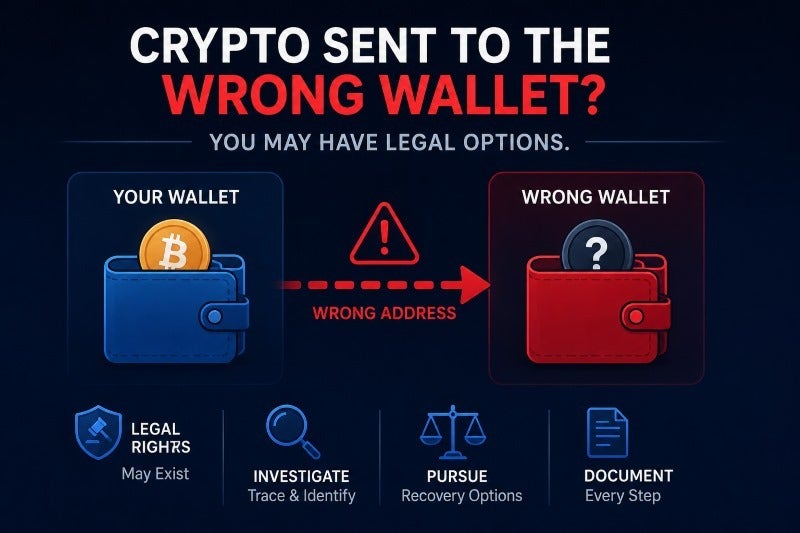
Lost Crypto After Sending to the Wrong Wallet Address can feel unrecoverable because blockchain transactions are usually difficult or impossible to reverse once confirmed. But the legal answer depends on what happened, who controls the receiving wallet, whether an exchange or platform is involved, and whether the transfer was a true mistake, a scam, a hack, or part of a larger fraud scheme.
A wrong-wallet transfer is not always the same as stolen crypto. Sometimes the assets were sent to a valid wallet controlled by a person or exchange. Sometimes they were sent on the wrong network. Sometimes they went to a burn address or incompatible address. Sometimes the “mistake” was caused by malware, address poisoning, a fake exchange, a wallet drainer, or social engineering. Each scenario creates different legal and practical options.
Lost Crypto After Sending to the Wrong Wallet Address: first questions to answer
The first step is to classify the loss. A legal strategy cannot be built from the phrase “wrong wallet” alone. The facts determine whether the issue is a recoverable mistake, a customer-support problem, a civil claim, a criminal fraud report, or a tax documentation issue.
Important questions include:
- Was the destination wallet a valid address on the correct blockchain?
- Was the transfer sent on the wrong network, such as sending a token to an exchange on an unsupported chain?
- Is the receiving address controlled by a centralized exchange, hosted wallet, or identifiable person?
- Did malware, clipboard substitution, address poisoning, phishing, or a malicious smart contract change the address?
- Was the transfer part of a scam, fake investment platform, romance fraud, or impersonation scheme?
- Did the recipient move, swap, bridge, mix, or cash out the assets after receiving them?
- Are there screenshots, transaction hashes, chats, emails, wallet approvals, or exchange tickets showing what happened?
A simple typo may create a very different case than a transfer caused by deception. If the transaction was induced by a fraudulent investment scheme, the legal analysis may resemble pig butchering crypto scam recovery strategies. If the transfer went to a fake platform posing as an exchange, the case may involve the same evidence issues discussed in fake crypto exchange fraud claims.
When a mistaken crypto transfer may be recoverable
Some wrong-address transfers have practical recovery options. The best-case scenario is usually a transfer to a wallet controlled by a reputable centralized exchange or hosted wallet provider. If the receiving address can be tied to an account, the exchange may be able to identify the customer internally, preserve records, restrict movement, or process a recovery request under its own policies.
That does not mean the exchange must automatically return funds. Exchanges often require proof of ownership, a transaction hash, a clear explanation, identification, account records, and sometimes a law enforcement request, subpoena, or court order. Some networks and token standards also make recovery technically difficult or commercially impractical.
A mistaken transfer to an identifiable individual may support civil claims if the recipient knows the assets were sent by mistake and refuses to return them. In California, possible theories may include conversion, unjust enrichment, restitution, constructive trust, or receiving stolen property theories if the facts show theft or fraud. These claims are fact-specific. A victim must still prove ownership, the transfer path, the recipient's control, notice, refusal, damages, and the legal basis for relief.
If assets were obtained by theft, fraud, extortion, or knowing retention of stolen property, California Penal Code section 496 may be relevant in some civil cases. That statute can allow an injured person to seek treble damages, costs, and reasonable attorney's fees when the legal requirements are met. It should not be treated as automatic. Courts look closely at whether the property was actually stolen or obtained in a way covered by the statute.
When the blockchain loss may be practically unrecoverable
Some wrong-wallet transfers may be legally frustrating because there is no practical target. If the crypto was sent to a burn address, an address with no known private key, or an incompatible address that no person or platform can control, there may be no one to sue and no account to freeze. A court order cannot force an unknown private key to exist.
Other cases are technically possible but practically difficult. A recipient may be anonymous, outside the United States, using privacy tools, moving assets through bridges, mixers, cross-chain swaps, or decentralized exchanges. These steps do not make recovery impossible in every case, but they can increase cost, delay, and uncertainty.
Mixing services and privacy tools may also raise law enforcement and regulatory issues. Federal scrutiny of crypto mixing has increased, and Bulldog Law's coverage of federal prosecution of cryptocurrency mixing services explains why tracing funds through privacy infrastructure can involve more than ordinary customer support.
Lost Crypto After Sending to the Wrong Wallet Address because of fraud or hacking
If the wrong address appeared because of malware, a hacked account, clipboard manipulation, address poisoning, social engineering, or a malicious signature, the case should be treated as a crypto theft or fraud matter rather than a simple mistake.
Address poisoning occurs when a scammer sends tiny transactions from an address that looks similar to one the victim has used before. The victim later copies the wrong address from transaction history and sends funds to the scammer. Clipboard malware may replace a copied address with the attacker's address. A malicious approval may allow a smart contract to move assets without the victim realizing the scope of the authorization.
These cases often require fast evidence preservation, wallet tracing, exchange notices, and security review. Bulldog Law's discussion of legal options for stolen cryptocurrency victims explains why transaction analysis and legal process should be coordinated early. If the transfer followed a malicious approval or fake decentralized application, legal rights after a crypto wallet drainer attack may also be relevant.
Some losses begin with account takeover. A SIM swap can allow criminals to access email, exchange accounts, password resets, or two-factor authentication before moving funds. Bulldog Law's guide to liability after SIM swap crypto theft addresses why telecom records, authentication logs, and exchange security practices may matter.
What to do immediately after a wrong-wallet crypto transfer
A victim should act quickly but carefully. Panic can lead to a second loss, especially when fake recovery agents appear in direct messages or search results. The goal is to preserve evidence, stop further exposure, and identify whether a recoverable person or platform is involved.
- Copy the transaction hash, wallet addresses, blockchain network, token name, amount, date, and time.
- Take screenshots of the wallet screen, exchange withdrawal page, approval request, QR code, website, chat, or email involved.
- Open a support ticket with the exchange or wallet provider if a platform address is involved.
- Ask the platform to preserve account records and restrict movement if the assets are traceable to a hosted account.
- Revoke suspicious token approvals and move remaining assets to a secure wallet if malware or a drainer may be involved.
- Do not send more crypto to anyone claiming they need a fee, tax, unlock code, validator charge, or recovery deposit.
- File reports where appropriate, including with law enforcement and relevant consumer protection agencies.
The FBI's Internet Crime Complaint Center requests transaction details in crypto complaints, including addresses, amount and type of cryptocurrency, date and time, and transaction hash. The California Department of Financial Protection and Innovation also maintains a Crypto Scam Tracker based on consumer complaints, which can help victims compare patterns and identify fraud warnings.
Legal process and recovery options in California
For California victims, a wrong-wallet case may involve private investigation, exchange escalation, civil litigation, or law enforcement reporting. Bulldog Law is not affiliated with any court, prosecutor, law enforcement agency, exchange, regulator, or government office, and no legal strategy can guarantee recovery.
When a receiving address appears connected to a centralized exchange, a lawyer may evaluate whether to send a preservation request, pursue subpoena options, seek a court order, or coordinate with law enforcement. If the recipient is known, a demand letter or civil lawsuit may be appropriate. If the recipient is unknown, a lawsuit against Doe defendants may sometimes be used to seek discovery from intermediaries, although courts require a proper basis for that relief.
Possible civil theories may include:
- Conversion, where someone wrongfully exercises control over property belonging to another person
- Unjust enrichment or restitution, where a recipient benefits from a mistaken transfer they are not entitled to keep
- Fraud, where deception caused the victim to send the assets
- California computer-access claims, where unauthorized access or misuse of computer data caused loss
- Receiving stolen property claims, where the facts support theft-based remedies
- Constructive trust or equitable relief, where traceable assets should be preserved for the rightful owner
The right approach depends on the amount at stake, whether the assets are still traceable, where the defendant or exchange is located, what records exist, and whether the expected recovery justifies the cost of legal action.
Tax issues after sending crypto to the wrong address
A wrong-wallet transfer can create tax questions even when no recovery occurs. The IRS treats digital assets as property for federal tax purposes. Taxpayers may need to report digital asset transactions whether they result in gain or loss, and they should keep records of purchases, transfers, sales, exchanges, basis, fair market value, and disposition details.
Tax treatment is fact-specific. A mistaken transfer may not be treated the same way as a sale, exchange, abandonment, theft, or casualty event. Victims should not assume that lost crypto is automatically deductible, automatically a capital loss, or irrelevant because the wallet balance disappeared. The answer may depend on ownership, basis, investment purpose, whether there was a completed disposition, whether the loss was theft-related, and whether recovery remains possible.
Good tax records should include the transaction hash, date, asset type, amount, wallet addresses, cost basis, screenshots, exchange statements, and any recovery or law enforcement reports. Bulldog Law's resource on reporting cryptocurrency losses on a tax return explains why documentation and characterization of the loss are critical.
Investors should also watch broker reporting. Form 1099-DA is used for digital asset broker transaction reporting, and mismatches between exchange forms and wallet activity can draw attention. Bulldog Law's explanation of Form 1099-DA crypto tax reporting rules and crypto taxes in 2026 for investors addresses why taxpayers should reconcile third-party forms with their own blockchain records.
Wrong-address transfers can be especially complicated when the lost assets came from staking, swaps, liquidity pools, or lending positions. Bulldog Law's discussions of tax rules for staking rewards and DeFi tax reporting for swaps, yield farming, liquidity pools, and lending explain why the source and history of the asset may affect reporting. If the IRS later sends a notice, crypto tax audit defense after IRS contact may become part of the response strategy.
Avoiding recovery scams after a wrong-wallet transfer
Wrong-wallet victims are often targeted by secondary scammers. These scammers may claim they can reverse blockchain transactions, hack the recipient, bribe an exchange employee, generate a private key, or recover funds through a secret validator process. Many demand an upfront crypto payment and disappear.
Warning signs include guaranteed recovery, pressure to act immediately, requests for seed phrases, instructions to connect a wallet to a recovery site, fake court documents, fake law enforcement letters, and claims that more crypto must be sent to release the original funds. Bulldog Law's crypto recovery scam warning for victims explains how secondary fraud often targets people right after a loss.
Lost Crypto After Sending to the Wrong Wallet Address lawyers in California
Bulldog Law helps California crypto victims evaluate legal options after wrong-wallet transfers, mistaken withdrawals, exchange-address errors, wallet drainers, account takeovers, address poisoning, fake exchanges, and other digital asset losses. The firm focuses on evidence preservation, blockchain transaction review, exchange notices, law enforcement reporting, civil recovery options, and tax-sensitive documentation.
Not every wrong-wallet transfer can be recovered, but early review can identify whether there is a reachable recipient, a platform account, a fraud pattern, or a tax issue that should be handled before records disappear. Call Bulldog Law to discuss legal options after a mistaken or fraudulent crypto transfer.