
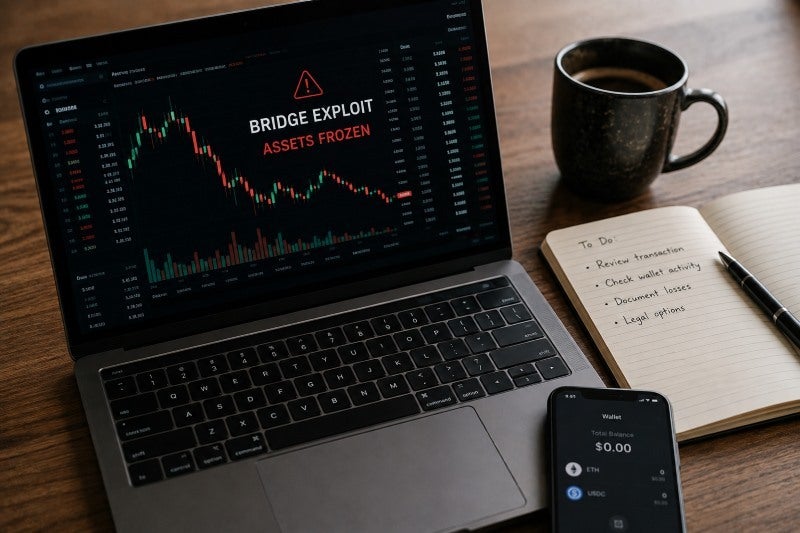
Bridge Exploit Claims can arise when users move crypto across blockchains and later discover that bridged assets were stolen, frozen, depegged, locked in a contract, or no longer redeemable. For California users, token projects, DAOs, investors, founders, and liquidity providers, the legal question is usually not only how the exploit happened. The harder questions are who controlled the bridge, what risks were disclosed, whether security warnings were ignored, and whether users have practical recovery options.
A bridge loss may involve smart contract flaws, validator compromise, admin key misuse, oracle problems, liquidity shortages, wrapped asset failures, exchange restrictions, or emergency freezes. Legal rights depend on the bridge terms, protocol design, custody structure, user disclosures, governance records, insurance or recovery plans, and evidence showing what happened before and after the incident.
Why Bridge Exploit Claims happen
Bridge Exploit Claims often begin because cross-chain systems require trust in more than one layer. A user may deposit ETH, USDC, NFTs, or another token on one chain and receive a wrapped or synthetic version on another chain. If the bridge contract, validator set, relayer, oracle, multisig, or custody wallet fails, the user may be left holding an asset that cannot be redeemed at full value.
Common bridge disputes include:
- A bridge is hacked and user deposits are drained.
- Wrapped assets lose value because backing assets are missing or frozen.
- A validator or relayer failure causes transfers to be delayed or rejected.
- A bridge pauses withdrawals after a suspected exploit.
- A protocol creates a recovery pool but excludes some users.
- A DAO vote changes reimbursement terms after users suffer losses.
- Users claim the project overstated bridge security, audits, or insurance coverage.
Many bridge incidents also involve security-review questions. If the bridge was marketed as audited or secure before the exploit, smart contract audit dispute issues may help determine whether the vulnerability was within the audit scope, disclosed to the project, or introduced after the review.
How cross-chain bridge losses affect users
A bridge exploit can harm users in several ways. Some users lose the original deposited asset. Others hold a wrapped token that becomes illiquid or trades below the value of the asset it was supposed to represent. Some users cannot withdraw because the bridge pauses activity, freezes wallets, or waits for governance approval before reopening.
The asset type matters. A wrapped stablecoin may create different damages than a governance token, NFT, LP token, staking derivative, or bridged collateral. If a stablecoin or wrapped dollar-like token loses its peg after a bridge failure, stablecoin depeg loss claims may overlap with bridge liability, disclosure, and redemption issues.
NFTs can create separate complications. A bridged NFT may be frozen on one chain while marketplace access, metadata, royalties, or ownership records remain disputed on another chain. If a marketplace suspends trading after a bridge incident, NFT marketplace suspension options may become part of the user's recovery strategy.
Bridge Exploit Claims and protocol disclaimers
Bridge Exploit Claims often turn on protocol terms and disclaimers. Many bridge interfaces warn that users assume smart contract risk, bridge risk, validator risk, liquidity risk, and market risk. Those disclaimers can matter, but they do not always end the analysis.
A user may still have arguments if the project made specific statements about security, audits, insurance, validator independence, reserve backing, or reimbursement. A disclaimer may be less persuasive if the project knew about a vulnerability, ignored internal warnings, concealed a validator compromise, or continued marketing the bridge as safe after serious issues were known.
Important questions include:
- What terms did the user accept before bridging assets?
- Did the project clearly disclose smart contract and validator risks?
- Were reserves, backing assets, or custody arrangements described accurately?
- Did the project promise reimbursement, insurance, or a recovery pool?
- Were security reports, audits, bug disclosures, or warnings shared with users?
- Did the exploit involve code that was changed after public security statements?
If the bridge was part of a broader token launch or investment campaign, users may also evaluate whether they relied on fundraising materials, launch promises, or tokenomics statements. token sale refund demand issues may overlap when bridge failure affects launch timing, investor delivery, or promised utility.
Validator failures, multisig control, and DAO decisions
Bridge security often depends on validators, signers, relayers, or multisig wallets. If those controls fail, users may ask whether the responsible parties acted reasonably. A validator compromise may raise questions about key management, monitoring, centralization, incident response, and whether the protocol accurately described the level of decentralization.
Some bridges are governed by DAOs or foundations. After an exploit, tokenholders may vote on reimbursement, treasury use, contract upgrades, or whether to relaunch the bridge. DAO governance and treasury control disputes may affect whether a recovery vote was valid, whether insiders influenced the outcome, and whether members or contributors face exposure.
Multisig signer disputes can also delay recovery. If required signers refuse to approve emergency transactions, freeze funds, or release recovery assets, multisig wallet signer deadlock may become a central issue in determining who had authority to act and whether delay worsened the loss.
Recovery pools, denied claims, and user eligibility
After a bridge exploit, projects may create a claims process, reimbursement program, recovery pool, or replacement token plan. These programs can help users, but they can also create new disputes. A user may be denied recovery because the project says the wallet was ineligible, the claim was late, the assets were moved after the exploit, or the user failed KYC review.
Eligibility disputes can look similar to airdrop disputes. Wallet clustering, bot accusations, and multiple-wallet exclusions may be used to prevent fraudulent claims, but those tools can also exclude legitimate users. airdrop farming and Sybil accusation disputes may be relevant when a bridge recovery process relies on wallet clustering or automated risk scoring to deny compensation.
If the recovery process requires identity verification, the project should explain what information is needed and how it will be used. KYC and AML controls for crypto startups may affect whether a bridge project can identify claimants, screen wallets, and avoid paying recovery funds to sanctioned or fraudulent actors.
Collateral, payroll, and token compensation problems after a bridge failure
Bridge failures can trigger downstream losses. If bridged assets were used as collateral, an exploit or freeze may cause forced sales, margin calls, or liquidation. crypto loan liquidation disputes may arise when borrowers argue that collateral was sold because the bridge, oracle, or platform failed rather than because the borrower breached the loan terms.
Projects may also use bridged assets for payroll, contractor payments, grants, or contributor rewards. If the bridge freezes funds, workers may not be paid on time. crypto payroll compliance risks can become important when a California business relies on digital assets to pay employees or contractors but loses access to bridged funds.
Founder and contributor token rights can also be affected. If a bridge incident drains the treasury or delays token delivery, token vesting disputes over unpaid grants may become part of the broader dispute over who should bear the loss.
Exchange delistings and trading restrictions after a bridge exploit
Bridge incidents can affect exchange support. Exchanges may suspend deposits, halt withdrawals, delist bridged versions of tokens, or require a migration to a new contract. Those restrictions can cause liquidity loss even for users who were not directly hacked.
If a token or wrapped asset is removed from a platform after a bridge failure, exchange delisting legal risks may affect notice obligations, investor claims, liquidity damages, and project disclosure duties. Users should preserve exchange notices, account alerts, withdrawal attempts, trading records, and communications showing whether they had a practical opportunity to exit.
Tax records after bridged assets are lost or frozen
Bridge losses can create complicated tax records. A user may have sent assets to a bridge, received wrapped assets, lost redemption rights, received partial reimbursement, or later sold replacement tokens. The tax treatment may depend on whether the user sold, exchanged, abandoned, lost, or still holds the asset.
Users should preserve transaction hashes, bridge receipts, claim portal records, exchange statements, valuation records, and reimbursement communications. If third-party records do not match what the user reports, IRS crypto CP2000 mismatch issues may arise later.
Tax records should also identify whether the loss involved ordinary market movement, theft, contract failure, frozen assets, depegged wrapped assets, or a later recovery payment. Those distinctions can matter in tax reporting, insurance claims, and civil damages analysis.
Where bridge exploit claims may be handled in California
Bridge exploit claims may be handled through protocol claims programs, private negotiation, arbitration, California Superior Court, federal court, bankruptcy proceedings, insurance claims, or regulatory complaints depending on the facts. Claims may involve breach of contract, fraud, negligent misrepresentation, negligence, unfair competition, breach of fiduciary duty, conversion, accounting, or securities and commodities issues.
Federal court may be involved if the dispute includes federal securities claims, commodities claims, wire fraud, money laundering, sanctions issues, diversity jurisdiction, bankruptcy, or foreign defendants. Some bridge terms may require arbitration, identify a forum outside California, or limit available remedies. Courts, agencies, and arbitration providers are neutral institutions and are not affiliated with Bulldog Law.
Emergency relief may be considered if remaining assets are at risk, wallets can be identified, exchange accounts may preserve funds, or a recovery pool is about to distribute assets unfairly. Possible remedies may include a temporary restraining order, preliminary injunction, preservation order, expedited discovery, accounting, or receiver depending on the evidence and jurisdiction.
Evidence to preserve after a bridge exploit
Bridge exploit cases are evidence-heavy. Users and projects should preserve records before claim portals change, announcements disappear, or wallet activity becomes harder to reconstruct.
- Bridge transaction hashes, deposit records, wrapped asset mint records, and withdrawal attempts.
- Wallet addresses, chain IDs, token contract addresses, bridge interface screenshots, and gas fee records.
- Terms of service, risk disclosures, audit reports, bug bounty notices, and security announcements.
- Discord, Telegram, X, email, support tickets, governance posts, and investor updates.
- Exchange notices, delisting announcements, account freezes, and withdrawal suspension records.
- Recovery pool rules, claim portal submissions, eligibility decisions, and appeal responses.
- Valuation records showing asset value before the exploit, during the freeze, and after any recovery.
The strongest record connects the technical cause of loss to the legal claims. A transaction hash may show the transfer, but the legal dispute usually depends on disclosures, control, authority, reliance, and damages.
Practical steps after cross-chain assets are lost or frozen
After a bridge exploit, users should avoid rushing into fake recovery sites, unofficial claim portals, or public accusations that may complicate the record. Practical steps may include:
- Save bridge records, transaction hashes, wallet screenshots, and claim portal pages.
- Identify whether the assets were stolen, frozen, depegged, delisted, or still redeemable.
- Review bridge terms, disclaimers, audit reports, and reimbursement announcements.
- Preserve exchange notices, withdrawal attempts, and support communications.
- Document any recovery claim, denial, appeal, or KYC request.
- Track tax records and valuation at each major event.
- Evaluate whether emergency relief, claims submission, negotiation, arbitration, or litigation is realistic.
A bridge exploit can involve several overlapping disputes at once. A careful early response may help preserve evidence, identify responsible parties, and reduce the risk that users miss claim deadlines or accept an inadequate recovery process.
Bridge Exploit Claims lawyers in California
Bridge Exploit Claims require legal analysis that connects blockchain tracing, smart contract security, wrapped assets, validator failures, protocol disclaimers, recovery pools, tax records, exchange restrictions, and user damages. The right strategy may differ depending on whether the assets were stolen, frozen, depegged, liquidated, or withheld through a claims process.
Bulldog Law helps California clients evaluate bridge exploit disputes involving cross-chain asset losses, frozen wrapped tokens, recovery pools, DAO votes, multisig controls, smart contract audit issues, exchange delistings, tax records, and user claims. Early legal review may help preserve evidence, assess responsible parties, and identify practical options before assets move or claim deadlines pass.
Comments
There are no comments for this post. Be the first and Add your Comment below.
Leave a Comment