
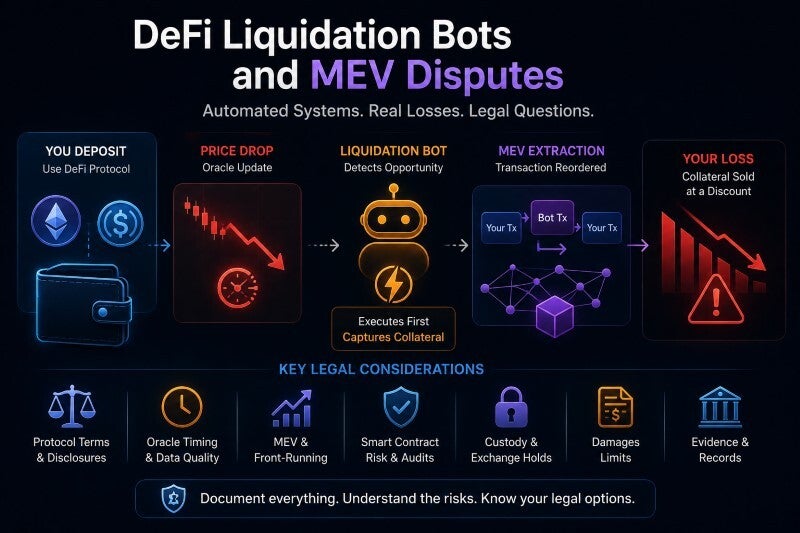
DeFi Liquidation Bots and MEV Disputes can arise when a borrower, trader, liquidity provider, or protocol user loses digital assets because automated systems liquidated collateral, reordered transactions, exploited price movement, or captured value before the user could react. In California, a user may be frustrated by the loss, but legal rights usually depend on the protocol terms, smart contract design, oracle data, disclosures, bot behavior, transaction records, and whether anyone made misleading statements or exercised improper control.
Automated losses are not automatically unlawful. Many DeFi protocols disclose that liquidations, slippage, front-running, oracle changes, and smart contract risks are part of the system. But users may have legal arguments if a protocol, operator, front end, lender, market maker, or insider misrepresented risks, manipulated data, ignored known vulnerabilities, selectively protected favored users, or caused a loss that went beyond the disclosed rules.
Why DeFi Liquidation Bots and MEV Disputes happen
DeFi Liquidation Bots and MEV Disputes happen because decentralized finance relies on automated contracts, price feeds, liquidation thresholds, mempool behavior, validators, searchers, relayers, bridges, and front ends that can interact in unpredictable ways. A user may believe they had enough collateral, only to be liquidated after a rapid oracle update, market move, transaction delay, or bot action.
Common disputes include:
- A borrower is liquidated after an oracle price changes suddenly.
- A user submits a repayment or collateral-add transaction, but a bot liquidates first.
- A transaction is sandwiched, front-run, or re-ordered in a way that worsens execution.
- A protocol pauses withdrawals or blocks access during volatile conditions.
- A liquidation bot captures collateral at a discount after a short-lived price spike.
- Users allege that insiders, validators, or market makers had unfair access to transaction flow.
- A protocol points to terms of service while users claim the system did not work as disclosed.
When collateral is sold after a platform-triggered margin or liquidation event, crypto loan liquidation disputes may overlap with DeFi bot claims because both issues involve notice, price feeds, collateral rights, and whether forced sales followed the applicable terms.
DeFi Liquidation Bots and MEV Disputes under protocol terms
DeFi Liquidation Bots and MEV Disputes usually start with the protocol terms, interface disclosures, smart contract documentation, and risk warnings. A protocol may say that users assume liquidation risk, oracle risk, slippage risk, smart contract risk, validator risk, and MEV risk. Those warnings can matter, but they do not always resolve the dispute.
Important questions include:
- What terms did the user accept before depositing or borrowing?
- Did the protocol clearly explain liquidation thresholds and penalties?
- Were oracle sources, update intervals, and emergency controls disclosed?
- Did the front end differ from the smart contract documentation?
- Were users told that MEV, front-running, or transaction reordering could affect execution?
- Did the protocol reserve discretion to pause, upgrade, or change liquidation rules?
- Was the loss caused by the disclosed system or by a bug, manipulation, or misrepresentation?
If the dispute depends on user terms, forum clauses, or private dispute procedures, crypto arbitration clauses in Web3 disputes may affect whether the case proceeds in court, arbitration, small claims court, or an emergency injunction proceeding.
Oracle timing, data quality, and price-feed disputes
Oracle timing is often central to automated liquidation claims. A DeFi protocol may rely on one or more price feeds to determine collateral value, borrowing power, liquidation thresholds, and penalties. If the oracle updates during market volatility, thin liquidity, a bridge failure, or a temporary pricing anomaly, the protocol may liquidate users even though they believe the broader market price was different.
Oracle-related disputes may involve stale data, delayed updates, manipulated liquidity pools, thin trading markets, exchange outages, bridge prices, wrapped-asset discounts, or inconsistent data sources. The question is usually not only whether the price changed, but whether the protocol accurately disclosed how price data would be used.
When price inputs, dashboards, or automated triggers are unreliable, data quality in DeFi transactions may affect whether users can challenge the liquidation, calculate damages, or show that the platform relied on inaccurate or misleading data.
MEV extraction, front-running, and transaction ordering
MEV, or maximal extractable value, generally refers to value captured through transaction ordering, inclusion, exclusion, or timing. In DeFi, this can affect swaps, collateral deposits, liquidations, NFT purchases, arbitrage, and bridge transactions. A user may submit a transaction expecting one result, but bots or validators may reorder or react to public mempool information before the transaction confirms.
Not every MEV loss is actionable. Many DeFi systems are designed around public mempools and open competition among searchers. But legal risk can increase if a protocol operator, validator, insider, market maker, or affiliated bot had special access, concealed conflicts, manipulated transaction flow, or misrepresented the level of user protection.
If the dispute involves artificial trading activity, deceptive liquidity, or market integrity concerns, cryptocurrency market manipulation risks under the Commodity Exchange Act may become relevant. The CFTC states that it has anti-fraud and anti-manipulation enforcement authority over virtual currency cash markets as commodities in interstate commerce.
Smart contract bugs, audits, and failed liquidation logic
Some liquidation losses happen because the protocol worked as designed. Others happen because the code failed. A liquidation module may calculate collateral incorrectly, apply the wrong penalty, use a stale oracle, mishandle decimals, fail during congestion, or permit a bot to exploit a known bug.
If the protocol was marketed as audited, users may want to know what the audit covered and whether the vulnerability was identified. smart contract audit liability disputes may help determine whether the loss was caused by a missed bug, an ignored warning, post-audit code changes, or a risk that was outside the audit scope.
Projects should preserve audit reports, bug bounty reports, GitHub commits, deployment records, oracle settings, admin changes, incident timelines, and communications about known vulnerabilities. Users should preserve transaction hashes, screenshots, liquidation notices, dashboard data, and support responses.
Liquid staking, collateral tokens, and bridge-related losses
Many DeFi users borrow against liquid staking tokens, LP tokens, wrapped assets, or bridged tokens. These assets can trade below their expected value during stress. A temporary depeg, bridge failure, validator issue, or redemption delay can trigger liquidations even if the underlying asset later recovers.
If liquid staking assets were used as collateral, crypto liquid staking legal issues may matter because staking derivatives can create distinct risks around redemption, validator performance, protocol disclosures, and tax records.
Bridge failures can also affect liquidation claims. If bridged collateral was frozen, discounted, or no longer redeemable, bridge exploit claims after frozen cross-chain assets may overlap with liquidation disputes and damages analysis.
Exchange holds, custody problems, and failed rescue transactions
Users often try to avoid liquidation by moving more collateral into a protocol. Problems arise when an exchange delays withdrawals, a custodian freezes assets, or a wallet provider blocks transactions during the critical window. The user may argue that they tried to add collateral but could not access funds in time.
If an exchange or platform froze assets during a volatility event, crypto exchange account freeze disputes may affect whether the user can seek records, release funds, or prove they were prevented from preventing liquidation. If private keys or platform custody prevented access, crypto custody disputes with exchanges and wallet providers may help identify whether the issue was user control, third-party control, or platform failure.
These records can be important because a DeFi protocol may say liquidation was automatic and final, while the user may claim a third-party access failure caused the loss.
Protocol governance, market makers, and insider concerns
Some DeFi disputes involve governance decisions. A DAO or protocol team may change risk parameters, collateral factors, liquidation penalties, oracle sources, or emergency pause settings. Users may argue that the change came too late, benefited insiders, or was not disclosed clearly enough.
When governance decisions affect liquidation rules or treasury-backed recovery, DAO governance and treasury control disputes may affect who had authority to change parameters, compensate users, or approve emergency actions.
Market makers and liquidity providers may also affect liquidation events. Thin liquidity, coordinated trading, or inventory arrangements can influence prices used by oracles and bots. crypto market maker agreement risks may become relevant when liquidity support, token loans, fee structures, or trading activity are alleged to have distorted the market.
Tax reporting after automated DeFi losses
Automated liquidation can create complicated tax records. A user may have a collateral sale, repayment, fee, penalty, reward, swap, bad debt issue, or loss event. If the user later receives compensation or a recovery token, that may create additional records.
For users with multiple protocol interactions, DeFi tax reporting for swaps, lending, and liquidity pools may be important because the same transaction history used to analyze liquidation liability may also be needed for tax reporting. If the IRS later questions the reported activity, IRS crypto CP2000 mismatch issues may require exchange records, wallet histories, valuation evidence, and liquidation data.
Tax treatment can depend on facts, timing, and records. Users should avoid assuming that every automated loss produces an immediately deductible loss or that a liquidation has no tax consequences.
Damages limits and recovery pools
Even when a user has a valid complaint, damages can be disputed. Protocol terms may disclaim liability, limit damages, exclude consequential losses, or state that smart contract outcomes are final. A user may argue that those limits should not apply because of fraud, gross negligence, misleading statements, or conduct outside the disclosed protocol rules.
Damages may include lost collateral, liquidation penalties, slippage, fees, lost opportunity, tax costs, or unrecovered borrowed assets. But damages should be supported by records, not speculation. Courts and arbitrators may require transaction-level proof, valuation evidence, expert analysis, and a clear causal connection between the wrongful conduct and the loss.
Some protocols create recovery pools after liquidations, oracle failures, or exploits. Recovery pools can reduce losses, but they can also create new disputes if eligibility is unclear, claims are denied, or insiders receive better treatment than ordinary users.
Evidence to preserve in DeFi Liquidation Bots and MEV Disputes
DeFi Liquidation Bots and MEV Disputes require detailed evidence. A user should preserve records before dashboards change, chat messages disappear, or oracle data becomes harder to reconstruct.
- Wallet addresses, transaction hashes, liquidation transactions, and block numbers.
- Protocol terms, liquidation rules, oracle documentation, and dashboard screenshots.
- Collateral ratios, price feeds, slippage settings, gas settings, and failed rescue transactions.
- Mempool data, transaction ordering evidence, bot wallet addresses, and MEV traces when available.
- Exchange withdrawal attempts, account holds, support tickets, and custody records.
- Governance proposals, risk-parameter changes, Discord messages, and public announcements.
- Tax records, valuation data, recovery pool submissions, and compensation records.
If the dispute proceeds to court or arbitration, blockchain evidence in court may affect authentication, wallet attribution, expert testimony, and the limits of chain-analysis conclusions.
Where DeFi liquidation and MEV disputes may be handled in California
DeFi liquidation and MEV disputes may be handled through protocol support, governance appeals, mediation, arbitration, California Superior Court, federal court, bankruptcy proceedings, or regulatory complaints depending on the parties and claims. Potential claims may include breach of contract, fraud, negligent misrepresentation, unfair competition, negligence, conversion, breach of fiduciary duty, market manipulation, or securities and commodities issues depending on the facts.
Federal court may be involved if the dispute includes federal securities claims, commodities claims, diversity jurisdiction, bankruptcy, wire fraud, or cross-border defendants. Regulatory issues may involve the SEC or CFTC depending on the asset, product, conduct, and market. The SEC cautions that crypto asset investments can involve significant risks, and the SEC regulates crypto assets when they are offered or sold as securities.
Emergency relief may be considered if funds can be traced to an exchange, a protocol is about to distribute a recovery pool, or a party needs to preserve records before they disappear. Courts, agencies, and arbitration providers are neutral institutions and are not affiliated with Bulldog Law.
Practical steps after an automated DeFi loss
After a liquidation or MEV-related loss, users should avoid relying only on dashboard summaries. Practical steps may include:
- Save transaction hashes, block numbers, wallet screenshots, and protocol dashboard records.
- Identify the liquidation rule, oracle source, price feed, and liquidation threshold used.
- Check whether a repayment or collateral-add transaction failed, delayed, or was reordered.
- Preserve exchange and custody records showing whether funds were available to prevent liquidation.
- Review protocol terms, disclaimers, governance posts, and recovery pool rules.
- Calculate damages using transaction-level records and reliable valuation data.
- Evaluate whether the loss was ordinary protocol risk or the result of a misrepresentation, bug, manipulation, or access failure.
A careful evidence review can help separate legally disclosed protocol risk from potentially actionable misconduct. The strongest claims usually connect the automated loss to a specific statement, system failure, data problem, insider action, or contractual duty.
DeFi Liquidation Bots and MEV Disputes lawyers in California
DeFi Liquidation Bots and MEV Disputes require legal analysis that connects liquidation bots, oracle timing, slippage, MEV extraction, protocol terms, custody access, tax records, market manipulation concerns, and damages limits. These cases often require both blockchain evidence and a clear theory of legal responsibility.
Bulldog Law helps California clients evaluate DeFi liquidation and MEV disputes involving automated collateral sales, oracle failures, bot behavior, front-running, exchange holds, smart contract issues, bridge losses, DAO decisions, market-maker activity, and recovery pools. Early legal review may help preserve evidence, identify responsible parties, and evaluate practical options before records disappear or assets move beyond reach.