
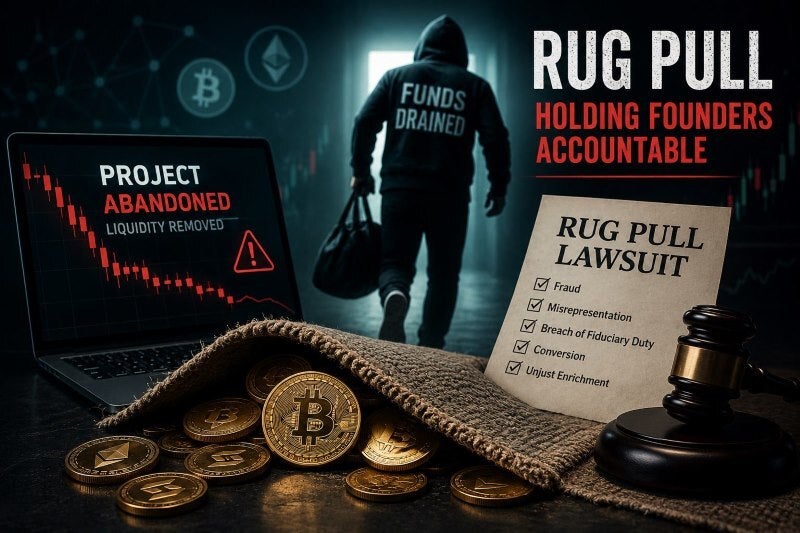
Rug pull lawsuits are civil claims brought after crypto founders, developers, promoters, insiders, or affiliated entities allegedly raise money for a project, create investor demand, then abandon the project, drain liquidity, dump tokens, or disappear with user funds. Some rug pulls look like failed startups. Others look like coordinated fraud. The legal difference depends on what was promised, who controlled the funds, what insiders knew, and how investor money moved.
These cases can involve private lawsuits, SEC or CFTC investigations, DOJ criminal charges, exchange freezes, wallet tracing, and asset seizure. Victims need fast evidence preservation. Founders and promoters need careful legal defense before statements, wallet movement, or deleted communications make the situation worse.
What rug pull lawsuits usually allege
A rug pull generally involves a crypto project that attracts users or investors and then collapses after insiders remove value. The alleged misconduct can involve a token launch, NFT collection, staking pool, DeFi protocol, play-to-earn game, DAO treasury, fake exchange listing, liquidity pool, or influencer-backed promotion.
Common allegations include:
- Founders promised long-term development but never intended to build the project
- Insiders secretly controlled wallets, liquidity, or token supply
- Promoters made misleading claims about partnerships, audits, exchange listings, or utility
- Developers inserted code that allowed liquidity removal, minting, freezing, or draining
- Influencers promoted the project without disclosing compensation
- Founders dumped tokens while encouraging the public to buy or hold
- Investor funds were moved through mixers, bridges, offshore exchanges, or shell entities
For victims, the first step is often identifying whether the loss was a rug pull, hack, wallet drainer, mistaken transfer, fake exchange, or account takeover. Bulldog Law's guide to legal options for stolen cryptocurrency explains why the recovery strategy depends on how the digital assets were taken.
Rug pull lawsuits against founders and core team members
Founders are usually the first targets in rug pull litigation because they often control the project narrative, treasury, smart contracts, token allocation, roadmap, and public statements. Plaintiffs may argue that the founders misrepresented the project's purpose, concealed insider control, or diverted investor funds for personal use.
Potential civil claims may include fraud, negligent misrepresentation, breach of fiduciary duty, breach of contract, unjust enrichment, conversion, civil conspiracy, unfair competition, and securities-law violations. The claims depend on the project structure and the relationship between the parties.
Key evidence often includes:
- Whitepapers, pitch decks, websites, and roadmap statements
- Discord, Telegram, X, Reddit, and Medium posts
- Tokenomics documents and vesting schedules
- Wallet ownership evidence and treasury movements
- Smart contract permissions and admin keys
- Audit reports or claims that an audit existed
- Private investor communications and presale agreements
A failed project is not automatically fraud. The defense may argue that market conditions, technical failures, lack of adoption, exchange delistings, or business mistakes caused the loss. Plaintiffs must connect the loss to legally actionable misconduct, not just disappointment.
Claims against promoters, influencers, and paid shills
Promoters can face exposure when they made false statements, hid compensation, exaggerated expected returns, or helped create artificial demand. A celebrity, influencer, moderator, or community manager may not have written the code or controlled the treasury, but public promotion can still matter if investors relied on those statements.
Promoter liability often turns on what the person knew and what they said. A general statement that a project is exciting may be different from a claim that the token is guaranteed to 100x, has a confirmed exchange listing, is backed by a real partnership, or has locked liquidity when those statements are false.
Rug pull allegations frequently overlap with pump-and-dump theories. When insiders hype a token, coordinate demand, then sell into retail buying, the case may resemble crypto pump and dump schemes involving SEC, CFTC, and criminal exposure.
Securities claims in crypto rug pull lawsuits
Some rug pull lawsuits include securities claims. Plaintiffs may argue that the token, NFT project, staking product, or investment arrangement was sold as an investment contract because buyers invested money in a common enterprise with an expectation of profit based on the efforts of founders, developers, or promoters.
Securities-law claims can be powerful because they may support rescission, damages, control-person liability, aiding-and-abetting theories in some contexts, and claims based on misleading offerings. However, not every crypto asset or transaction is automatically a security. Courts and regulators evaluate the specific facts, including marketing, purchaser expectations, managerial efforts, decentralization, and how the asset was sold.
Founders and promoters should not assume that calling a token a “utility token,” “meme coin,” or “community project” avoids securities analysis. Victims should not assume that every rug pull is a securities case. The legal theory must match the facts.
Fraud, wire fraud, and criminal exposure
A civil rug pull lawsuit may run parallel to a criminal investigation. Federal prosecutors may consider wire fraud if online communications, investor transfers, exchange accounts, or digital payment systems were used to carry out a deceptive scheme. They may also investigate securities fraud, commodities fraud, conspiracy, identity crimes, tax issues, obstruction, or money laundering depending on the evidence.
Crypto cases often turn on digital records. Prosecutors may use exchange subpoenas, wallet tracing, device searches, chat logs, email records, social media posts, domain registration records, and investor statements. A person under investigation should avoid public explanations, witness contact, wallet transfers, or deletion of messages without legal advice.
When a rug pull becomes a federal fraud case, crypto wire fraud charges may be built from the same promotional statements and wallet movements used in the civil lawsuit.
Money laundering and post-rug wallet movement
Investigators often focus on what happened after the alleged rug pull. Moving tokens from a treasury wallet to a personal wallet may be one issue. Swapping into stablecoins, bridging assets across chains, using mixers, sending funds through multiple exchanges, or converting to fiat may create additional scrutiny.
Money laundering allegations require more than movement of crypto. Prosecutors generally need to prove a connection to unlawful proceeds and a prohibited purpose, such as concealment, promotion of unlawful activity, or avoiding reporting requirements. Still, suspicious post-rug movement can make a case look worse, especially if insiders moved funds after receiving legal notices, subpoenas, or investor demands.
For both plaintiffs and defendants, blockchain tracing must be accurate. Exchange omnibus wallets, liquidity pool contracts, routers, bridges, treasury wallets, and market-maker wallets can be misinterpreted. A strong case often requires technical analysis that explains what each transfer actually means.
When prosecutors or civil plaintiffs claim funds were moved to hide fraud proceeds, crypto money laundering charges and defenses require separate analysis from the underlying rug pull allegation.
Asset freezes, seizure, and recovery in rug pull cases
Rug pull victims often want one thing first: stop the money from moving. Depending on the facts, lawyers may seek preservation demands, exchange notifications, temporary restraining orders, preliminary injunctions, civil subpoenas, writs of attachment, or cooperation with law enforcement. Speed matters because crypto can move across wallets, chains, and exchanges quickly.
Federal agents may also seize cryptocurrency if they believe the assets are proceeds of fraud, traceable to fraud, or involved in money laundering. A seizure does not automatically mean the government will return funds to victims quickly. Victims may need to monitor forfeiture proceedings, file claims, seek remission, or document ownership and loss.
Targets of seizure should understand that police and federal agents can seize cryptocurrency through legal process in certain cases. When assets are already in government custody, government seizure of Bitcoin in a criminal case can raise forfeiture, ownership, and third-party claim issues.
Smart contract rug pulls and wallet drainer issues
Some rug pulls are technical rather than promotional. A project may include hidden mint functions, upgradeable contracts, blacklist powers, withdrawal restrictions, fake renounced ownership, or liquidity controls. In other cases, users are tricked into signing malicious approvals that let a wallet drainer move assets.
These cases require review of the smart contract, transaction history, approvals, admin functions, deployer wallets, audits, and developer communications. Plaintiffs may need to show that the code was intentionally designed to trap users or drain value. Defendants may argue that the problem was a bug, exploit by a third party, or known contract risk disclosed to users.
When malicious approvals or smart contract attacks are involved, victims may need to evaluate legal rights after a crypto wallet drainer attack rather than treating the case as a traditional founder rug pull.
Fake exchanges, SIM swaps, and wrong-wallet transfers
Not every crypto loss connected to a collapsed project is a rug pull. Some victims are pushed to fake exchanges where account balances are fabricated. Others lose assets when a SIM swap allows attackers to access exchange accounts or reset authentication. Some transfers are sent to the wrong wallet address and become difficult or impossible to reverse.
Correct classification matters because the target of a claim may change. A fake exchange case may involve website operators, payment processors, domain hosts, shell entities, or identifiable recipients. A SIM swap case may involve telecom security failures, account takeover evidence, and exchange response time. A mistaken transfer may involve tracing and ownership issues but not necessarily fraud.
Victims should compare the facts with fake crypto exchange scam recovery, SIM swap crypto theft liability, and legal options after sending crypto to the wrong wallet address before deciding which legal path fits the loss.
Evidence victims should preserve for a rug pull lawsuit
Victims should preserve evidence before websites disappear, Discord servers are deleted, Telegram chats are wiped, and influencers remove posts. Screenshots help, but they are not always enough. Save URLs, timestamps, usernames, wallet addresses, transaction hashes, browser history, email headers, exchange records, and the exact path of funds.
Important evidence includes:
- Transaction hashes for purchases, transfers, swaps, and failed withdrawals
- Wallet addresses used by the victim, project, exchange, and suspected insiders
- Whitepapers, tokenomics pages, audit claims, and roadmap promises
- Discord, Telegram, X, YouTube, Reddit, and website screenshots
- Presale documents, private messages, invoices, and payment records
- Exchange account records, KYC messages, support tickets, and freeze notices
- Names, aliases, entity names, domains, email addresses, and social media handles
Victims should also be cautious of secondary fraud. After a rug pull, scammers may pretend to be recovery experts, blockchain investigators, law enforcement contacts, or hackers who can retrieve funds for an upfront fee. Anyone contacted after a crypto loss should review crypto recovery scam warning signs before paying for supposed recovery help.
Defenses for founders, developers, and promoters
Rug pull allegations can be serious, but defendants may have valid defenses. A crypto project may fail without fraud. A promoter may have relied on information from founders. A developer may have written code without controlling the treasury. A token sale may have disclosed risk. A wallet may be misattributed. A market collapse may have caused losses that plaintiffs later blame on insiders.
Potential defenses may include:
- No false statement or omission
- No intent to defraud
- No reliance by the plaintiff
- No securities transaction under the facts
- No control over the project wallet, treasury, or liquidity
- No agreement to participate in a conspiracy
- Accurate disclosure of compensation or risk
- Loss caused by market conditions, third-party exploit, or business failure
- Incorrect blockchain tracing or mistaken wallet attribution
- Lack of personal jurisdiction over an out-of-state or foreign defendant
The defense must be built carefully. Publicly attacking victims, deleting chats, moving crypto, or giving informal explanations to investigators can create additional civil and criminal risk.
Where rug pull lawsuits are filed
Rug pull lawsuits may be filed in state court, federal court, arbitration, or bankruptcy proceedings depending on the claims, parties, contracts, and jurisdiction. Federal court may be used when securities claims, federal fraud theories, diversity jurisdiction, class actions, or federal forfeiture issues are involved.
Venue can become contested because crypto projects are often decentralized in appearance but controlled by real people, companies, servers, exchanges, bank accounts, and marketing activity in specific places. California connections may matter if founders, promoters, victims, bank accounts, exchanges, meetings, or marketing activity are tied to the state.
For victims, the legal goal may be identifying defendants, freezing traceable assets, joining other victims, or filing claims in a government forfeiture process. For defendants, the goal may be defeating weak claims early, limiting discovery, protecting constitutional rights, and preventing a civil case from feeding a criminal investigation.
Rug pull lawsuits lawyers in California
Rug pull lawsuits require more than a basic fraud complaint. These cases often involve blockchain tracing, securities analysis, promoter liability, smart contract review, exchange subpoenas, asset freezes, government seizure, and possible criminal exposure. The same wallet movement can matter in a civil lawsuit, SEC inquiry, CFTC investigation, DOJ case, and forfeiture proceeding.
Bulldog Law represents clients in serious crypto, fraud, asset seizure, and digital asset recovery matters. Whether you are a victim trying to trace stolen assets or a founder, developer, or promoter accused of participating in a rug pull, early legal strategy can help preserve evidence, reduce risk, and identify the strongest available path forward.