
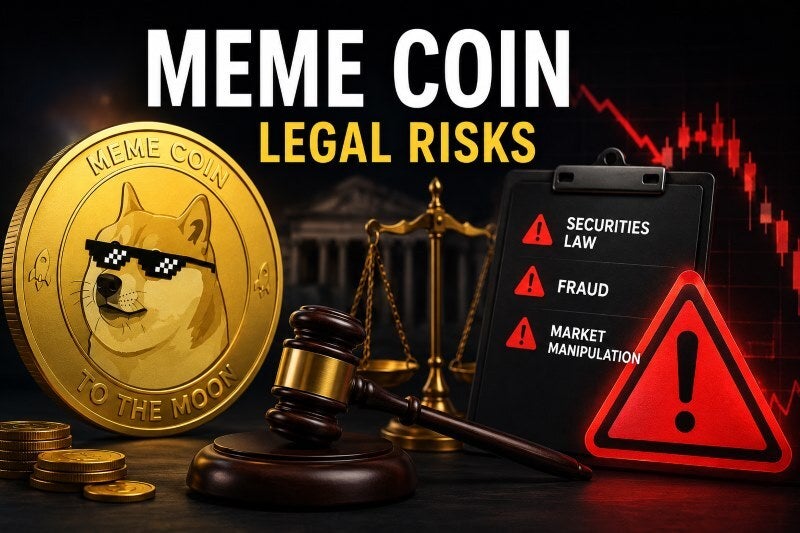
Meme Coin Legal Risks can affect founders, promoters, influencers, exchanges, market makers, community managers, and investors. A meme coin may begin as an internet joke or community token, but legal exposure can grow quickly when people raise money, promise profits, hide insider allocations, manipulate trading, drain liquidity, or mislead buyers about what is happening behind the scenes.
Not every meme coin is automatically a security, and not every failed token is fraud. The legal analysis depends on the facts. Regulators, prosecutors, plaintiffs, and blockchain investigators look at how the coin was launched, what promoters said, who controlled supply, whether buyers expected profits from others' efforts, whether insiders secretly sold, and whether trading activity was manipulated.
What Meme Coin Legal Risks mean for founders and promoters
A meme coin can create legal risk even when the project has no formal company, no traditional business plan, and no promise of dividends. The question is not only what the token is called. The question is what the people behind it did.
Legal risk may arise from:
- Promising or implying that buyers will profit.
- Concealing insider wallets or founder allocations.
- Using bots, wash trading, or paid groups to create fake demand.
- Announcing fake partnerships, exchange listings, audits, or burn events.
- Locking liquidity publicly while secretly retaining control elsewhere.
- Paying influencers without disclosure.
- Changing smart contracts after buyers rely on earlier representations.
- Leaving investors with no meaningful way to recover funds after a rug pull.
The more a meme coin looks like a coordinated fundraising, promotion, or exit-liquidity scheme, the more likely it is to attract regulatory, civil, or criminal attention.
Meme Coin Legal Risks and securities law
Federal securities law often turns on whether a token sale involved an investment of money in a common enterprise with an expectation of profits based primarily on the efforts of others. Some recent regulatory guidance has suggested that a typical meme coin, viewed as a collectible or speculative entertainment asset without rights to income, profits, or business assets, may not be a security. That does not end the analysis.
A meme coin can still create securities risk when the facts show investment-style promotion. For example, a project may be marketed as a chance to profit from the team's roadmap, exchange listings, token burns, treasury management, staking rewards, revenue sharing, or future ecosystem development. If buyers are encouraged to rely on the team's efforts to increase value, the securities analysis becomes more serious.
Important securities questions include:
- Was there a presale, private allocation, or fundraising round?
- Did promoters promise a roadmap, utility, profit, or future listing?
- Did insiders retain large supplies while marketing scarcity?
- Were paid endorsements disclosed?
- Did the project claim decentralization while insiders controlled key decisions?
- Were buyers given accurate information about supply, liquidity, and risk?
When investors sue founders or promoters after a collapse, the case may resemble rug pull lawsuits against crypto founders and promoters, especially if the project raised money and insiders allegedly disappeared with liquidity or treasury assets.
Meme Coin Legal Risks and fraud allegations
Fraud risk does not depend entirely on whether the token is a security. False statements, half-truths, concealed facts, and deceptive conduct can support civil lawsuits, regulatory actions, or criminal investigations. Prosecutors may focus on whether buyers were deceived into sending money, connecting wallets, buying tokens, or holding while insiders sold.
Common fraud theories include:
- Wire fraud based on online communications, websites, social media, or messaging apps.
- Conspiracy when multiple promoters, developers, or marketers coordinated the scheme.
- Money laundering when proceeds were moved through wallets, mixers, exchanges, bridges, or nominees.
- False advertising or consumer protection claims.
- Misrepresentation claims by investors or liquidity providers.
- Aiding and abetting theories against people who helped market or conceal the scheme.
Federal prosecutors often build digital asset fraud cases through wallet tracing, exchange records, Discord and Telegram messages, developer logs, IP records, influencer payments, and blockchain analytics. Bulldog Law's article on crypto wire fraud charges in digital asset cases explains why online statements and transaction history can become central evidence.
Market manipulation and pump-and-dump exposure
Meme coin trading is especially vulnerable to manipulation because prices can move quickly on hype, thin liquidity, influencer posts, bots, and coordinated buying. A dramatic price increase is not illegal by itself. The legal risk comes from deceptive or manipulative conduct used to create artificial demand or trap later buyers.
Market manipulation allegations may involve:
- Wash trading to inflate volume.
- Coordinated pump groups.
- Bot-driven buying or spoofed demand.
- False claims of exchange listings or celebrity support.
- Hidden insider selling during public promotion.
- Market makers creating misleading liquidity.
- Paid influencers pretending to be organic community members.
When promoters hype a coin, sell into the demand they created, and leave later buyers with losses, the case may resemble crypto pump-and-dump schemes involving SEC, CFTC, and criminal exposure. The exact charge depends on the asset, market, statements, and evidence.
Influencers, celebrities, and community managers
Influencers and community managers can face legal risk even if they did not write the smart contract or control the treasury. Liability can arise when a person makes promotional claims, hides compensation, repeats false statements, organizes trading activity, or reassures buyers while insiders are exiting.
Risk increases when an influencer says a token is “guaranteed,” “safe,” “about to be listed,” or “backed by insiders” without support. Risk also increases when the influencer receives tokens, cash, referral payments, or early access but presents the promotion as independent opinion.
Defenses may include lack of knowledge, no material misstatement, no control over the project, no duty to disclose, no reliance, protected opinion, or lack of causation. But those defenses depend on the actual messages, payments, wallet activity, and relationship with the project team.
Victims of meme coin scams and recovery options
Victims may have legal options, but speed matters. Crypto moves quickly, and recovery becomes harder when funds pass through mixers, bridges, foreign exchanges, OTC brokers, or nominee wallets. The first step is preserving evidence before chats disappear, websites go offline, or wallets move funds again.
Recovery may involve civil claims, emergency injunctions, exchange preservation requests, law enforcement reports, blockchain tracing, subpoenas, insurance claims, or claims against negligent third parties. Bulldog Law's guide to recovering stolen cryptocurrency through legal options explains why victims should organize wallet addresses, transaction hashes, exchange records, and communications immediately.
Different scam patterns require different strategies. Some meme coin losses occur inside broader relationship or investment scams, including pig butchering crypto scams and recovery strategies. Others involve platforms that only appear legitimate, such as fake crypto exchange scams.
Wallet drainers, SIM swaps, and wrong-wallet transactions
Not every meme coin loss comes from a bad token. Some losses happen when a buyer connects a wallet to a malicious site, signs a dangerous approval, loses control of a phone number, or sends assets to the wrong address.
Wallet-drainer cases often involve malicious smart contracts that trick users into granting token approvals or signing transactions that transfer assets. Bulldog Law explains legal rights after crypto wallet drainer attacks for victims who connected wallets to fake mint pages, airdrops, or meme coin presales.
SIM swap cases can involve phone carriers, hackers, exchanges, and authentication failures. Victims should review who can be held liable after SIM swap crypto theft when account access was taken through phone-number hijacking. When funds were sent voluntarily but mistakenly, legal options after sending crypto to the wrong wallet address may depend on whether the recipient can be identified and whether an exchange or platform can help preserve assets.
Recovery scam warnings after meme coin losses
Victims of meme coin losses are often targeted again. Secondary scammers monitor social media posts, Discord channels, wallet activity, and complaint forums. They may claim to be blockchain recovery experts, law enforcement contacts, exchange insiders, hackers, or lawyers who can guarantee return of funds for an upfront fee.
Warning signs include:
- Guaranteed recovery.
- Requests for seed phrases or private keys.
- Demands for upfront crypto payments.
- Claims of secret access to exchanges or police databases.
- Fake court orders or fake government badges.
- Pressure to act immediately without written engagement terms.
Before paying anyone, victims should review crypto recovery scam warnings for secondary fraud. A legitimate recovery strategy should not require handing over private keys or trusting someone who promises a guaranteed result.
Government seizure, forfeiture, and criminal investigations
Meme coin cases can involve government seizure when prosecutors believe wallets contain fraud proceeds, laundered funds, victim assets, or property connected to a criminal offense. Seizure does not always mean guilt, but it creates urgent deadlines and procedural risk.
People contacted by federal agents should not explain wallet ownership, token sales, exchange accounts, or fund movements without legal advice. Statements about control, source of funds, intent, or who owned a wallet can become evidence in fraud, money laundering, tax, conspiracy, or forfeiture proceedings.
Bulldog Law explains whether police or federal agents can seize cryptocurrency and what may happen when the government seizes bitcoin in a criminal case. For people accused of moving scam proceeds, crypto money laundering charges and defenses should be reviewed before making statements or entering a plea.
Where meme coin cases are handled
Meme coin disputes can appear in several forums. A victim may file a civil lawsuit in state or federal court. A regulator may open an investigation through the SEC, CFTC, state securities regulators, or state consumer protection agencies. Federal prosecutors may investigate through the Department of Justice, FBI, IRS Criminal Investigation, Homeland Security Investigations, or other agencies depending on the facts.
Venue may depend on where victims lived, where defendants operated, where servers or exchanges were located, where communications were sent, where funds moved, or where a company was formed. In California, crypto cases may involve state court, federal district court, arbitration clauses, exchange terms of service, or multi-jurisdictional investigations.
The forum matters because each path has different procedures, deadlines, remedies, discovery rules, and settlement leverage.
Steps for meme coin founders, promoters, and accused participants
Anyone involved in launching or promoting a meme coin should preserve records and avoid public statements once legal risk appears. Deleting chats, moving tokens, changing websites, or blaming others online can create additional exposure.
Practical steps include:
- Preserve smart contract records, deployment logs, multisig information, and wallet history.
- Save all marketing drafts, influencer agreements, payment records, and disclosure records.
- Do not move treasury, liquidity, or insider wallets without legal advice.
- Do not contact investors, witnesses, or cofounders to coordinate stories.
- Review whether statements about listings, audits, burns, partnerships, or liquidity were accurate.
- Identify who controlled each wallet and each public account.
- Get legal advice before responding to subpoenas, exchange requests, or law enforcement.
The defense should be built around facts, not slogans. A project being a meme coin may help in some securities arguments, but it does not excuse fraud, theft, market manipulation, or laundering.
Steps for meme coin victims
Victims should move quickly but carefully. Panic can lead to secondary scams or lost evidence. A legal recovery strategy begins with documentation and tracing.
Important steps include:
- Preserve transaction hashes, wallet addresses, exchange records, and screenshots.
- Save Discord, Telegram, X, website, email, and influencer materials.
- Do not send more money to anyone promising guaranteed recovery.
- Do not delete wallet apps or browser history.
- Identify exchanges or bridges where funds may have moved.
- Prepare a clear timeline of deposits, purchases, approvals, and withdrawals.
- Seek legal advice before contacting suspects or posting accusations publicly.
Recovery may be possible in some cases, especially when funds reach a compliant exchange or identifiable person. But the legal strategy must be realistic, evidence-driven, and fast enough to matter.
Meme Coin Legal Risks lawyers in California
Meme Coin Legal Risks can involve securities law, fraud, market manipulation, money laundering, civil recovery, wallet tracing, government seizure, and investor lawsuits. The same facts can create exposure for founders, promoters, market makers, influencers, exchanges, and alleged victims who later move funds in ways investigators question.
Bulldog Law helps clients evaluate crypto enforcement risk, defend digital asset investigations, pursue recovery after crypto theft, and respond to complex blockchain disputes. If a meme coin launch, promotion, loss, seizure, or investigation is moving toward legal action, the strategy should begin before wallets move, messages disappear, or regulators define the story first.