
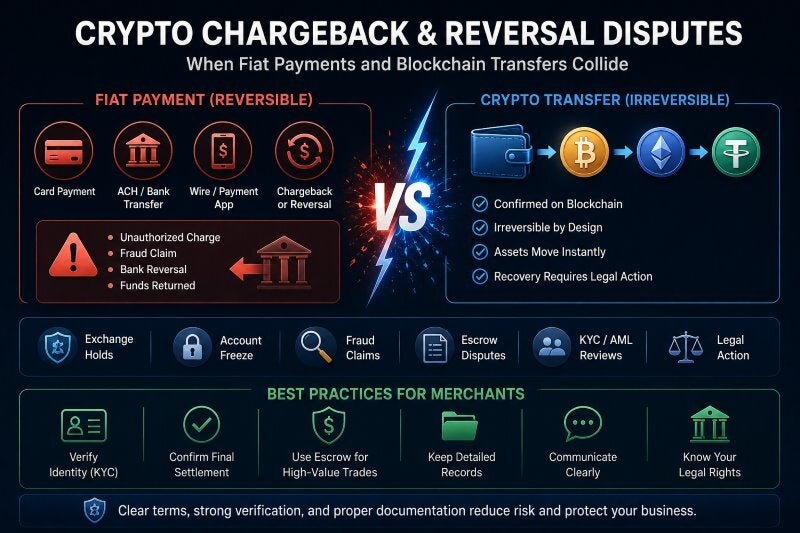
Crypto Chargeback and Reversal Disputes can arise when a buyer pays with a credit card, debit card, ACH transfer, wire, payment app, or other fiat method, but the crypto delivery has already occurred on-chain. The problem is that many fiat payment systems have dispute or reversal processes, while blockchain transfers are usually difficult or impossible to reverse without the recipient's cooperation.
For California merchants, OTC sellers, exchanges, crypto payment processors, founders, and consumers, the key question is whether the fiat payment was final before the digital asset was released. These disputes often involve proof of authorization, fraud claims, cardholder disputes, account freezes, escrow instructions, exchange holds, and evidence showing who actually received the assets.
Why Crypto Chargeback and Reversal Disputes happen
Crypto Chargeback and Reversal Disputes happen because fiat rails and blockchain rails operate differently. A cardholder may dispute a charge after crypto is delivered. A bank may reverse an ACH transfer. A payment app may freeze funds for review. A wire may be recalled or rejected. Meanwhile, the seller may have already sent Bitcoin, Ether, stablecoins, NFTs, or tokens to a wallet that cannot be forced to return them without legal action or voluntary cooperation.
Common scenarios include:
- A customer buys crypto by card and later claims the charge was unauthorized.
- A buyer sends ACH funds that are reversed after the seller releases crypto.
- A wire appears pending, but the seller transfers digital assets before final settlement.
- An OTC trade fails because proof of funds was fake, delayed, or incomplete.
- A payment processor withholds merchant funds after fraud complaints.
- An exchange freezes an account after detecting suspected chargeback abuse.
- A scammer uses stolen payment credentials to buy crypto and move it quickly.
When a dispute involves a private, high-value transaction, OTC crypto trade disputes involving chargebacks may affect proof of funds, settlement timing, broker responsibility, escrow records, and contract enforcement.
Crypto Chargeback and Reversal Disputes and payment finality
Crypto Chargeback and Reversal Disputes often turn on payment finality. A seller may see a payment confirmation and assume the money is safe. That can be risky. A pending bank transfer, provisional credit, card authorization, or app balance may not mean the payment is final and irreversible.
Credit card networks, banks, payment apps, ACH systems, and wires each have different rules. A consumer may have rights to dispute unauthorized electronic transfers, while a merchant may have contract duties under processor terms. Wire transfers and commercial payments may involve different rules from card or consumer electronic fund transfers. The details matter because the available remedy may depend on the payment method, account type, timing, and reason for reversal.
Merchants should define final settlement before releasing crypto. A written policy should explain whether delivery occurs after card authorization, captured funds, bank settlement, escrow confirmation, or expiration of a reversal window. If the transaction uses escrow, crypto escrow disputes over unreleased assets may determine whether the escrow agent was supposed to wait for confirmed fiat settlement before releasing digital assets.
Card payments, ACH reversals, and merchant risk
Merchants that accept fiat payments for crypto face a difficult risk profile. If they deliver the asset too early, they may lose both the fiat and the crypto. If they delay delivery too long, customers may complain, cancel, or accuse the merchant of withholding funds.
Risk increases when the transaction involves:
- First-time buyers with no verified history.
- Large purchases made shortly after account creation.
- Billing information that does not match KYC records.
- VPNs, new devices, unusual IP locations, or rapid wallet changes.
- Pressure to release crypto before funds settle.
- Multiple failed cards or repeated payment attempts.
- Requests to send crypto to a third-party wallet.
Recurring payment businesses face similar issues when customers claim they did not consent to repeat charges. crypto subscription and auto-renewal payment disputes may involve consent, cancellation terms, refund policies, wallet permissions, and customer claims after repeat billing.
Fraud claims and stolen payment credentials
Some reversal disputes involve genuine fraud. A person may use stolen cards, stolen bank credentials, compromised payment app accounts, or synthetic identities to buy crypto. Once the assets are delivered, they may be sent through multiple wallets, exchanges, bridges, or mixers.
A merchant may argue that the buyer authorized the transaction and then filed a false dispute. A consumer may argue that their credentials were stolen and they never authorized the purchase. The payment processor may freeze funds while it investigates. The outcome often depends on device records, IP logs, customer verification, communications, wallet delivery records, and payment network evidence.
If digital assets were stolen or fraudulently obtained, legal options after stolen cryptocurrency may include blockchain tracing, exchange notices, subpoenas, preservation letters, police reports, and civil claims. If the chargeback dispute is tied to a romance or investment scheme, pig butchering crypto scam recovery strategies may help identify wallets, communications, and platforms used to move funds.
Exchange holds, custody disputes, and frozen accounts
Exchanges and payment processors may freeze accounts when they see chargeback risk, fraud complaints, suspicious deposits, reversed payments, or KYC concerns. A freeze may protect other users or the platform, but it can also create disputes if legitimate users cannot access funds or if merchants cannot withdraw settled balances.
If a platform restricts access after a reversal or suspected fraud event, crypto exchange account freeze disputes may affect what notice, records, and release options are available. When a platform controls private keys, wallet access, or customer funds, crypto custody disputes with exchanges and wallet providers may determine whether a user, merchant, or business can demand access, records, or return of assets.
Businesses should preserve platform notices, account dashboards, transaction histories, support tickets, risk-review messages, and identity verification submissions. Those records may become essential if the freeze continues or if litigation becomes necessary.
KYC, AML, and sanctions review after a reversal
Chargeback and reversal disputes can trigger compliance reviews. A platform may ask whether the buyer was properly identified, whether payment information matched the customer profile, whether the receiving wallet was screened, and whether suspicious activity was reported or escalated.
For crypto businesses, KYC and AML planning for crypto startups may affect onboarding, transaction monitoring, payment acceptance, wallet screening, and records needed to defend a merchant decision. A business that cannot show basic identity checks may have a harder time challenging processor holds or defending against fraud complaints.
Sanctions screening can also matter if disputed funds move to high-risk wallets, blocked addresses, mixers, or restricted jurisdictions. crypto sanctions compliance for wallets and exchanges may affect whether a business can lawfully process, refund, freeze, or release funds after suspicious activity.
Computer fraud, wire fraud, and criminal exposure
Not every failed payment or reversal is a crime. A chargeback may be legitimate. A bank reversal may be caused by an error. A customer may have a real dispute over non-delivery, unauthorized use, or misleading terms. But some cases can raise criminal concerns when false statements, stolen credentials, fake identities, or intentional deception are involved.
If the dispute involves online communications, false payment confirmations, fake proof of funds, or electronic transfers used to obtain crypto, federal crypto wire fraud allegations may become relevant. If the case involves unauthorized account access, malware, credential theft, fake interfaces, or compromised systems, cryptocurrency and computer fraud claims may also affect the legal strategy.
Businesses should avoid overreacting by accusing every chargeback customer of fraud. At the same time, users should understand that falsely disputing a valid payment after receiving crypto can create civil and potentially criminal risk depending on the facts. cryptocurrency fraud defense issues may be important when a disputed trading or payment strategy is being characterized as intentional deception.
Arbitration clauses and platform terms
Many crypto payment, exchange, merchant, and wallet disputes are governed by online terms. Those terms may require arbitration, limit class claims, restrict remedies, define refund rules, or give the platform discretion to freeze accounts during fraud review.
Before filing in court, the parties should review the applicable terms of service, merchant agreement, payment processor agreement, exchange terms, wallet terms, and any OTC or escrow agreement. crypto arbitration clauses in exchange and Web3 disputes may affect whether the matter proceeds in court, private arbitration, small claims court, or an emergency injunction proceeding.
Forum terms can affect speed and leverage. If a platform freezes assets or a merchant faces a large processor hold, urgent relief may be needed before a slow dispute process causes further harm.
Tax records after reversals, refunds, and crypto delivery
Chargebacks and reversals can create tax record problems. A merchant may have recorded a sale when crypto was delivered, but later the fiat payment was reversed. A customer may have acquired crypto, returned it, lost it, or transferred it before the dispute was resolved. A refund may be issued in dollars, stablecoins, tokens, or store credit, each of which can create different records.
If a reversal, refund, or failed transaction produces records that do not match tax reporting, IRS crypto CP2000 mismatch issues may arise later. If a party lost crypto through fraud or a failed payment dispute, reporting cryptocurrency losses may require careful documentation of ownership, transaction timing, recovery efforts, and the nature of the loss.
Businesses should keep clean records of original payment, delivery, reversal, refund, chargeback fee, crypto transfer, exchange rate, and customer communication. Without those records, a payment dispute can become a tax and accounting dispute as well.
Evidence to preserve in Crypto Chargeback and Reversal Disputes
Crypto Chargeback and Reversal Disputes are evidence-heavy. The most important records usually show payment authorization, identity verification, delivery, timing, finality, customer communications, and what happened after the dispute began.
- Card, ACH, wire, payment app, or processor records.
- Chargeback notices, reversal notices, retrieval requests, and response deadlines.
- Wallet addresses, transaction hashes, delivery confirmations, and exchange records.
- Customer KYC records, device records, IP logs, login history, and support tickets.
- Terms of service, refund policies, merchant agreements, and escrow instructions.
- Emails, texts, Telegram, Discord, Signal, WhatsApp, and payment confirmations.
- Fraud indicators, fake proof-of-funds documents, altered screenshots, or account takeover evidence.
- Accounting records, tax records, refund records, and valuation evidence.
A strong record should show whether the buyer authorized payment, whether the merchant delivered crypto as promised, whether the payment was final, and whether the later reversal was legitimate or disputed.
Where crypto payment reversal disputes may be handled in California
Crypto payment reversal disputes may be handled through a payment processor dispute process, exchange support process, private negotiation, mediation, arbitration, California Superior Court, federal court, small claims court, or criminal investigation depending on the facts. Civil claims may include breach of contract, fraud, conversion, unjust enrichment, negligent misrepresentation, unfair competition, breach of escrow instructions, or declaratory relief.
Federal court may be involved if the dispute includes federal fraud claims, computer fraud issues, bank-related claims, bankruptcy, diversity jurisdiction, or cross-border defendants. Payment processors, banks, card networks, exchanges, and law enforcement agencies are neutral third parties or institutions and are not affiliated with Bulldog Law.
Emergency relief may be considered when crypto can be traced to an exchange, a processor hold threatens business operations, or a party is about to move disputed assets. Possible remedies may include preservation letters, subpoenas, temporary restraining orders, preliminary injunctions, expedited discovery, or accountings depending on the evidence and forum.
Practical steps after a crypto chargeback or reversal
After a crypto payment reversal, the parties should act quickly but carefully. Practical steps may include:
- Preserve payment records, processor notices, wallet records, and communications immediately.
- Determine whether the fiat payment was authorized, pending, settled, reversed, or recalled.
- Identify where the crypto was delivered and whether it moved to an exchange or known wallet.
- Review merchant terms, exchange terms, refund policies, escrow instructions, and arbitration clauses.
- Respond to chargeback or processor deadlines with organized evidence.
- Send preservation notices to exchanges, custodians, or processors when appropriate.
- Evaluate civil claims, recovery options, tax records, and possible criminal exposure before making public accusations.
Prevention is also important. Merchants should use written policies, waiting periods for risky payments, verified wallets, identity checks, clear refund terms, documented delivery confirmations, and risk controls that match the size and type of transaction.
Crypto Chargeback and Reversal Disputes lawyers in California
Crypto Chargeback and Reversal Disputes require legal analysis that connects fiat payment rules, blockchain delivery, merchant agreements, fraud evidence, exchange holds, custody records, tax reporting, and court or arbitration strategy. The main challenge is often that one system allows disputes while the blockchain transfer may already be final.
Bulldog Law helps California clients evaluate crypto chargeback and reversal disputes involving card payments, ACH reversals, wire recalls, OTC trades, escrow releases, exchange freezes, fraud claims, processor holds, tax records, and merchant risk. Early legal review may help preserve evidence, identify responsible parties, and pursue practical options before records disappear or assets move beyond reach.