
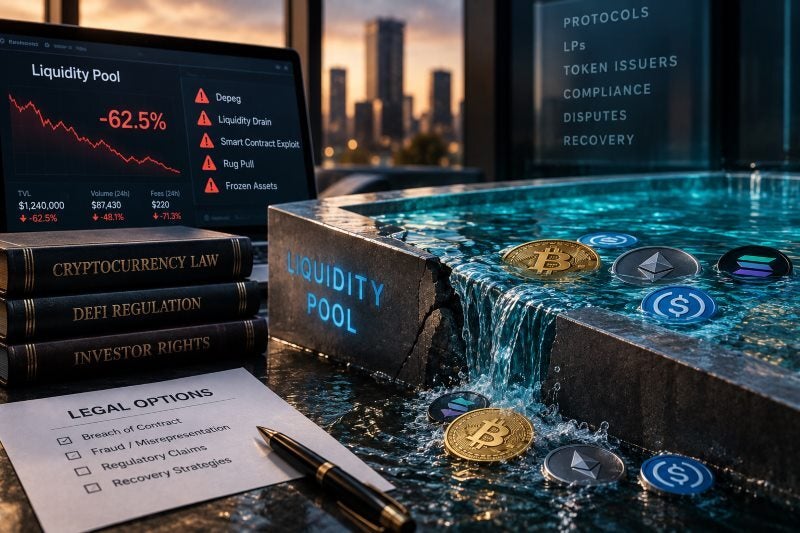
Crypto Liquidity Pool Losses can occur even when no one has done anything unlawful. Liquidity providers may suffer from impermanent loss, token volatility, changing trading volume, or declining rewards. Legal disputes become more likely when losses are connected to misleading statements, hidden control over a pool, unauthorized withdrawals, smart contract failures, manipulation, or promises about liquidity that were never honored.
For California users, the key question is usually not simply how much money was lost. It is why the loss occurred, who controlled the relevant system, what representations were made, and whether the conduct violated a contract, applicable law, or another recognized legal duty.
Quick answer
Liquidity providers generally cannot recover losses merely because a pool performed poorly or impermanent loss occurred. Potential claims become more plausible when a protocol, token issuer, founder, market participant, or other actor allegedly made material misrepresentations, removed liquidity improperly, manipulated prices, breached an agreement, or failed to perform specific obligations. Liability depends heavily on the pool design, governing terms, token structure, and cause of the loss.
How Crypto Liquidity Pool Losses Happen
Liquidity pools allow users to deposit digital assets into smart contracts that facilitate decentralized trading, lending, or other transactions. In return, liquidity providers may receive trading fees, protocol incentives, or LP tokens representing their position.
Losses can arise from ordinary economic risks such as:
- Impermanent loss after the relative prices of pooled tokens change.
- A sharp decline in one of the deposited tokens.
- Lower-than-expected trading fees.
- Token reward inflation reducing the value of incentives.
- Users moving liquidity to another protocol.
- Changes in pool parameters or fee structures.
Providing liquidity therefore involves risks that differ from simply holding the underlying assets. Related tax consequences may also arise from swaps, rewards, and yield strategies, as discussed in the overview of DeFi tax reporting for liquidity pools and yield farming.
When Is a Liquidity Pool Loss a Legal Problem?
A financial loss does not automatically create liability. A legal claim generally requires conduct that satisfies the elements of a recognized cause of action.
Warning signs may include:
- Founders secretly withdrawing project-controlled liquidity.
- False statements about locked liquidity.
- Undisclosed minting that dramatically dilutes a token.
- Protocol administrators changing pool rules for personal benefit.
- Smart contract vulnerabilities that were known but concealed.
- Manipulated token prices used to drain a pool.
- Market makers operating outside agreed trading or liquidity limits.
Projects using outside firms to support liquidity should also understand the contractual risks in crypto market maker agreements involving token projects and liquidity providers.
Crypto Liquidity Pool Losses and Potential Legal Claims
Depending on the facts, potential claims may include breach of contract, fraud, negligent misrepresentation, unjust enrichment, conversion, or other business and property claims. Fiduciary-duty theories may sometimes arise, but the existence of a fiduciary relationship cannot be assumed merely because someone deposited assets into a DeFi protocol.
The governing documents matter. Terms of service, liquidity agreements, token-sale documents, governance proposals, white papers incorporated into agreements, and smart contract specifications may establish what a project actually promised.
Broader operational requirements can also become relevant, particularly for businesses dealing with DeFi compliance and regulatory risks.
Impermanent Loss Usually Is Not Misconduct
Impermanent loss occurs when the relative value of assets deposited into an automated market maker changes compared with simply holding those assets. The pool's mathematical formula automatically rebalances the provider's position as traders swap between the tokens.
If this mechanism was accurately disclosed and worked as designed, the resulting loss generally looks more like market risk than misconduct.
The situation can be different if a platform materially misrepresented how the pool worked, guaranteed protection that did not exist, concealed special privileges held by insiders, or manipulated a token price to affect LP positions.
What if Founders Pull the Liquidity?
A sudden removal of liquidity can cause severe losses, but legality depends on who owned or controlled the assets and what commitments were made.
If founders clearly retained unrestricted control of project-owned liquidity and disclosed that fact, withdrawal may present a different legal situation from one where investors were told the liquidity was locked for several years.
Claims may become more serious if insiders allegedly represented that liquidity could not be removed and then secretly transferred it to themselves. Similar conduct can appear in rug pull lawsuits against crypto founders and promoters.
Token purchasers may also have separate rights if the project changes important promises concerning launch terms, liquidity, or token economics. Those issues can overlap with token-sale disputes involving changed tokenomics.
Smart Contract Exploits and Protocol Liability
Liquidity pools depend heavily on smart contracts. A coding vulnerability may allow an attacker to manipulate accounting, borrow improperly against pool assets, exploit a pricing mechanism, or withdraw funds that should remain locked.
A protocol is not automatically liable simply because hackers found a vulnerability. Relevant questions may include whether operators knew about the flaw, what security promises they made, whether reasonable warnings were ignored, and what contractual obligations applied.
If the code had previously undergone a professional security review, responsibility may extend into smart contract audit disputes after an exploit.
Cross-chain pools create additional risks because a bridge failure may remove or freeze assets supporting liquidity on another network. Similar issues arise in claims involving lost or frozen cross-chain assets.
Price Manipulation and Automated Losses
A liquidity pool can also suffer losses when someone manipulates a thin market, oracle, or token price and then uses the distorted value to trade against the pool.
Not every profitable trade is unlawful manipulation. The analysis may depend on deception, intent, trading behavior, applicable commodities or securities laws, and how the protocol was designed.
Automated systems can amplify the damage. Manipulated prices may trigger liquidations or arbitrage transactions before human operators can respond. These issues are similar to DeFi liquidation and MEV disputes involving automated losses.
Can Token Issuers Face Liability?
Potentially. A token issuer may face greater risk when it actively markets a liquidity program using materially misleading claims about returns, locked liquidity, reserves, token supply, or how project insiders will manage the ecosystem.
Federal securities laws may also matter in some circumstances. Under current SEC guidance, a crypto asset is not automatically a security simply because it is a token. However, transactions involving crypto assets can become subject to federal securities laws when the legal requirements for an investment contract or another type of security are satisfied.
The specific offering and surrounding promises therefore matter. Projects should consider the issues addressed in digital-asset securities and investment-contract analysis rather than assuming every LP token or governance token receives the same regulatory treatment.
DAO Governance and Liquidity Changes
A DAO may control pool fees, reward emissions, treasury liquidity, approved assets, or emergency withdrawal procedures. Disputes can arise when a governance vote changes those rules after users have committed capital.
A governance decision is not automatically unlawful because LPs lose money. Relevant questions include whether the change was authorized, properly disclosed, implemented according to governing rules, or influenced by undisclosed conflicts.
Projects using governance tokens should understand the relationship between voting authority and token governance rights and compliance obligations.
California Regulation of DeFi Businesses
California's Digital Financial Assets Law has applied since July 1, 2026 to many businesses engaging in covered digital financial asset activity with or on behalf of California residents, subject to statutory exclusions and exemptions.
Not every decentralized protocol, developer, token issuer, or LP automatically falls within the licensing framework. The analysis depends on the activities actually performed and the degree of control involved.
Businesses serving California users should evaluate these requirements as part of a broader California DeFi legal and compliance analysis.
Evidence LPs Should Preserve
Liquidity pool disputes are highly technical, so preserving evidence early can be critical. Useful materials may include:
- Wallet addresses and transaction hashes.
- LP deposit and withdrawal records.
- Smart contract addresses and code versions.
- Pool balances before and after the loss.
- Token price and oracle data.
- Governance proposals and voting records.
- Marketing claims about yield or locked liquidity.
- Terms of service and risk disclosures.
- Audit reports.
- Discord, Telegram, email, and support communications.
If internal participants knew about manipulation or concealed losses, records may also become relevant to crypto whistleblower claims involving fraud or market manipulation.
Frequently Asked Questions About Liquidity Pool Losses
Can I sue because I suffered impermanent loss?
Impermanent loss alone usually does not establish misconduct. A viable claim generally requires an independent legal basis, such as fraud, breach of contract, or another legally recognized violation.
Can a protocol avoid liability by saying users assume all risks?
Risk disclosures can be important, but their effect depends on their wording and applicable law. They should not be assumed to excuse fraud or other independently unlawful conduct.
What if the pool was drained by a hacker?
The hacker may be a primary wrongdoer, but additional questions can arise about protocol security, representations, known vulnerabilities, administrators, and other responsible parties.
Crypto Liquidity Pool Losses lawyers in California
Crypto Liquidity Pool Losses can result from ordinary investment risk, technical failures, market manipulation, governance decisions, or misconduct. Identifying the cause is essential before determining whether a legal claim exists.
Bulldog Law helps clients evaluate cryptocurrency and DeFi disputes involving liquidity pools, protocols, token issuers, developers, founders, and digital-asset losses. Early review can help preserve blockchain evidence and distinguish ordinary market losses from potentially actionable conduct. No recovery or outcome can be guaranteed.