
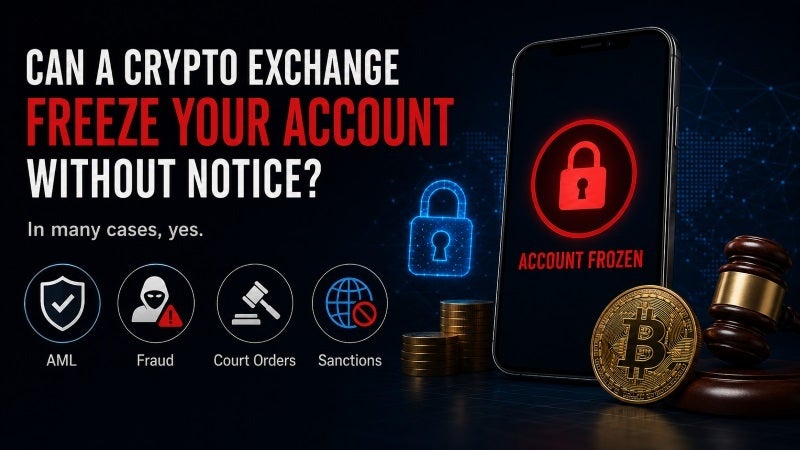
Can a Crypto Exchange Freeze Your Account Without Notice? In many situations, yes. A crypto exchange may freeze withdrawals, trading, deposits, or an entire account without advance warning if its terms of service, fraud controls, sanctions screening, court orders, law enforcement requests, bankruptcy concerns, or anti-money laundering obligations require immediate action.
That does not mean the freeze is always lawful, permanent, or beyond challenge. The key questions are why the freeze happened, whether the exchange is holding customer property, whether a government agency is involved, what the user agreement says, whether the assets are connected to suspicious transactions, and whether the customer has legal rights to demand release, accounting, notice, or damages.
Can a Crypto Exchange Freeze Your Account Without Notice because of AML or fraud concerns?
Crypto exchanges that serve U.S. customers often operate under anti-money laundering, know-your-customer, sanctions, fraud monitoring, and suspicious activity reporting rules. If activity triggers compliance alerts, an exchange may restrict the account first and ask questions later.
Common triggers include:
- large deposits or withdrawals inconsistent with prior activity;
- funds traced to hacks, scams, mixers, darknet markets, or sanctioned wallets;
- rapid movement through multiple wallets;
- use of VPNs, false identity documents, or mismatched account information;
- chargebacks, stolen bank information, or account takeover reports;
- law enforcement preservation requests or subpoenas;
- activity that resembles layering, structuring, or laundering.
If the exchange suspects criminal exposure, it may provide only a vague explanation. It may not tell the user whether a suspicious activity report exists, and it may not disclose internal compliance analysis. That can be frustrating, but it does not end the inquiry. A user can still preserve records, request a written reason, correct KYC problems, and evaluate whether the freeze violates contract, consumer protection, property, or due process rights.
Can a Crypto Exchange Freeze Your Account Without Notice after a scam or wallet drainer?
Exchanges frequently freeze accounts after hacked funds, scam proceeds, phishing transfers, or wallet drainer activity move through their platform. The freeze may affect the thief, a mule account, a receiving address, or even a later customer who unknowingly received tainted assets.
If the freeze follows a smart contract attack, the exchange may rely on blockchain analytics, abuse reports, customer complaints, or law enforcement alerts. A victim should move quickly to preserve wallet addresses, transaction hashes, screenshots, exchange tickets, emails, browser history, hardware wallet logs, seed phrase exposure details, and any communication with the attacker. In wallet drainer cases, legal rights after a malicious smart contract attack can involve both civil recovery strategy and criminal reporting.
A mistaken transfer creates a different problem. If a customer sent funds to the wrong address and the recipient account is frozen, the exchange may be unwilling to return assets without proof, consent, a court order, or law enforcement direction. Legal options after sending crypto to the wrong wallet address depend on traceability, recipient identity, exchange cooperation, and whether the transfer was truly mistaken or part of a disputed transaction.
Government seizure is different from an exchange freeze
A private exchange freeze and a government seizure are not the same thing. An exchange freeze may be based on terms of service, internal compliance, fraud review, or account security. A government seizure usually involves a warrant, forfeiture action, restraining order, criminal investigation, or civil forfeiture procedure.
If police or federal agents are involved, the customer needs to know whether the exchange is merely preserving assets or whether the government has actually seized them. Police or federal agents seizing cryptocurrency raises separate issues of warrants, probable cause, custody of private keys, blockchain tracing, and the right to contest forfeiture.
When the government seizes Bitcoin in a criminal case, the process may involve notices, claims, deadlines, forfeiture allegations, plea negotiations, victim restitution, and ownership disputes. Government seizure of Bitcoin in a criminal case requires immediate attention because missing a forfeiture deadline can be more damaging than the initial freeze.
Money laundering and wire fraud red flags
An exchange freeze can be a warning sign that a user is being reviewed for money laundering, wire fraud, sanctions, or stolen funds. It can also be a false alarm caused by poor documentation, high-volume trading, DeFi activity, airdrops, transfers from third parties, or funds received from unknown sources.
The defense should examine source of funds, transaction history, wallet ownership, customer messages, business purpose, tax records, bank records, exchange communications, and whether the customer knew the funds were connected to unlawful activity. Crypto money laundering red flags and defenses are important when an account freeze appears alongside questions about mixers, layering, third-party wallets, or unexplained transfers.
Wire fraud concerns can arise when prosecutors believe digital assets were obtained through false statements, fake investments, phishing, romance scams, business email compromise, or fraudulent token sales. Crypto wire fraud charges and digital asset evidence can involve emails, chats, wallet movements, IP logs, exchange records, and investor communications.
Market manipulation, rug pulls, meme coins, and insider information
Exchanges may freeze accounts if they suspect market manipulation, pump-and-dump trading, wash trading, coordinated promotion, undisclosed compensation, rug pulls, token dumping, or insider trading. A freeze may begin as a platform compliance decision and later become a civil, regulatory, or criminal issue.
When a token spikes and collapses, the exchange may investigate who promoted it, who traded before announcements, who controlled wallets, and whether investors were misled. Crypto pump-and-dump exposure may involve the SEC, CFTC, DOJ, state regulators, private plaintiffs, or exchange enforcement teams.
Founders and promoters face additional risk if liquidity is removed, promises are broken, token allocations are hidden, or project funds disappear. Rug pull lawsuits against crypto founders and promoters can overlap with exchange freezes when the platform identifies wallets tied to project insiders.
Meme coins create their own hazards because jokes, hype, influencer marketing, liquidity control, and token concentration can become evidence. Meme coin legal risks may become relevant when an exchange freezes proceeds after a rapid launch, promotion, and selloff.
Token airdrops can also trigger review if the exchange questions tax reporting, securities compliance, sanctions exposure, or suspicious wallet clustering. Token airdrops and U.S. law can affect how users document source of assets and respond to compliance questions.
Trading before public token announcements, listings, delistings, partnerships, exploits, or enforcement news can create insider trading questions. Crypto insider trading risks should be evaluated before a frozen customer gives explanations that could be used later by regulators or prosecutors.
Bankruptcy, liquidity problems, and withdrawal pauses
Sometimes the problem is not the customer. The exchange itself may face insolvency, liquidity shortages, banking disruption, hacking, regulatory enforcement, or bankruptcy. In those situations, a “freeze” may be a platform-wide withdrawal pause, not an individualized accusation.
The legal result depends on custody terms, whether assets were held in trust, whether the customer retained title, whether assets were commingled, whether the platform lent or rehypothecated funds, and what bankruptcy court orders require. Crypto exchange bankruptcy and customer funds can determine whether a user is treated like a property owner, creditor, customer claimant, or something else.
Customers should preserve account statements, wallet deposit addresses, transaction confirmations, user agreements, emails, screenshots of balances, tax forms, and any proof that assets were supposed to be held for their benefit.
What to do when your crypto account is frozen
Do not panic-trade, create new accounts to evade controls, send false documents, threaten exchange employees, or delete transaction history. Those actions can make a compliance problem look like obstruction, fraud, or laundering.
Practical steps include:
- download or screenshot account balances, open orders, wallet addresses, and transaction history;
- save every email, ticket number, chat message, and compliance request;
- identify the exact freeze, including withdrawals, trading, deposits, fiat, crypto, or account login;
- review the terms of service, arbitration clause, custody terms, and risk disclosures;
- prepare source-of-funds documentation before responding;
- avoid guessing about facts you cannot verify;
- do not communicate with law enforcement without legal advice;
- track all deadlines for appeals, arbitration, complaints, or forfeiture claims.
A short, accurate, documented response is often better than a long emotional explanation. If the matter involves criminal exposure, sanctions, hacked funds, or a subpoena, legal review should happen before the user sends a detailed statement.
Where account freeze disputes are handled
Crypto exchange disputes may be handled through the exchange's internal support process, arbitration, state court, federal court, bankruptcy court, regulatory complaints, law enforcement victim reporting, or forfeiture proceedings. The correct path depends on the user agreement, location of the exchange, location of the customer, amount at issue, government involvement, and whether emergency relief is needed.
Courts, federal agencies, state regulators, prosecutors, law enforcement offices, bankruptcy trustees, arbitrators, and exchanges are separate institutions or private entities with specific roles. Bulldog Law has no affiliation, endorsement, partnership, special access, or special relationship with any of them.
In California, a customer may need to consider contract claims, fraud claims, conversion, unfair competition, negligence, consumer protection, emergency injunctions, arbitration demands, or federal forfeiture defenses. If the freeze is tied to a criminal investigation, the civil strategy must be coordinated with criminal defense.
Can a Crypto Exchange Freeze Your Account Without Notice? lawyers in California
Bulldog Law helps clients address the question, Can a Crypto Exchange Freeze Your Account Without Notice?, including exchange freezes, frozen withdrawals, AML reviews, source-of-funds demands, wallet drainer losses, mistaken wallet transfers, government seizures, forfeiture claims, money laundering investigations, wire fraud concerns, token trading disputes, rug pull exposure, and crypto exchange bankruptcy issues.
No lawyer can promise that an exchange will release funds, that a regulator will close an investigation, or that frozen crypto can always be recovered. What Bulldog Law can do is review the freeze, preserve evidence, evaluate contract rights, identify criminal or forfeiture risk, prepare a response strategy, and pursue the legal path most likely to protect the client's assets and rights.