
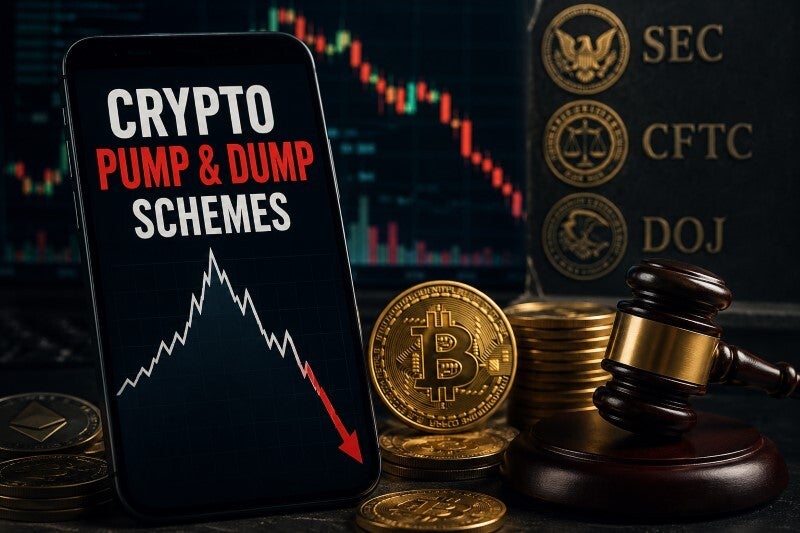
Crypto Pump and Dump Schemes can turn a token launch, meme coin promotion, trading group, influencer campaign, or private Discord chat into a federal investigation. The core allegation is usually simple: insiders or promoters hyped a digital asset, helped inflate the price, and then sold into the market while later buyers were left with losses.
These cases are rarely simple in practice. A crypto pump and dump investigation can involve the SEC, CFTC, DOJ, IRS, FBI, Homeland Security Investigations, blockchain analytics firms, exchanges, Telegram channels, X posts, Discord logs, wallet clusters, trading bots, market makers, offshore entities, and seized digital assets. The defense depends on what was said, who said it, whether the token was a security or commodity, what the defendant knew, and whether trading activity was manipulative or merely speculative.
What crypto pump and dump schemes usually involve
A crypto pump and dump case typically starts with promotion. The government may allege that founders, insiders, promoters, influencers, market makers, or trading group leaders created artificial demand through misleading statements, fake partnerships, undisclosed compensation, wash trading, coordinated buying, false scarcity, fake community growth, or exaggerated exchange listing rumors.
The “pump” is the price increase allegedly caused by hype or manipulation. The “dump” is the sale by insiders, early holders, promoters, or coordinated wallets while public buyers are still entering the market. Investigators then compare public statements, private chats, token flows, wallet timing, exchange records, and profit withdrawals.
Not every failed token is fraud. Crypto markets are volatile. Meme coins can rise and collapse quickly. A poor project, bad timing, weak liquidity, or speculative mania does not automatically prove a crime. The key issue is whether there was deception, manipulation, undisclosed insider conduct, or a scheme to defraud.
Crypto pump and dump schemes and SEC exposure
SEC exposure depends heavily on whether the digital asset, token sale, staking arrangement, investment program, or promotional campaign involved a security. The analysis is fact-specific. A token label does not control. A project may call something a utility token, meme coin, governance token, presale, launchpad allocation, yield product, or community asset, but regulators and courts look at economic reality.
The SEC may investigate whether buyers invested money in a common enterprise with an expectation of profit based on the efforts of others. If the facts support that theory, the agency may pursue claims involving unregistered securities offerings, securities fraud, market manipulation, misleading promotions, undisclosed compensation, or false statements to investors.
Promoters can face scrutiny even if they did not build the token. Paid influencers, marketing agencies, call-channel operators, newsletter writers, and social media personalities may be investigated if they touted a token while hiding compensation, dumping their own holdings, or repeating claims they knew were false.
Crypto pump and dump schemes and CFTC exposure
The CFTC may become involved when the digital asset is treated as a commodity, or when the conduct affects commodity markets, derivatives, swaps, futures, leveraged trading, or fraud in interstate commerce involving virtual currency. CFTC cases often focus on fraud, manipulation, deceptive devices, spoofing-like conduct, false trading volume, or schemes involving commodity interests.
This matters because a defense cannot assume that avoiding SEC jurisdiction ends the risk. If the token is not a security, the government may still evaluate CFTC authority, criminal wire fraud, commodities fraud, money laundering, tax issues, or state-law claims.
The classification fight can be central. The same token ecosystem may include different legal relationships: spot trading, staking rewards, liquidity pool incentives, lending, derivatives, exchange listings, and promotional contracts. Each part may need separate analysis.
DOJ criminal charges in crypto pump and dump cases
Criminal exposure is often broader than civil enforcement. Prosecutors may charge wire fraud, securities fraud, commodities fraud, conspiracy, money laundering, obstruction, false statements, tax crimes, or identity-related offenses depending on the evidence.
Wire fraud is a common charge because crypto promotions and trades usually involve interstate wires, internet communications, exchanges, payment rails, and electronic transfers. Federal crypto wire fraud charges often depend on messages, investor statements, transaction timing, and whether the government can prove intent to defraud.
Securities or commodities fraud may be added when the government alleges market manipulation or deceptive conduct tied to a covered asset. Conspiracy can expand the case to include people who allegedly joined the plan even if they did not personally write the main promotional post or execute the largest trades.
Red flags prosecutors look for
Investigators often search for patterns rather than one single message. A case may be built from trading data, wallet movements, private chats, public posts, and financial records.
- Promoters publicly said they were “holding” while privately selling.
- Insiders concealed wallet ownership or used nominees.
- Paid promotion was not disclosed.
- Trading volume was created through wash trades or coordinated wallets.
- The project announced fake partnerships, listings, audits, or backing.
- Liquidity was pulled after public buyers entered.
- Token supply, vesting, or lockups were misrepresented.
- Private chat logs discussed timing the dump.
- Profits were routed through mixers, bridges, offshore exchanges, or shell entities.
- Victim funds were moved into personal spending, luxury assets, or unrelated projects.
Money laundering and asset seizure risks
Crypto pump and dump investigations often follow the money after the alleged dump. Prosecutors may argue that moving proceeds through wallets, exchanges, bridges, DeFi protocols, stablecoins, NFTs, mixers, or nominee accounts shows concealment or laundering.
Crypto money laundering charges can arise when the government claims transactions were designed to hide ownership, source, control, or location of alleged criminal proceeds.
Federal agents may also seek seizure warrants for wallets, exchange accounts, bank accounts, hardware wallets, NFTs, stablecoins, or proceeds converted into cash or property. Police or federal seizure of cryptocurrency can happen early in an investigation, sometimes before charges are filed.
When Bitcoin or other crypto is seized in a criminal case, the defense must address access, custody, valuation, forfeiture, restitution, and whether the government can prove the asset is traceable to unlawful conduct. Government seizure of Bitcoin in a criminal case can become a separate fight from guilt or innocence.
DeFi, staking, and tax issues after a pump and dump investigation
Tax exposure can exist even when the criminal theory is market manipulation. Trading profits, token allocations, airdrops, staking rewards, yield farming, swaps, and liquidity pool income may create reporting issues. The IRS may examine whether income was reported, whether cost basis was accurate, and whether proceeds were hidden.
Staking rewards tax treatment may matter when a project distributed rewards to insiders, validators, promoters, or investors during the same period that promotional claims were made.
DeFi activity can be even harder to reconstruct. DeFi tax reporting for swaps, yield farming, liquidity pools, and lending can affect both civil tax compliance and criminal defense when investigators use transaction history to argue concealment, profit, or intent.
Tax problems should be handled carefully. A rushed explanation to investigators, an inaccurate amended return, or an incomplete wallet disclosure can create new exposure.
Victims of crypto pump and dump schemes
Victims may have civil, criminal, exchange-based, and recovery options, but recovery is often time-sensitive. Wallet tracing, exchange notices, preservation letters, police reports, civil subpoenas, and emergency restraining orders may be needed before assets move through multiple chains or offshore platforms.
Legal options to recover stolen cryptocurrency may include tracing, exchange contact, civil claims, law enforcement reports, and actions against identifiable wrongdoers.
Pump and dump losses can overlap with other scams. Pig butchering crypto scam recovery strategies may be relevant when a victim was groomed into buying a token or joining a fake trading opportunity.
Some victims are targeted again after the initial loss. Crypto recovery scam warnings are important because secondary fraudsters often claim they can retrieve lost tokens for an upfront fee.
Related crypto theft and loss scenarios
A pump and dump investigation is different from a wallet hack, SIM swap, mistaken transfer, or fake exchange, but the evidence can overlap. Investigators may need to determine whether losses came from market manipulation, unauthorized access, social engineering, or user error.
SIM swap crypto theft liability may arise when attackers gain control of a phone number, reset exchange credentials, and move tokens before or during a market event.
Fake crypto exchange scam recovery may be relevant when victims were directed to a fraudulent platform showing fake token prices or fake profits.
Smart contract exploits can also be confused with insider dumping. Crypto wallet drainer legal rights may matter when malicious approvals or malicious contracts, rather than open-market trading, caused the loss.
Not every irreversible transfer is fraud. Crypto sent to the wrong wallet address requires a different analysis from a deliberate pump and dump scheme.
Defenses to crypto pump and dump allegations
Defense strategy depends on the asset, statements, trading data, role of the accused, and proof of intent. The government may have blockchain analytics, but analytics are not the same as proof beyond a reasonable doubt.
- The token was not a security under the facts of the transaction.
- The CFTC lacks a sufficient connection to the alleged conduct or market.
- The accused did not make false or misleading statements.
- Public statements were opinions, puffery, or forward-looking statements, not fraud.
- The accused did not know promotional claims were false.
- Token sales were disclosed or consistent with public risk warnings.
- Wallet attribution is incorrect or incomplete.
- Trading activity reflected market volatility, not manipulation.
- There was no agreement to join a conspiracy.
- Loss calculations are inflated or not caused by the accused.
- Funds moved for legitimate business, tax, custody, or security reasons.
- The government seized assets without adequate probable cause or traceability.
What to do if you are contacted by the SEC, CFTC, FBI, or DOJ
Anyone contacted about a crypto pump and dump investigation should avoid informal explanations. A “quick clarification” can become an admission, a false statement allegation, or a roadmap for prosecutors.
- Do not delete chats, wallets, transaction records, websites, or marketing materials.
- Do not contact co-founders, promoters, investors, or witnesses to coordinate stories.
- Preserve wallet addresses, private accounting, exchange records, tax files, and token documents.
- Do not move funds after learning of an investigation without legal advice.
- Identify whether the contact is civil, criminal, regulatory, or grand jury related.
- Have counsel review subpoenas, preservation demands, Wells notices, seizure warrants, or interview requests.
Where crypto pump and dump cases are handled
Crypto pump and dump matters may be handled through SEC civil enforcement, CFTC enforcement, DOJ criminal prosecution, IRS examination, FBI or HSI investigation, exchange compliance review, civil litigation, arbitration, or bankruptcy proceedings. A single project can trigger several tracks at the same time.
Federal cases may be filed in the district where victims, servers, exchanges, promoters, bank accounts, wire transfers, or defendants are located. California cases may involve the Central District of California, Northern District of California, Southern District of California, or Eastern District of California depending on the facts.
The SEC, CFTC, DOJ, FBI, IRS, HSI, federal courts, exchanges, blockchain analytics companies, and other agencies or institutions are independent entities. Bulldog Law is not affiliated, endorsed, partnered, connected, or associated with any regulator, prosecutor, court, agency, exchange, analytics company, or government entity.
Crypto Pump and Dump Schemes lawyers in California
Bulldog Law defends clients facing Crypto Pump and Dump Schemes investigations, SEC inquiries, CFTC enforcement, DOJ subpoenas, wire fraud allegations, securities fraud, commodities fraud, money laundering, asset seizure, forfeiture, tax issues, token promotion investigations, and victim recovery disputes.
Crypto Pump and Dump Schemes require fast, careful defense because wallet records, public posts, private chats, exchange data, tax filings, and seizure issues can all shape the case. A strong defense reviews token classification, promotional statements, trading records, wallet attribution, profit calculations, investor reliance, agency jurisdiction, and criminal intent before responding to regulators or prosecutors.